Sovi.AI - AI Math Tutor

Scan to solve math questions

QUESTION IMAGE

the graph of a polynomial function is given. what is the smallest degre…

Question

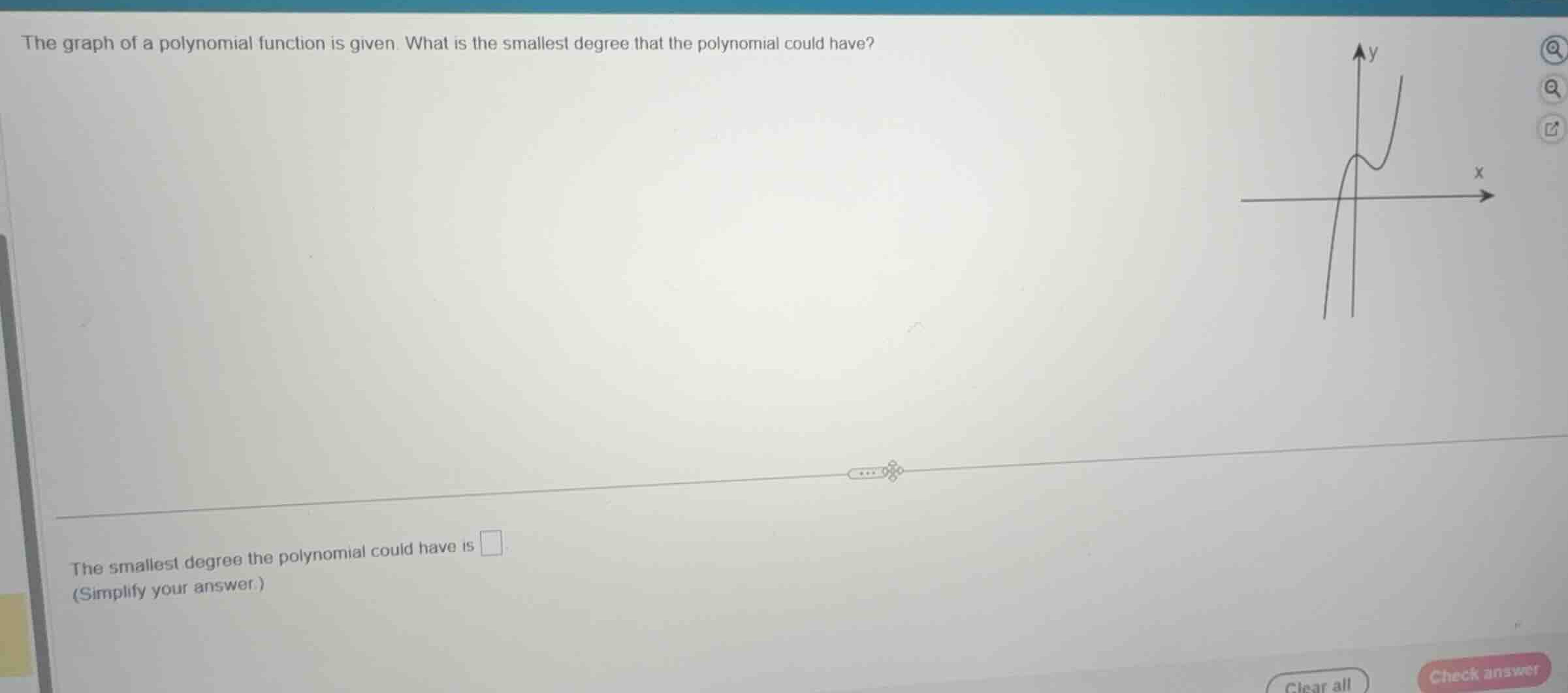
the graph of a polynomial function is given. what is the smallest degree that the polynomial could have?

the smallest degree the polynomial could have is
(simplify your answer.)

Explanation:

Response

<pre_analysis>
{
"quality": "clear",
"question_count": 1,
"skills_matched": [
"step_cot",
"blank_filling_formatter",
"explain_then_answer",
"tutor",
"mastery_adaptive_brevity"
],
"needs_drawing": false,
"concepts_used": [
"Degree of Polynomial",
"Turning Points",
"End Behavior of Polynomials"
],
"new_concepts": [],
"current_concepts": [
"Degree of Polynomial",
"Turning Points",
"End Behavior of Polynomials"
]
}
</pre_analysis>

<reasoning>

Analyze the end behavior of the graph

Using the End Behavior of Polynomials knowledge point

  • Left end: \(y \to -\infty\) as \(x \to -\infty\)
  • Right end: \(y \to \infty\) as \(x \to \infty\)
  • Since the ends point in opposite directions, the polynomial must have an odd degree.

Count the turning points of the graph

Using the Turning Points knowledge point

  • The graph has one local maximum (peak) and one local minimum (valley).
  • Total number of turning points: \(2\)

Determine the minimum degree

Using the Degree of Polynomial knowledge point

  • A polynomial of degree \(n\) can have at most \(n - 1\) turning points.
  • Therefore, \(n - 1 \ge 2 \implies n \ge 3\).
  • Since \(n\) must be odd and \(n \ge 3\), the smallest possible degree is \(3\).

</reasoning>

<answer>
The smallest degree the polynomial could have is <blank>3</blank>
(Simplify your answer.)
</answer>

<post_analysis>
{
"subject": "Mathematics",
"question_type": "Fill-in-the-blank",
"knowledge_point": [
"Mathematics",
"Algebra",
"Degree of Polynomial"
]
}
</post_analysis>

Answer:

<pre_analysis>
{
"quality": "clear",
"question_count": 1,
"skills_matched": [
"step_cot",
"blank_filling_formatter",
"explain_then_answer",
"tutor",
"mastery_adaptive_brevity"
],
"needs_drawing": false,
"concepts_used": [
"Degree of Polynomial",
"Turning Points",
"End Behavior of Polynomials"
],
"new_concepts": [],
"current_concepts": [
"Degree of Polynomial",
"Turning Points",
"End Behavior of Polynomials"
]
}
</pre_analysis>

<reasoning>

Analyze the end behavior of the graph

Using the End Behavior of Polynomials knowledge point

  • Left end: \(y \to -\infty\) as \(x \to -\infty\)
  • Right end: \(y \to \infty\) as \(x \to \infty\)
  • Since the ends point in opposite directions, the polynomial must have an odd degree.

Count the turning points of the graph

Using the Turning Points knowledge point

  • The graph has one local maximum (peak) and one local minimum (valley).
  • Total number of turning points: \(2\)

Determine the minimum degree

Using the Degree of Polynomial knowledge point

  • A polynomial of degree \(n\) can have at most \(n - 1\) turning points.
  • Therefore, \(n - 1 \ge 2 \implies n \ge 3\).
  • Since \(n\) must be odd and \(n \ge 3\), the smallest possible degree is \(3\).

</reasoning>

<answer>
The smallest degree the polynomial could have is <blank>3</blank>
(Simplify your answer.)
</answer>

<post_analysis>
{
"subject": "Mathematics",
"question_type": "Fill-in-the-blank",
"knowledge_point": [
"Mathematics",
"Algebra",
"Degree of Polynomial"
]
}
</post_analysis>