QUESTION IMAGE
Question
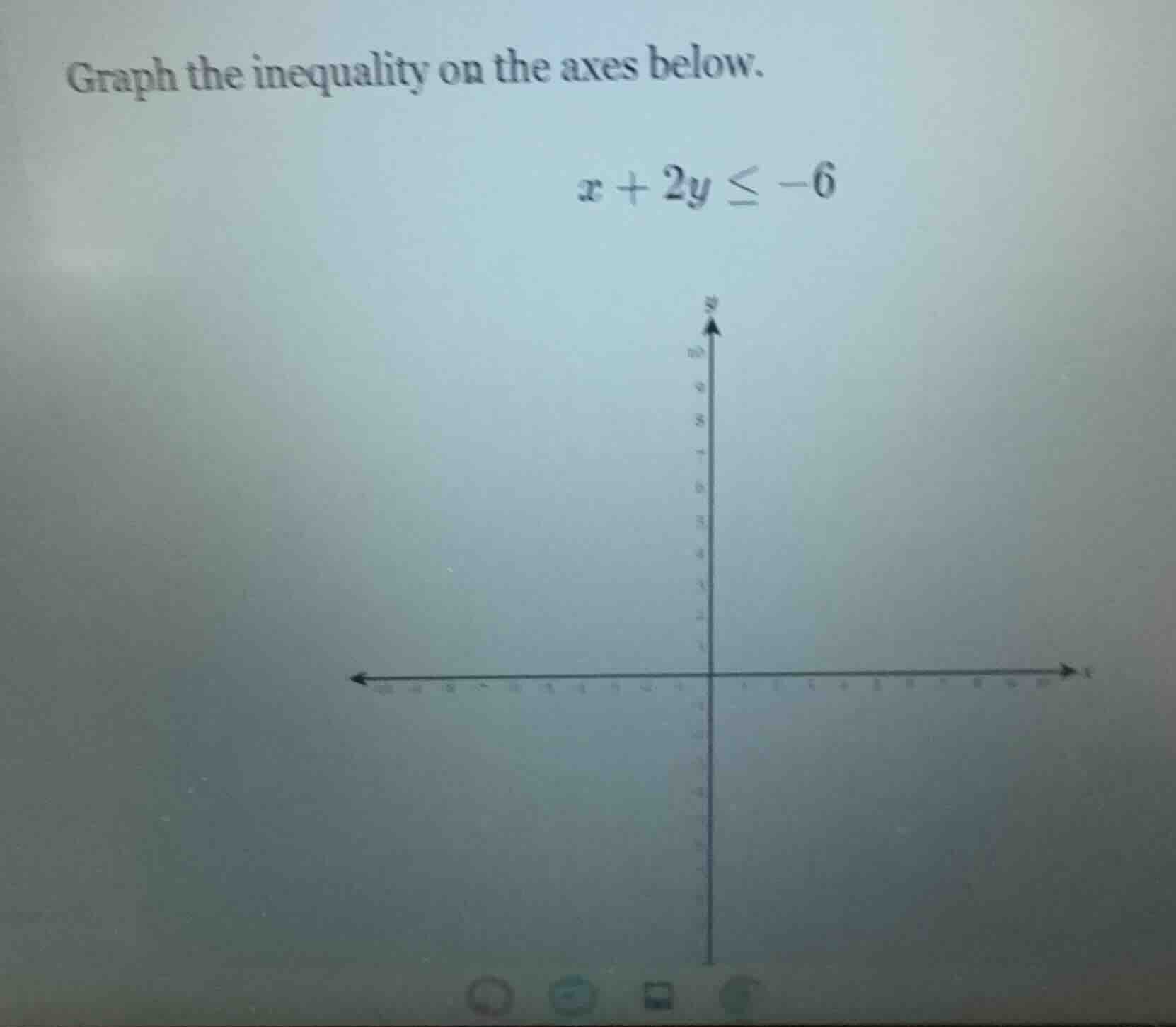
graph the inequality on the axes below.
$x + 2y \leq -6$
Step1: Rewrite the inequality in slope - intercept form
We start with the inequality \(x + 2y\leq - 6\). To get it in the form \(y=mx + b\) (slope - intercept form), we solve for \(y\).
Subtract \(x\) from both sides: \(2y\leq -x - 6\).
Then divide each term by 2: \(y\leq-\frac{1}{2}x - 3\).
Step2: Graph the boundary line
The boundary line is \(y =-\frac{1}{2}x - 3\). This is a linear equation.
- Find the y - intercept: When \(x = 0\), \(y=-3\). So the line passes through the point \((0,-3)\).
- Find the x - intercept: When \(y = 0\), \(0=-\frac{1}{2}x-3\). Add 3 to both sides: \(\frac{1}{2}x=- 3\), then multiply both sides by 2: \(x=-6\). So the line passes through the point \((-6,0)\).
Since the inequality is \(\leq\), the boundary line should be a solid line (because the points on the line are included in the solution set).
Step3: Determine the region to shade
We can use a test point that is not on the line. A common test point is \((0,0)\).
Substitute \(x = 0\) and \(y = 0\) into the original inequality \(x + 2y\leq - 6\):
\(0+2(0)\leq - 6\)
\(0\leq - 6\), which is false.
This means that the test point \((0,0)\) is not in the solution set. So we shade the region that does not contain the point \((0,0)\). In other words, we shade the region below the line \(y =-\frac{1}{2}x - 3\) (since the inequality is \(y\leq-\frac{1}{2}x - 3\)).
(Note: Since this is a graphing problem, the final answer is the graph with a solid line through \((-6,0)\) and \((0, - 3)\) and the region below the line shaded. If we were to describe the steps for graphing, the above steps are the key steps. If we need to represent the graph in a more formal way, we can plot the two intercepts, draw the solid line, and shade the appropriate region.)

Snap & solve any problem in the app
Get step-by-step solutions on Sovi AI
Photo-based solutions with guided steps
Explore more problems and detailed explanations
- Rewrite the inequality as \(y\leq-\frac{1}{2}x - 3\).
- Graph the solid line \(y =-\frac{1}{2}x - 3\) (passing through \((0,-3)\) and \((-6,0)\)).
- Shade the region below the line (since the test point \((0,0)\) does not satisfy the inequality, we shade the region that does not contain \((0,0)\)).