QUESTION IMAGE
Question
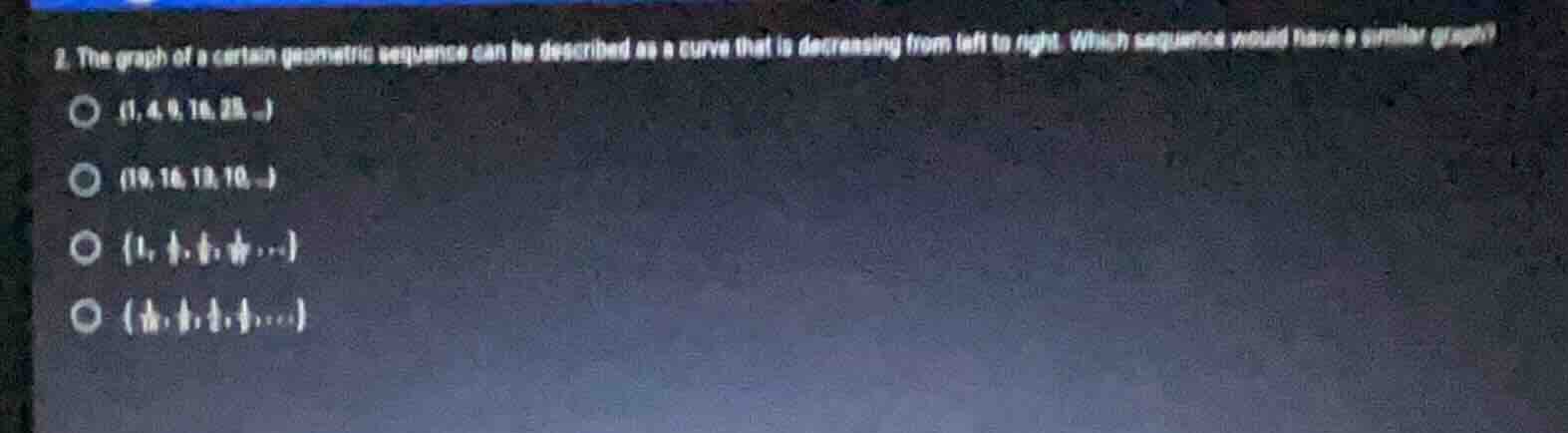
- the graph of a certain geometric sequence can be described as a curve that is decreasing from left to right. which sequence would have a similar graph?
(a) \\( \\{1, 4, 9, 16, 25, \dots\\} \\)
(b) \\( \\{19, 16, 13, 10, \dots\\} \\)
(c) \\( \\{1, \frac{1}{2}, \frac{1}{4}, \frac{1}{8}, \dots\\} \\)
(d) \\( \\{\frac{1}{16}, \frac{1}{8}, \frac{1}{4}, \frac{1}{2}, \dots\\} \\)
🆕 New Concept Discovered: Geometric Sequences
Exponential growth or decay patterns
Step 1: Understand the Goal
We need to find a sequence that satisfies two conditions:
- It must be a geometric sequence (each term is found by multiplying the previous term by a constant number called the common ratio, \(r\)).
- Its graph must be a curve that is decreasing from left to right (the values get smaller and smaller, flattening out toward zero).
Step 2: Analyze the Options
Let's look at each sequence to see if it is geometric and if it is decreasing.
- Option 1: \(\{1, 4, 9, 16, 25, \dots\}\)
- These are perfect squares (\(1^2, 2^2, 3^2, \dots\)).
- There is no constant multiplier between terms (\(\frac{4}{1} = 4\), but \(\frac{9}{4} = 2.25\)). This is not a geometric sequence.
- Option 2: \(\{19, 16, 13, 10, \dots\}\)
- Each term decreases by subtracting \(3\) (\(19 - 3 = 16\), \(16 - 3 = 13\)).
- Since we subtract a constant amount, this is an arithmetic sequence, not geometric. Its graph is a straight line, not a curve.
- Option 3: \(\{1, \frac{1}{2}, \frac{1}{4}, \frac{1}{8}, \dots\}\)
- Each term is multiplied by \(\frac{1}{2}\) to get the next term:
$$
1 \times \frac{1}{2} = \frac{1}{2}, \quad \frac{1}{2} \times \frac{1}{2} = \frac{1}{4}, \quad \frac{1}{4} \times \frac{1}{2} = \frac{1}{8}
$$
- This is a geometric sequence with a common ratio of \(r = \frac{1}{2}\).
- Since \(0 < r < 1\), the values are positive and decreasing, forming a downward-sloping curve (exponential decay).
- Option 4: \(\{\frac{1}{16}, \frac{1}{8}, \frac{1}{4}, \frac{1}{2}, \dots\}\)
- Each term is multiplied by \(2\) to get the next term:
$$
\frac{1}{16} \times 2 = \frac{1}{8}, \quad \frac{1}{8} \times 2 = \frac{1}{4}
$$
- This is a geometric sequence, but because \(r = 2\), the values are increasing (growing larger), not decreasing.

Snap & solve any problem in the app
Get step-by-step solutions on Sovi AI
Photo-based solutions with guided steps
Explore more problems and detailed explanations
The correct option is the third one:
$$
\{1, \frac{1}{2}, \frac{1}{4}, \frac{1}{8}, \dots\}
$$