QUESTION IMAGE
Question
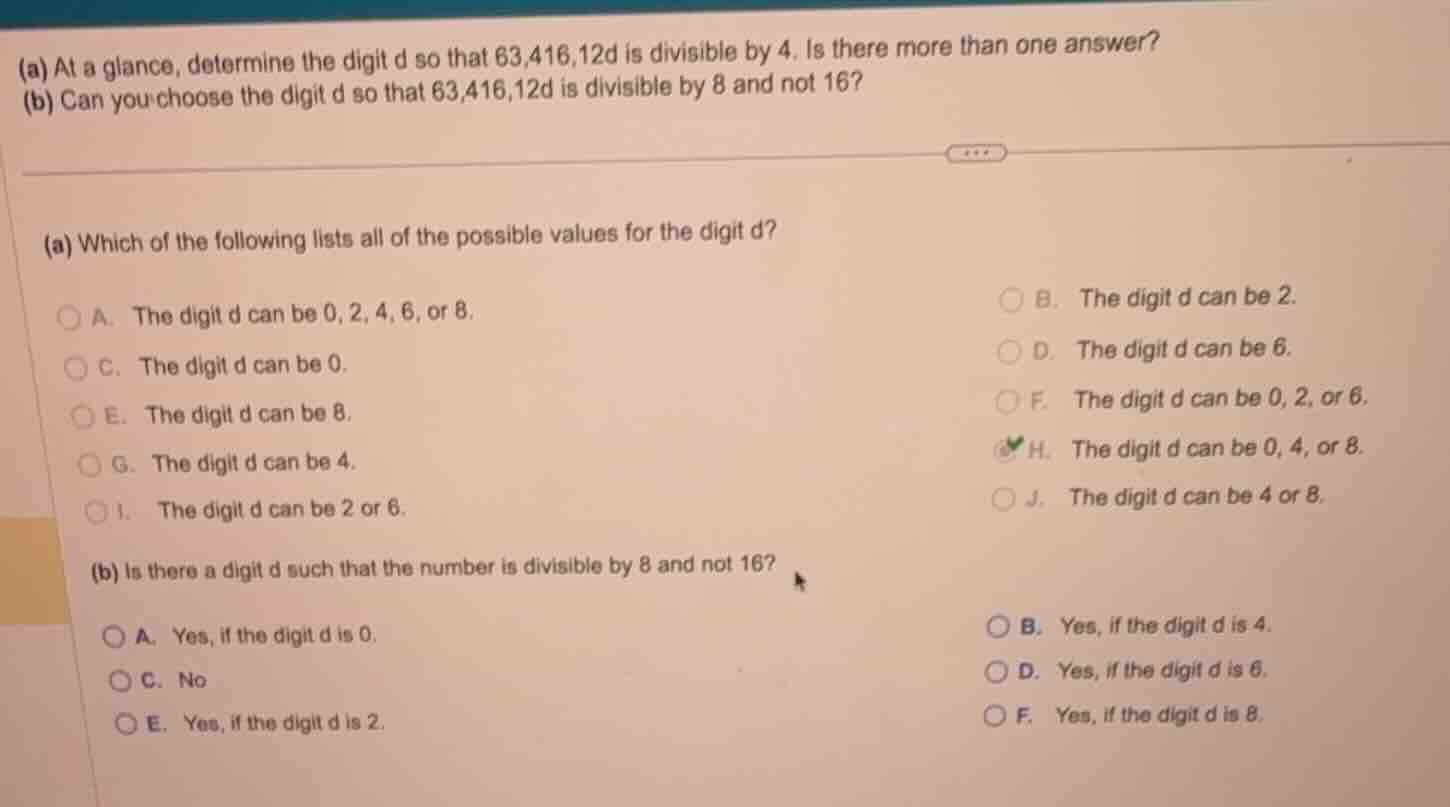
(a) at a glance, determine the digit d so that 63,416,12d is divisible by 4. is there more than one answer?
(b) can you choose the digit d so that 63,416,12d is divisible by 8 and not 16?
(a) which of the following lists all of the possible values for the digit d?
a. the digit d can be 0, 2, 4, 6, or 8.
b. the digit d can be 2.
c. the digit d can be 0.
d. the digit d can be 6.
e. the digit d can be 8.
f. the digit d can be 0, 2, or 6.
g. the digit d can be 4.
h. the digit d can be 0, 4, or 8.
i. the digit d can be 2 or 6.
j. the digit d can be 4 or 8.
(b) is there a digit d such that the number is divisible by 8 and not 16?
a. yes, if the digit d is 0.
b. yes, if the digit d is 4.
c. no
d. yes, if the digit d is 6.
e. yes, if the digit d is 2.
f. yes, if the digit d is 8.
Apply divisibility rule for 4
Using the Divisibility Rules knowledge point
Analyze divisibility by 8 and 16
We test the candidate digits \(d \in \{0, 4, 8\}\) for the number \(N = 63,416,12d\).
A number is divisible by 8 if its last 3 digits form a number divisible by 8.
A number is divisible by 16 if its last 4 digits form a number divisible by 16.
For \(d = 0\):
- Last 3 digits: \(120\). Since \(120 = 8 \times 15\), \(N\) is divisible by 8.
- Last 4 digits: \(6120\). Since \(6120 = 16 \times 382.5\), \(N\) is not divisible by 16.
Thus, \(d = 0\) satisfies the condition.
For \(d = 4\):
- Last 3 digits: \(124\). Since \(124 = 8 \times 15.5\), \(N\) is not divisible by 8.
For \(d = 8\):
- Last 3 digits: \(128\). Since \(128 = 8 \times 16\), \(N\) is divisible by 8.
- Last 4 digits: \(6128\). Since \(6128 = 16 \times 383\), \(N\) is divisible by 16.
Thus, \(d = 8\) does not satisfy the "not 16" condition.
Match options for both questions
- For part (a), the possible values for \(d\) are 0, 4, or 8. This matches option H.
- For part (b), the digit \(d\) must be 0. This matches option A.

Snap & solve any problem in the app
Get step-by-step solutions on Sovi AI
Photo-based solutions with guided steps
Explore more problems and detailed explanations
Question 1
- A. The digit d can be 0, 2, 4, 6, or 8.
- B. The digit d can be 2.
- C. The digit d can be 0.
- D. The digit d can be 6.
- E. The digit d can be 8.
- F. The digit d can be 0, 2, or 6.
- G. The digit d can be 4.
- H. The digit d can be 0, 4, or 8. (Correct answer)
- I. The digit d can be 2 or 6.
- J. The digit d can be 4 or 8.
Question 2
- A. Yes, if the digit d is 0. (Correct answer)
- B. Yes, if the digit d is 4.
- C. No.
- D. Yes, if the digit d is 6.
- E. Yes, if the digit d is 2.
- F. Yes, if the digit d is 8.