QUESTION IMAGE
Question
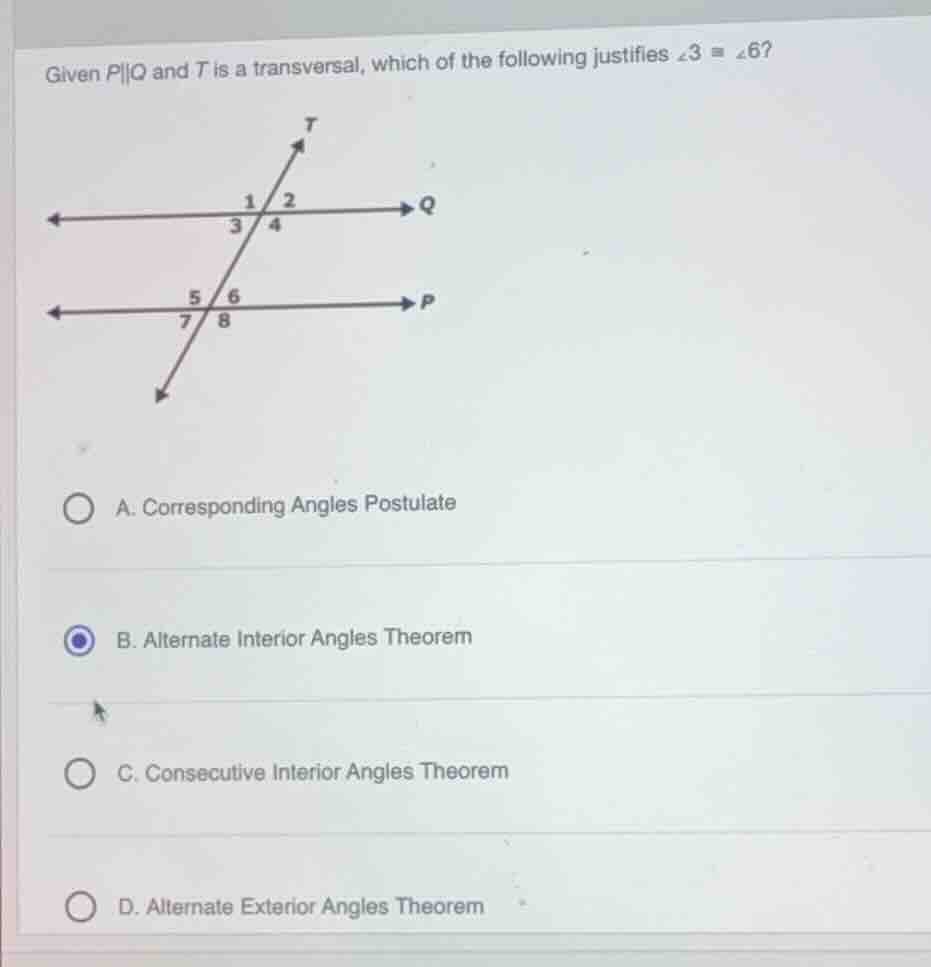
given \\(p \parallel q\\) and \\(t\\) is a transversal, which of the following justifies \\(\angle 3 \cong \angle 6\\)?
a. corresponding angles postulate
b. alternate interior angles theorem
c. consecutive interior angles theorem
d. alternate exterior angles theorem
Identify the given lines and transversal
Using the Parallel Line Angles and Transversal Lines knowledge points
- Two parallel lines \(P\) and \(Q\) are intersected by a transversal line \(T\).
- This intersection creates eight distinct angles labeled 1 through 8.
Analyze the positions of the given angles
Using the Alternate Interior Angles and Transversal Lines knowledge points
- We are analyzing the relationship between \(\angle 3\) and \(\angle 6\).
- Both angles lie in the interior region between the parallel lines \(P\) and \(Q\).
- \(\angle 3\) is on the left side of the transversal \(T\), while \(\angle 6\) is on the right side.
Determine the justifying theorem
Using the Alternate Interior Angles knowledge point
- Since \(\angle 3\) and \(\angle 6\) are on opposite sides of the transversal and inside the parallel lines, they are alternate interior angles.
- The theorem stating that alternate interior angles are equal when lines are parallel is the Alternate Interior Angles Theorem.

Snap & solve any problem in the app
Get step-by-step solutions on Sovi AI
Photo-based solutions with guided steps
Explore more problems and detailed explanations
- A. Corresponding Angles Postulate
- B. Alternate Interior Angles Theorem (Correct answer)
- C. Consecutive Interior Angles Theorem
- D. Alternate Exterior Angles Theorem