QUESTION IMAGE
Question
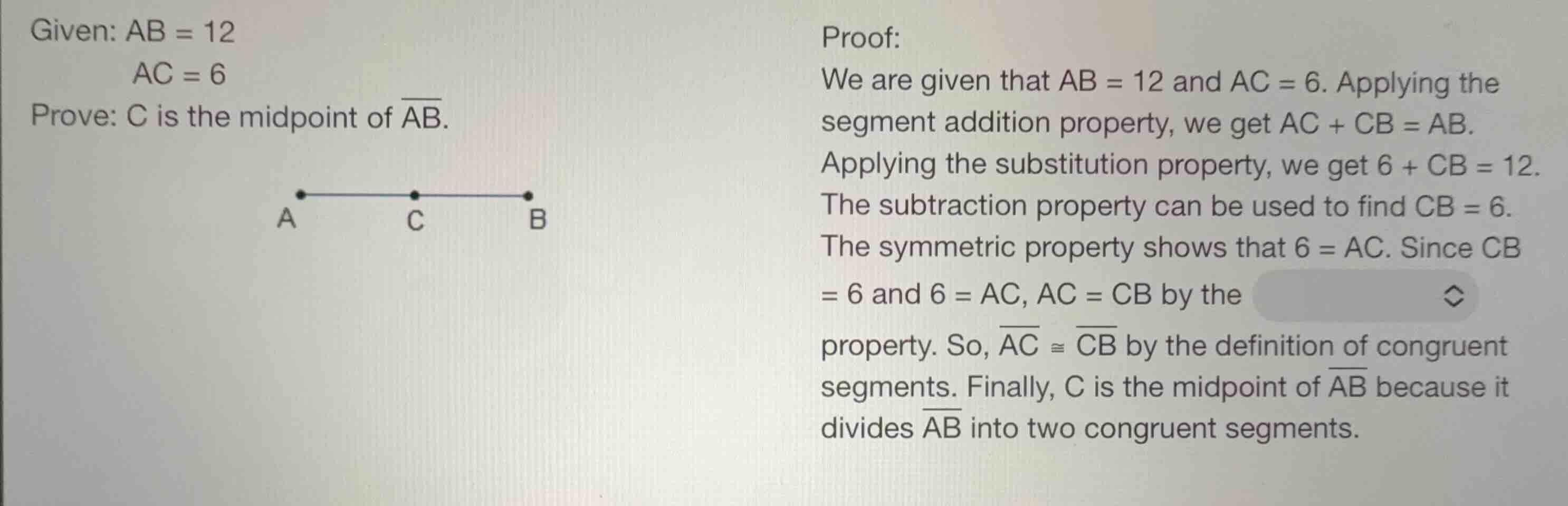
given: \\(ab = 12\\)
\\(ac = 6\\)
prove: \\(c\\) is the midpoint of \\(\overline{ab}\\).
proof:
we are given that \\(ab = 12\\) and \\(ac = 6\\). applying the segment addition property, we get \\(ac + cb = ab\\). applying the substitution property, we get \\(6 + cb = 12\\). the subtraction property can be used to find \\(cb = 6\\). the symmetric property shows that \\(6 = ac\\). since \\(cb = 6\\) and \\(6 = ac\\), \\(ac = cb\\) by the dropdown property. so, \\(\overline{ac} \cong \overline{cb}\\) by the definition of congruent segments. finally, \\(c\\) is the midpoint of \\(\overline{ab}\\) because it divides \\(\overline{ab}\\) into two congruent segments.
Analyze the given proof steps
We are given a geometric proof with a missing property name in the blank. Let's trace the logical steps:
- Given: \(AB = 12\) and \(AC = 6\).
- Using the Segment Addition Postulate, we write \(AC + CB = AB\).
- Substituting the given values: \(6 + CB = 12\).
- Subtracting \(6\) from both sides: \(CB = 6\).
- Symmetric property: \(6 = AC\).
- We have \(CB = 6\) and \(6 = AC\). We want to conclude that \(AC = CB\).
Identify the missing property
Using the Segment Addition Postulate knowledge point, we relate the segment lengths.
To transition from \(CB = 6\) and \(6 = AC\) to \(AC = CB\), we use the transitive property of equality.
The transitive property states that if \(a = b\) and \(b = c\), then \(a = c\).
Here, \(AC = 6\) and \(6 = CB\), which directly yields \(AC = CB\) by the transitive property.

Snap & solve any problem in the app
Get step-by-step solutions on Sovi AI
Photo-based solutions with guided steps
Explore more problems and detailed explanations
We are given that \(AB = 12\) and \(AC = 6\). Applying the segment addition property, we get \(AC + CB = AB\). Applying the substitution property, we get \(6 + CB = 12\). The subtraction property can be used to find \(CB = 6\). The symmetric property shows that \(6 = AC\). Since \(CB = 6\) and \(6 = AC\), \(AC = CB\) by the <blank>transitive</blank> property. So, \(\overline{AC} \cong \overline{CB}\) by the definition of congruent segments. Finally, C is the midpoint of \(\overline{AB}\) because it divides \(\overline{AB}\) into two congruent segments.