QUESTION IMAGE
Question
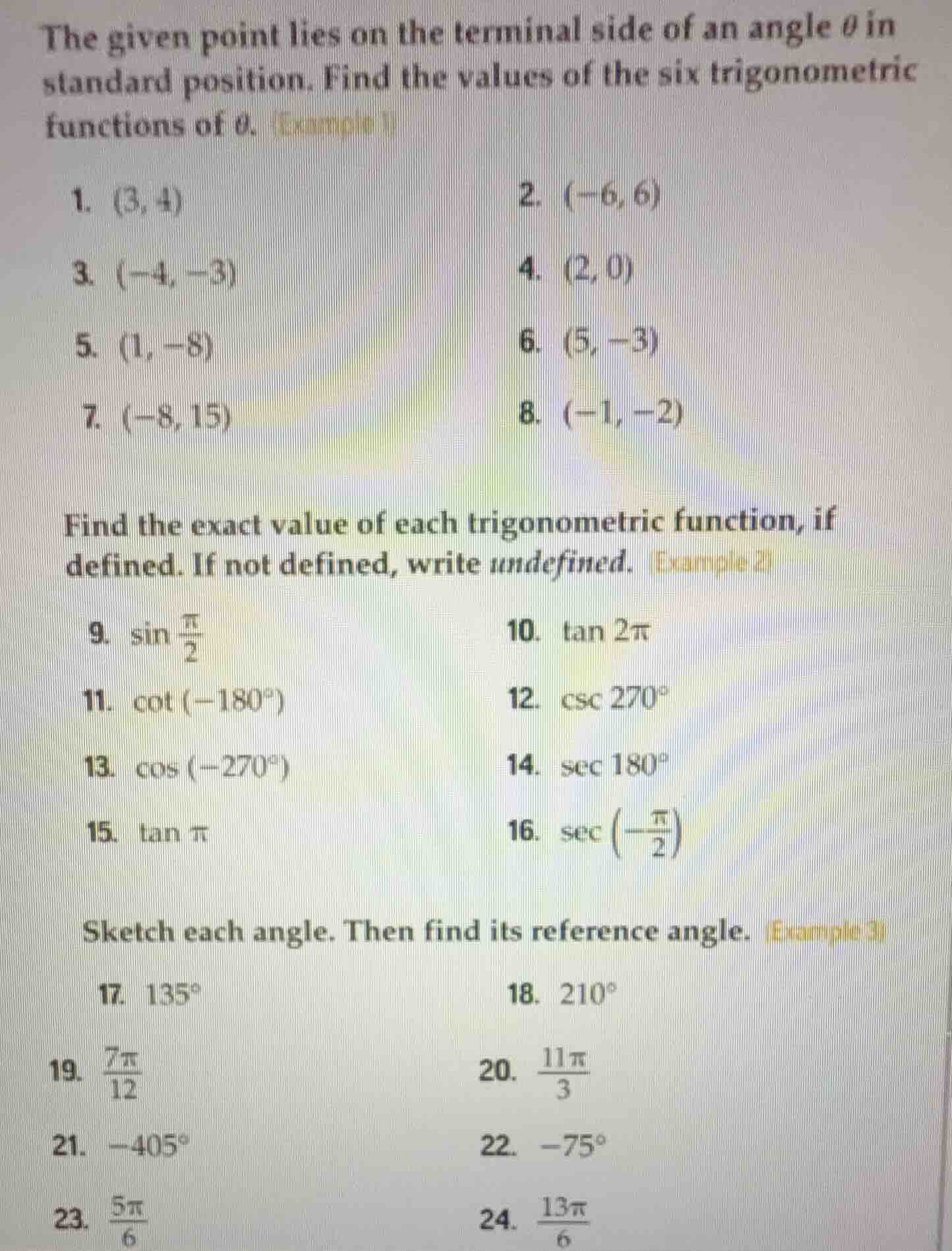
the given point lies on the terminal side of an angle \\(\theta\\) in standard position. find the values of the six trigonometric functions of \\(\theta\\).
- \\((3, 4)\\)
- \\((-6, 6)\\)
- \\((-4, -3)\\)
- \\((2, 0)\\)
- \\((1, -8)\\)
- \\((5, -3)\\)
- \\((-8, 15)\\)
- \\((-1, -2)\\)
find the exact value of each trigonometric function, if defined. if not defined, write undefined.
- \\(\sin \frac{\pi}{2}\\)
- \\(\tan 2\pi\\)
- \\(\cot (-180^\circ)\\)
- \\(\csc 270^\circ\\)
- \\(\cos (-270^\circ)\\)
- \\(\sec 180^\circ\\)
- \\(\tan \pi\\)
- \\(\sec \left(-\frac{\pi}{2}\
ight)\\)
sketch each angle. then find its reference angle.
- \\(135^\circ\\)
- \\(210^\circ\\)
- \\(\frac{7\pi}{12}\\)
- \\(\frac{11\pi}{3}\\)
- \\(-405^\circ\\)
- \\(-75^\circ\\)
- \\(\frac{5\pi}{6}\\)
- \\(\frac{13\pi}{6}\\)
Find trigonometric functions for points 1 to 8
Using the Trigonometric Ratios and Pythagorean Theorem knowledge points
- \((3,4)\): \(r = 5\). \(\sin\theta = \frac{4}{5}\), \(\cos\theta = \frac{3}{5}\), \(\tan\theta = \frac{4}{3}\), \(\csc\theta = \frac{5}{4}\), \(\sec\theta = \frac{5}{3}\), \(\cot\theta = \frac{3}{4}\).
- \((-6,6)\): \(r = 6\sqrt{2}\). \(\sin\theta = \frac{\sqrt{2}}{2}\), \(\cos\theta = -\frac{\sqrt{2}}{2}\), \(\tan\theta = -1\), \(\csc\theta = \sqrt{2}\), \(\sec\theta = -\sqrt{2}\), \(\cot\theta = -1\).
- \((-4,-3)\): \(r = 5\). \(\sin\theta = -\frac{3}{5}\), \(\cos\theta = -\frac{4}{5}\), \(\tan\theta = \frac{3}{4}\), \(\csc\theta = -\frac{5}{3}\), \(\sec\theta = -\frac{5}{4}\), \(\cot\theta = \frac{4}{3}\).
- \((2,0)\): \(r = 2\). \(\sin\theta = 0\), \(\cos\theta = 1\), \(\tan\theta = 0\), \(\csc\theta = \text{undefined}\), \(\sec\theta = 1\), \(\cot\theta = \text{undefined}\).
- \((1,-8)\): \(r = \sqrt{65}\). \(\sin\theta = -\frac{8\sqrt{65}}{65}\), \(\cos\theta = \frac{\sqrt{65}}{65}\), \(\tan\theta = -8\), \(\csc\theta = -\frac{\sqrt{65}}{8}\), \(\sec\theta = \sqrt{65}\), \(\cot\theta = -\frac{1}{8}\).
- \((5,-3)\): \(r = \sqrt{34}\). \(\sin\theta = -\frac{3\sqrt{34}}{34}\), \(\cos\theta = \frac{5\sqrt{34}}{34}\), \(\tan\theta = -\frac{3}{5}\), \(\csc\theta = -\frac{\sqrt{34}}{3}, \sec\theta = \frac{\sqrt{34}}{5}, \cot\theta = -\frac{5}{3}\).
- \((-8,15)\): \(r = 17\). \(\sin\theta = \frac{15}{17}\), \(\cos\theta = -\frac{8}{17}\), \(\tan\theta = -\frac{15}{8}\), \(\csc\theta = \frac{17}{15}\), \(\sec\theta = -\frac{17}{8}\), \(\cot\theta = -\frac{8}{15}\).
- \((-1,-2)\): \(r = \sqrt{5}\). \(\sin\theta = -\frac{2\sqrt{5}}{5}\), \(\cos\theta = -\frac{\sqrt{5}}{5}\), \(\tan\theta = 2\), \(\csc\theta = -\frac{\sqrt{5}}{2}\), \(\sec\theta = -\sqrt{5}\), \(\cot\theta = \frac{1}{2}\).
Evaluate exact values for 9 to 16
We evaluate each trigonometric function at the given quadrantal angle:
- \(\sin\frac{\pi}{2} = 1\)
- \(\tan 2\pi = 0\)
- \(\cot(-180^\circ) = \text{undefined}\) (since \(\sin(-180^\circ) = 0\))
- \(\csc 270^\circ = \frac{1}{\sin 270^\circ} = -1\)
- \(\cos(-270^\circ) = \cos 90^\circ = 0\)
- \(\sec 180^\circ = \frac{1}{\cos 180^\circ} = -1\)
- \(\tan\pi = 0\)
- \(\sec(-\frac{\pi}{2}) = \text{undefined}\) (since \(\cos(-\frac{\pi}{2}) = 0\))
Determine reference angles for 17 to 24
Using the Radian Measure and Degree Measure knowledge points, we find the reference angle \(\theta'\) (the acute angle formed with the x-axis):
- \(135^\circ\) (Quadrant II): \(\theta' = 180^\circ - 135^\circ = 45^\circ\)
- \(210^\circ\…

Snap & solve any problem in the app
Get step-by-step solutions on Sovi AI
Photo-based solutions with guided steps
Explore more problems and detailed explanations
| No. | Answer |
|---|---|
| 2 | \(\sin\theta = \frac{\sqrt{2}}{2}\), \(\cos\theta = -\frac{\sqrt{2}}{2}\), \(\tan\theta = -1\), \(\csc\theta = \sqrt{2}\), \(\sec\theta = -\sqrt{2}\), \(\cot\theta = -1\) |
| 3 | \(\sin\theta = -\frac{3}{5}\), \(\cos\theta = -\frac{4}{5}\), \(\tan\theta = \frac{3}{4}\), \(\csc\theta = -\frac{5}{3}\), \(\sec\theta = -\frac{5}{4}\), \(\cot\theta = \frac{4}{3}\) |
| 4 | \(\sin\theta = 0\), \(\cos\theta = 1\), \(\tan\theta = 0\), \(\csc\theta = \text{undefined}\), \(\sec\theta = 1\), \(\cot\theta = \text{undefined}\) |
| 5 | \(\sin\theta = -\frac{8\sqrt{65}}{65}\), \(\cos\theta = \frac{\sqrt{65}}{65}\), \(\tan\theta = -8\), \(\csc\theta = -\frac{\sqrt{65}}{8}\), \(\sec\theta = \sqrt{65}\), \(\cot\theta = -\frac{1}{8}\) |
| 6 | \(\sin\theta = -\frac{3\sqrt{34}}{34}\), \(\cos\theta = \frac{5\sqrt{34}}{34}\), \(\tan\theta = -\frac{3}{5}\), \(\csc\theta = -\frac{\sqrt{34}}{3}\), \(\sec\theta = \frac{\sqrt{34}}{5}\), \(\cot\theta = -\frac{5}{3}\) |
| 7 | \(\sin\theta = \frac{15}{17}\), \(\cos\theta = -\frac{8}{17}\), \(\tan\theta = -\frac{15}{8}\), \(\csc\theta = \frac{17}{15}\), \(\sec\theta = -\frac{17}{8}\), \(\cot\theta = -\frac{8}{15}\) |
| 8 | \(\sin\theta = -\frac{2\sqrt{5}}{5}\), \(\cos\theta = -\frac{\sqrt{5}}{5}\), \(\tan\theta = 2\), \(\csc\theta = -\frac{\sqrt{5}}{2}\), \(\sec\theta = -\sqrt{5}\), \(\cot\theta = \frac{1}{2}\) |
| 9 | \(1\) |
| 10 | \(0\) |
| 11 | \(\text{undefined}\) |
| 12 | \(-1\) |
| 13 | \(0\) |
| 14 | \(-1\) |
| 15 | \(0\) |
| 16 | \(\text{undefined}\) |
| 17 | \(45^\circ\) |
| 18 | \(30^\circ\) |
| 19 | \(\frac{5\pi}{12}\) |
| 20 | \(\frac{\pi}{3}\) |
| 21 | \(45^\circ\) |
| 22 | \(75^\circ\) |
| 23 | \(\frac{\pi}{6}\) |
| 24 | \(\frac{\pi}{6}\) |