QUESTION IMAGE
Question
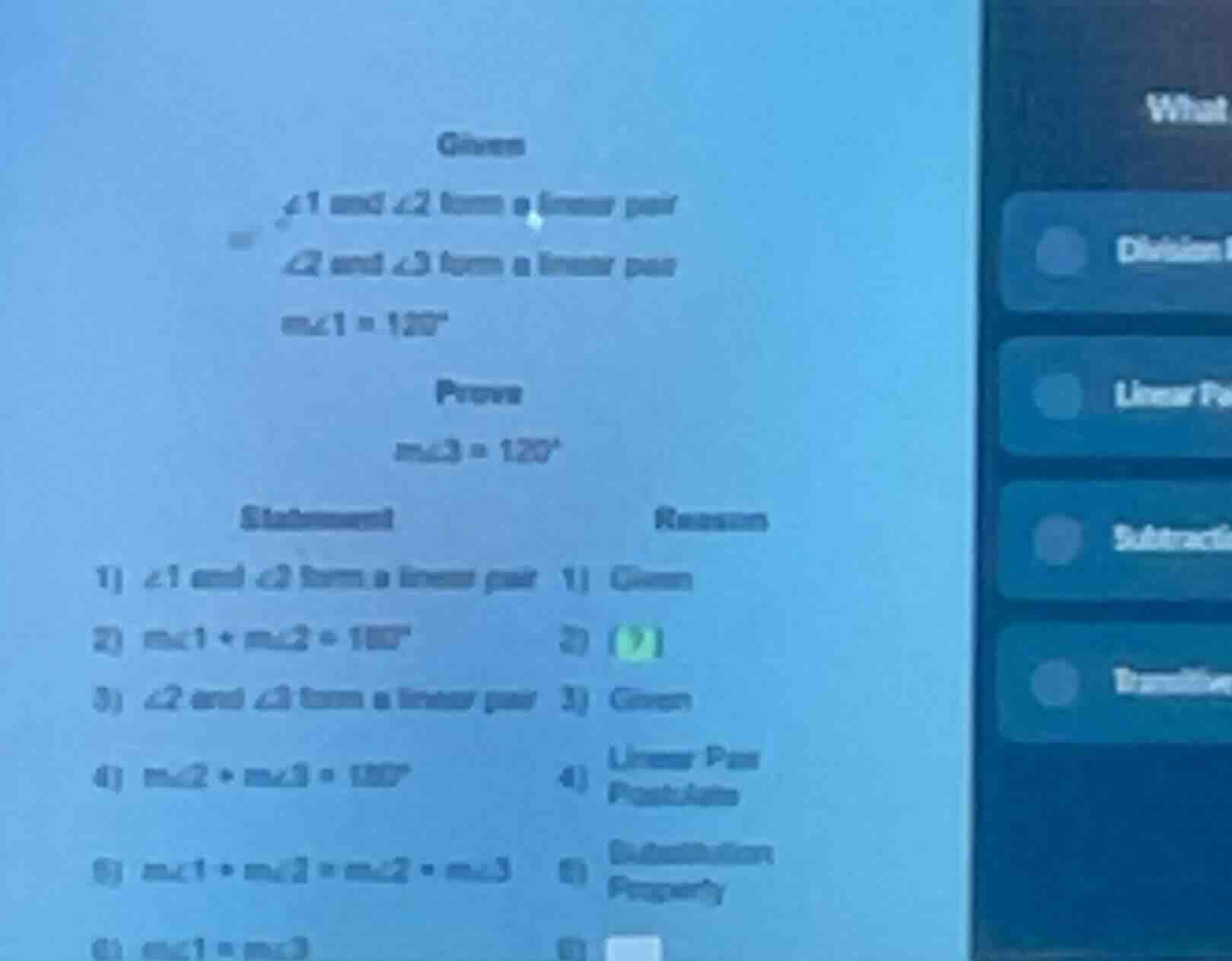
given
\\(\angle 1\\) and \\(\angle 2\\) form a linear pair
\\(\angle 2\\) and \\(\angle 3\\) form a linear pair
\\(m\angle 1 = 120^\circ\\)
prove
\\(m\angle 3 = 120^\circ\\)
statement | reason
- \\(\angle 1\\) and \\(\angle 2\\) form a linear pair | 1) given
- \\(m\angle 1 + m\angle 2 = 180^\circ\\) | 2) ?
- \\(\angle 2\\) and \\(\angle 3\\) form a linear pair | 3) given
- \\(m\angle 2 + m\angle 3 = 180^\circ\\) | 4) linear pair postulate
- \\(m\angle 1 + m\angle 2 = m\angle 2 + m\angle 3\\) | 5) substitution property
- \\(m\angle 1 = m\angle 3\\) | 6)
Identify the missing reason
We need to find the missing reason for step 2 in the geometric proof.
The statement is:
\( \angle 1 \) and \( \angle 2 \) form a linear pair.
The next statement is:
\( m\angle 1 + m\angle 2 = 180^\circ \).
Apply geometric definitions
Using Algebraic Proof principles, we look at the relationship between a linear pair and their measures.
By definition, angles in a linear pair are supplementary, meaning their measures add up to \( 180^\circ \).
This is justified by the Linear Pair Postulate.
Match with options
Looking at the visible options on the right side of the screen:
- Division Property
- Linear Pair Postulate
- Subtraction Property
- Transitive Property
The correct reason for step 2 is the Linear Pair Postulate.

Snap & solve any problem in the app
Get step-by-step solutions on Sovi AI
Photo-based solutions with guided steps
Explore more problems and detailed explanations
The missing reason for step 2 is <blank>Linear Pair Postulate</blank>.