QUESTION IMAGE
Question
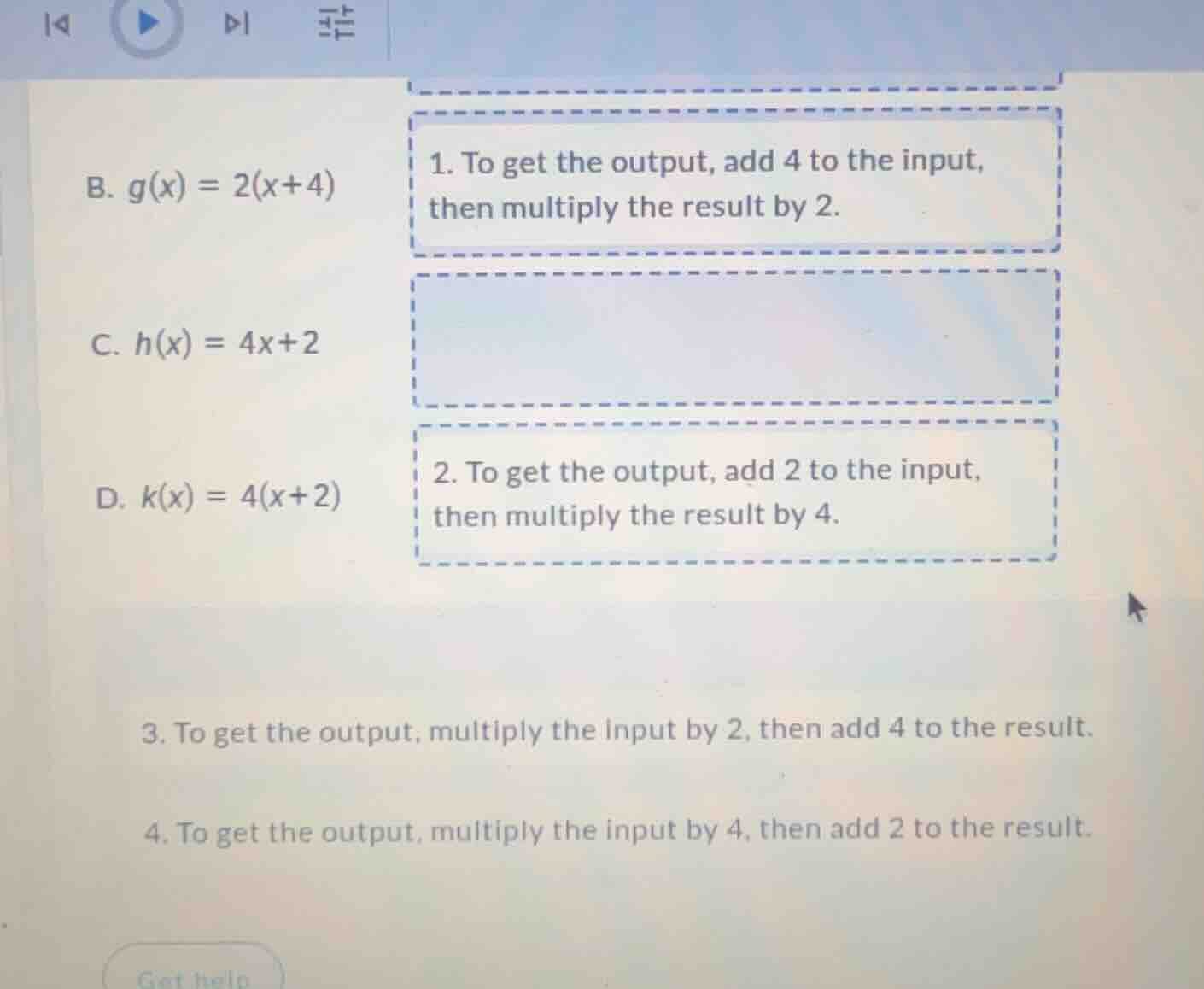
b. $g(x) = 2(x+4)$
- to get the output, add 4 to the input, then multiply the result by 2.
c. $h(x) = 4x+2$
d. $k(x) = 4(x+2)$
- to get the output, add 2 to the input, then multiply the result by 4.
- to get the output, multiply the input by 2, then add 4 to the result.
- to get the output, multiply the input by 4, then add 2 to the result.
Let's analyze each function and match it with the corresponding description:
For function \( g(x) = 2(x + 4) \)
- The description says: "To get the output, add 4 to the input, then multiply the result by 2."
- Let the input be \( x \). Adding 4 to the input gives \( x + 4 \). Multiplying the result by 2 gives \( 2(x + 4) \), which matches \( g(x) \). So this function corresponds to description 1.
For function \( h(x) = 4x + 2 \)
- The description "To get the output, multiply the input by 4, then add 2 to the result."
- Let the input be \( x \). Multiplying the input by 4 gives \( 4x \). Adding 2 to the result gives \( 4x + 2 \), which matches \( h(x) \). So this function corresponds to description 4.
For function \( k(x) = 4(x + 2) \)
- The description says: "To get the output, add 2 to the input, then multiply the result by 4."
- Let the input be \( x \). Adding 2 to the input gives \( x + 2 \). Multiplying the result by 4 gives \( 4(x + 2) \), which matches \( k(x) \). So this function corresponds to description 2.
For the remaining description (description 3: "To get the output, multiply the input by 2, then add 4 to the result.")
- Let the input be \( x \). Multiplying the input by 2 gives \( 2x \). Adding 4 to the result gives \( 2x + 4 \). Let's assume there was a function like \( f(x)=2x + 4 \) (not shown here, but based on the pattern), this would correspond to description 3.
If we were to match the given functions (B, C, D) with the descriptions:
- \( g(x) = 2(x + 4) \) (Option B) matches description 1.
- \( h(x) = 4x + 2 \) (Option C) matches description 4.
- \( k(x) = 4(x + 2) \) (Option D) matches description 2.
For example, if we were to answer which function matches description 1, the answer is B. \( g(x) = 2(x + 4) \)
If we were to answer which function matches description 2, the answer is D. \( k(x) = 4(x + 2) \)
If we were to answer which function matches description 4, the answer is C. \( h(x) = 4x + 2 \)
Let's assume the question was to match \( h(x) = 4x + 2 \) with its description:
Step 1: Analyze the function \( h(x)=4x + 2 \)
The function is of the form "multiply input by 4, then add 2".
Step 2: Match with the description
The description "To get the output, multiply the input by 4, then add 2 to the result" (description 4) matches \( h(x)=4x + 2 \).

Snap & solve any problem in the app
Get step-by-step solutions on Sovi AI
Photo-based solutions with guided steps
Explore more problems and detailed explanations
- \( g(x) = 2(x + 4) \) (B) matches description 1.
- \( h(x) = 4x + 2 \) (C) matches description 4.
- \( k(x) = 4(x + 2) \) (D) matches description 2.
If you had a specific question (like which function matches a particular description), you can pick the corresponding option. For example, if the question was "Which function matches the description 'To get the output, multiply the input by 4, then add 2 to the result'?", the answer is C. \( h(x) = 4x + 2 \)