Sovi.AI - AI Math Tutor

Scan to solve math questions

QUESTION IMAGE

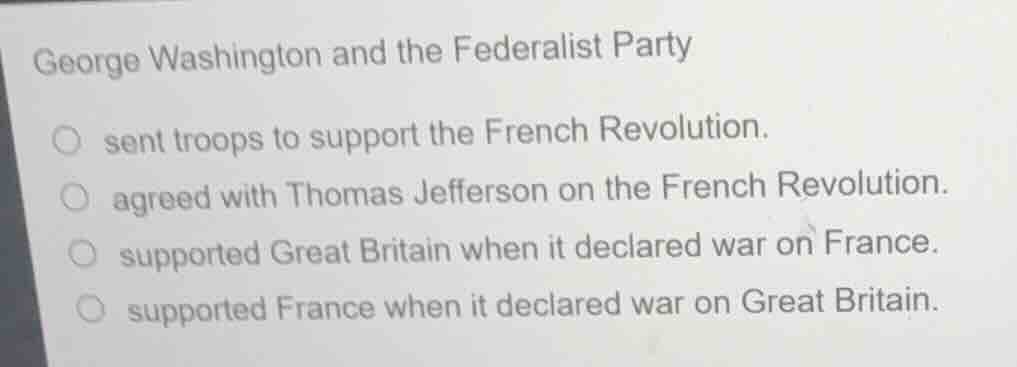
george washington and the federalist party sent troops to support the f…

Question

george washington and the federalist party

sent troops to support the french revolution.
agreed with thomas jefferson on the french revolution.
supported great britain when it declared war on france.
supported france when it declared war on great britain.

Explanation:

Response

<pre_analysis>
{
"quality": "clear",
"question_count": 1,
"skills_matched": [
"direct_cot",
"multiple_choice_formatter",
"explain_then_answer",
"tutor"
],
"needs_drawing": false,
"concepts_used": [
"George Washington Presidency",
"Thomas Jefferson"
],
"new_concepts": [
"Proclamation of Neutrality",
"Federalist Foreign Policy"
],
"current_concepts": [
"George Washington Presidency",
"Thomas Jefferson",
"Proclamation of Neutrality",
"Federalist Foreign Policy"
]
}
</pre_analysis>

<reasoning>

Analyze Washington's foreign policy stance

During the George Washington Presidency, the outbreak of the French Revolution in 1789 and the subsequent war between France and Great Britain in 1793 created deep political divisions in the United States. Washington and key Federalists, such as Alexander Hamilton, believed that the young nation was too weak militarily and economically to get involved in European conflicts. Consequently, Washington issued the Proclamation of Neutrality in 1793, declaring the nation neutral. Therefore, they did not send troops to support France, nor did they support France when it declared war on Great Britain.

Compare with Jefferson's perspective

Thomas Jefferson and the Democratic-Republicans strongly supported the French Revolution, viewing it as a sister struggle for liberty against monarchy. They believed the United States was obligated to assist France under the treaty of alliance signed during the American Revolutionary War. Washington and the Federalists strongly disagreed with Jefferson's pro-French stance, choosing neutrality instead. This highlights that Washington and the Federalists did not agree with Jefferson on the French Revolution.

Evaluate Federalist alignment with Great Britain

While Washington officially declared neutrality, the Federalist Party generally favored Great Britain over France. Federalists valued Great Britain as a vital trading partner and feared the radical, violent excesses of the French Revolution. When France declared war on Great Britain in 1793, the Federalists leaned toward supporting Great Britain diplomatically and economically to secure American trade and stability, culminating in the controversial Jay Treaty of 1794. Thus, the Federalists supported Great Britain when it was at war with France.
</reasoning>

<answer>
<mcq-option>sent troops to support the French Revolution.</mcq-option>
<mcq-option>agreed with Thomas Jefferson on the French Revolution.</mcq-option>
<mcq-correct>supported Great Britain when it declared war on France.</mcq-correct>
<mcq-option>supported France when it declared war on Great Britain.</mcq-option>
</answer>

<post_analysis>
{
"subject": "Social Science",
"question_type": "Multiple Choice",
"knowledge_point": [
"Social Science",
"U.S. History",
"Early Republic Foreign Policy"
]
}
</post_analysis>

Answer:

<pre_analysis>
{
"quality": "clear",
"question_count": 1,
"skills_matched": [
"direct_cot",
"multiple_choice_formatter",
"explain_then_answer",
"tutor"
],
"needs_drawing": false,
"concepts_used": [
"George Washington Presidency",
"Thomas Jefferson"
],
"new_concepts": [
"Proclamation of Neutrality",
"Federalist Foreign Policy"
],
"current_concepts": [
"George Washington Presidency",
"Thomas Jefferson",
"Proclamation of Neutrality",
"Federalist Foreign Policy"
]
}
</pre_analysis>

<reasoning>

Analyze Washington's foreign policy stance

During the George Washington Presidency, the outbreak of the French Revolution in 1789 and the subsequent war between France and Great Britain in 1793 created deep political divisions in the United States. Washington and key Federalists, such as Alexander Hamilton, believed that the young nation was too weak militarily and economically to get involved in European conflicts. Consequently, Washington issued the Proclamation of Neutrality in 1793, declaring the nation neutral. Therefore, they did not send troops to support France, nor did they support France when it declared war on Great Britain.

Compare with Jefferson's perspective

Thomas Jefferson and the Democratic-Republicans strongly supported the French Revolution, viewing it as a sister struggle for liberty against monarchy. They believed the United States was obligated to assist France under the treaty of alliance signed during the American Revolutionary War. Washington and the Federalists strongly disagreed with Jefferson's pro-French stance, choosing neutrality instead. This highlights that Washington and the Federalists did not agree with Jefferson on the French Revolution.

Evaluate Federalist alignment with Great Britain

While Washington officially declared neutrality, the Federalist Party generally favored Great Britain over France. Federalists valued Great Britain as a vital trading partner and feared the radical, violent excesses of the French Revolution. When France declared war on Great Britain in 1793, the Federalists leaned toward supporting Great Britain diplomatically and economically to secure American trade and stability, culminating in the controversial Jay Treaty of 1794. Thus, the Federalists supported Great Britain when it was at war with France.
</reasoning>

<answer>
<mcq-option>sent troops to support the French Revolution.</mcq-option>
<mcq-option>agreed with Thomas Jefferson on the French Revolution.</mcq-option>
<mcq-correct>supported Great Britain when it declared war on France.</mcq-correct>
<mcq-option>supported France when it declared war on Great Britain.</mcq-option>
</answer>

<post_analysis>
{
"subject": "Social Science",
"question_type": "Multiple Choice",
"knowledge_point": [
"Social Science",
"U.S. History",
"Early Republic Foreign Policy"
]
}
</post_analysis>