QUESTION IMAGE
Question
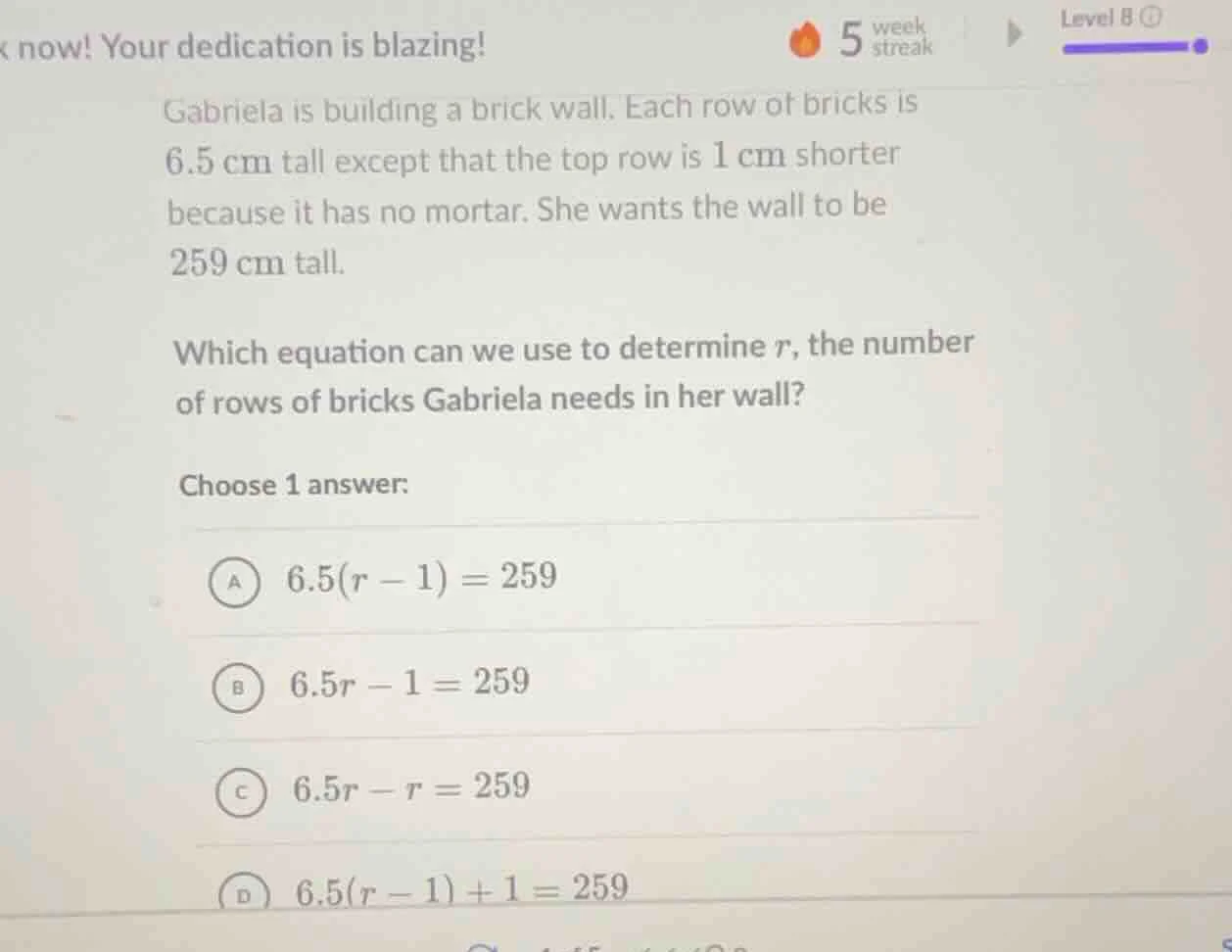
gabriela is building a brick wall. each row of bricks is 6.5 cm tall except that the top row is 1 cm shorter because it has no mortar. she wants the wall to be 259 cm tall. which equation can we use to determine r, the number of rows of bricks gabriela needs in her wall? choose 1 answer: a (6.5(r - 1) = 259) b (6.5r - 1 = 259) c (6.5r - r = 259) d (6.5(r - 1) + 1 = 259)
Step1: Analyze row heights
There are \( r \) rows. \( r - 1 \) rows are 6.5 cm tall (with mortar), and 1 row (top) is \( 6.5 - 1 = 5.5 \) cm? Wait, no—wait, the top row is 1 cm shorter than 6.5 cm? Wait, no, the problem says: "Each row of bricks is 6.5 cm tall except that the top row is 1 cm shorter because it has no mortar." So total height: height of \( r - 1 \) rows (each 6.5 cm) plus height of top row (6.5 - 1 = 5.5 cm)? Wait, no, let's re-express.
Alternative approach: Suppose there are \( r \) rows. If all rows were 6.5 cm, total height would be \( 6.5r \), but the top row is 1 cm shorter, so we subtract 1 cm. So total height is \( 6.5r - 1 \). Wait, but let's check the options. Option B is \( 6.5r - 1 = 259 \). Wait, but let's verify with another way.
Wait, another way: There are \( r \) rows. \( r - 1 \) rows are 6.5 cm, and 1 row is (6.5 - 1) cm? No, the top row is 1 cm shorter than 6.5 cm, so its height is \( 6.5 - 1 = 5.5 \) cm. Then total height is \( 6.5(r - 1) + 5.5 \). Let's simplify: \( 6.5r - 6.5 + 5.5 = 6.5r - 1 \). Ah, so that's the same as \( 6.5r - 1 \). So the total height is \( 6.5r - 1 \), and we set that equal to 259. So the equation is \( 6.5r - 1 = 259 \), which is option B. Wait, but let's check the options again.
Wait, option D is \( 6.5(r - 1) + 1 = 259 \). Wait, no—wait, maybe I misread. Wait, the top row is 1 cm shorter than 6.5, so its height is \( 6.5 - 1 = 5.5 \). So \( r - 1 \) rows at 6.5, 1 row at 5.5: total is \( 6.5(r - 1) + 5.5 = 6.5r - 6.5 + 5.5 = 6.5r - 1 \). So that's \( 6.5r - 1 = 259 \), which is option B. Wait, but let's check the options:
Option A: \( 6.5(r - 1) = 259 \): that would mean \( r - 1 \) rows at 6.5, and no top row? No.
Option B: \( 6.5r - 1 = 259 \): total if all \( r \) rows were 6.5, minus 1 (since top is 1 shorter). So yes, \( 6.5r - 1 = 259 \), which is option B. Wait, but let's check option D: \( 6.5(r - 1) + 1 = 259 \). Let's expand D: \( 6.5r - 6.5 + 1 = 6.5r - 5.5 = 259 \), which is not correct. So B is correct.
Step2: Verify the equation
Total height = (height of \( r \) rows at 6.5 cm) - 1 cm (because top row is 1 cm shorter). So \( 6.5r - 1 = 259 \), which matches option B.

Snap & solve any problem in the app
Get step-by-step solutions on Sovi AI
Photo-based solutions with guided steps
Explore more problems and detailed explanations
B. \( 6.5r - 1 = 259 \)