QUESTION IMAGE
Question
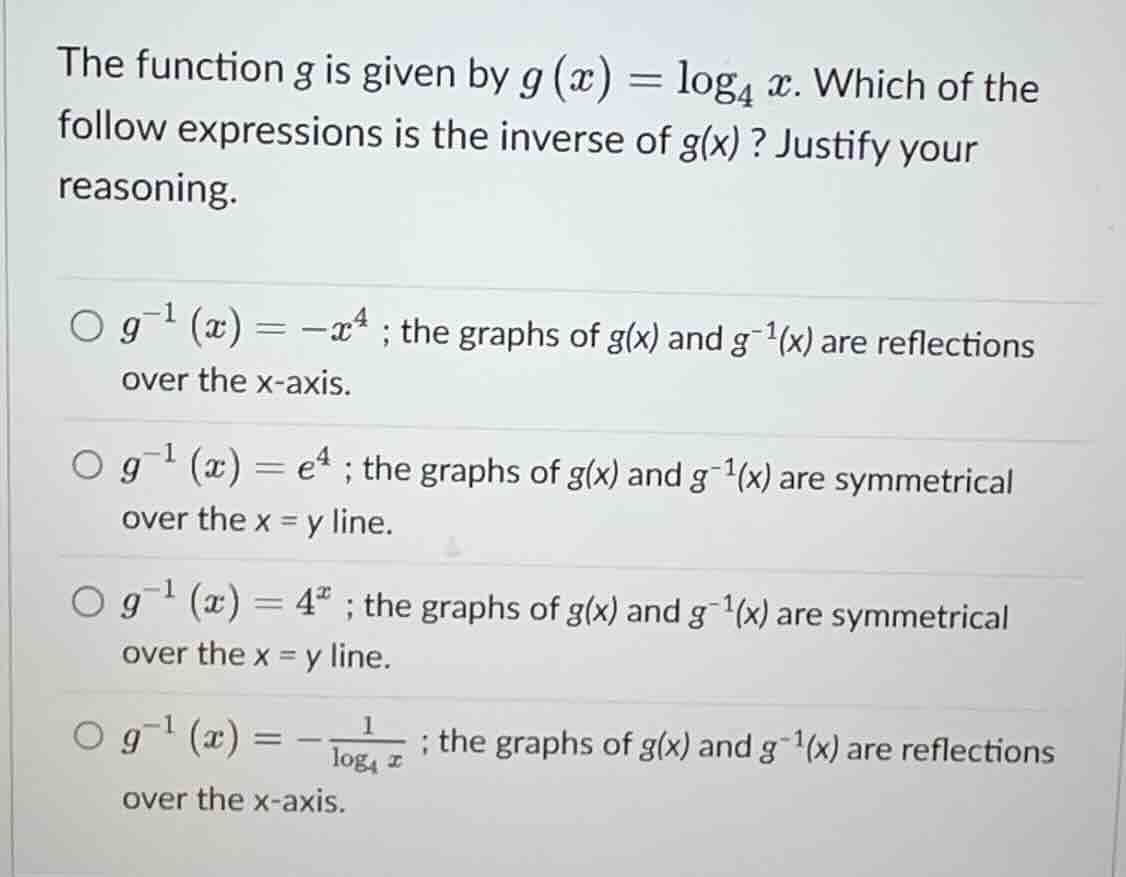
the function (g) is given by (g(x) = log_4 x). which of the follow expressions is the inverse of (g(x))? justify your reasoning.
(\bigcirc) (g^{-1}(x) = -x^4); the graphs of (g(x)) and (g^{-1}(x)) are reflections over the x-axis.
(\bigcirc) (g^{-1}(x) = e^4); the graphs of (g(x)) and (g^{-1}(x)) are symmetrical over the (x = y) line.
(\bigcirc) (g^{-1}(x) = 4^x); the graphs of (g(x)) and (g^{-1}(x)) are symmetrical over the (x = y) line.
(\bigcirc) (g^{-1}(x) = -\frac{1}{log_4 x}); the graphs of (g(x)) and (g^{-1}(x)) are reflections over the x-axis.
Set up the inverse equation
To find the inverse, set \(y = g(x)\).
Swap the variables \(x\) and \(y\) to find the inverse relation.
Solve for y
Using the Logarithmic Models concept, rewrite the logarithmic equation in its equivalent exponential form.
Thus, the inverse function is:
Identify the geometric relationship
Using the Exponential Equations concept, the graphs of any function and its inverse are reflections of each other.
They are symmetrical over the line \(y = x\).
This matches the third option.

Snap & solve any problem in the app
Get step-by-step solutions on Sovi AI
Photo-based solutions with guided steps
Explore more problems and detailed explanations
- (A) \(g^{-1}(x) = -x^4\) ; the graphs of \(g(x)\) and \(g^{-1}(x)\) are reflections over the x-axis.
- (B) \(g^{-1}(x) = e^4\) ; the graphs of \(g(x)\) and \(g^{-1}(x)\) are symmetrical over the \(x = y\) line.
- (C) \(g^{-1}(x) = 4^x\) ; the graphs of \(g(x)\) and \(g^{-1}(x)\) are symmetrical over the \(x = y\) line. (Correct answer)
- (D) \(g^{-1}(x) = -\frac{1}{\log_4 x}\) ; the graphs of \(g(x)\) and \(g^{-1}(x)\) are reflections over the x-axis.