QUESTION IMAGE
Question
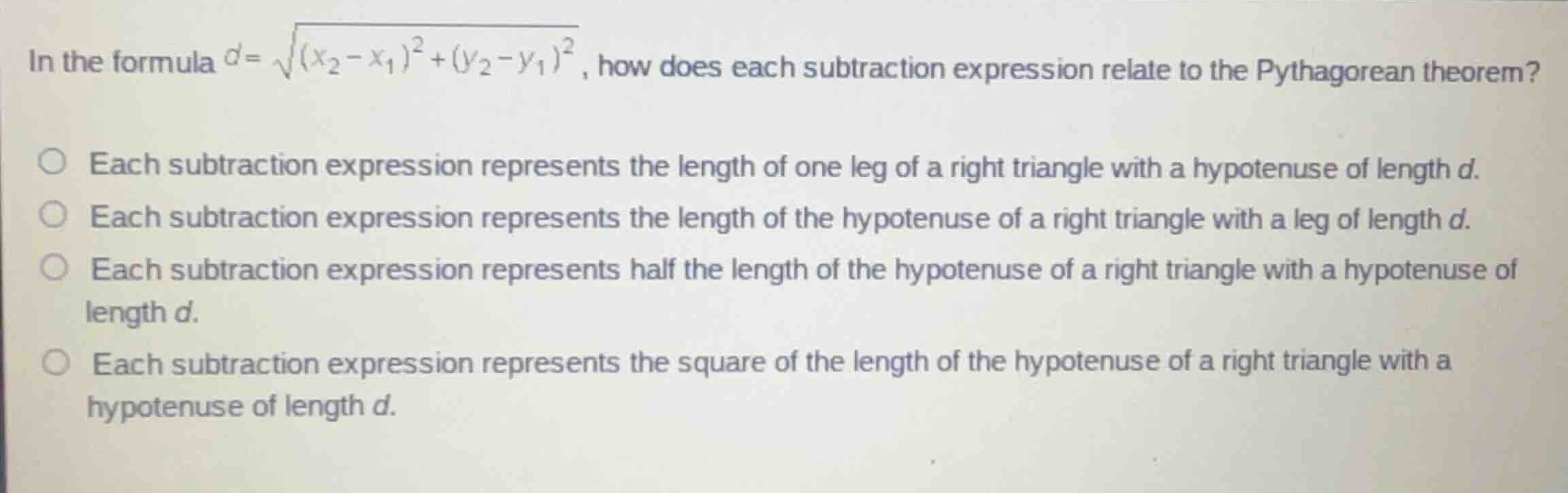
in the formula (d = \sqrt{(x_2-x_1)^2 + (y_2-y_1)^2}), how does each subtraction expression relate to the pythagorean theorem?
each subtraction expression represents the length of one leg of a right triangle with a hypotenuse of length (d).
each subtraction expression represents the length of the hypotenuse of a right triangle with a leg of length (d).
each subtraction expression represents half the length of the hypotenuse of a right triangle with a hypotenuse of length (d).
each subtraction expression represents the square of the length of the hypotenuse of a right triangle with a hypotenuse of length (d).
Relate the distance formula to the Pythagorean theorem
Compare with the Pythagorean theorem formula
Identify the geometric meaning of the subtraction expressions

Snap & solve any problem in the app
Get step-by-step solutions on Sovi AI
Photo-based solutions with guided steps
Explore more problems and detailed explanations
- (A) Each subtraction expression represents the length of one leg of a right triangle with a hypotenuse of length d. (Correct answer)
- (B) Each subtraction expression represents the length of the hypotenuse of a right triangle with a leg of length d.
- (C) Each subtraction expression represents half the length of the hypotenuse of a right triangle with a hypotenuse of length d.
- (D) Each subtraction expression represents the square of the length of the hypotenuse of a right triangle with a hypotenuse of length d.