QUESTION IMAGE
Question
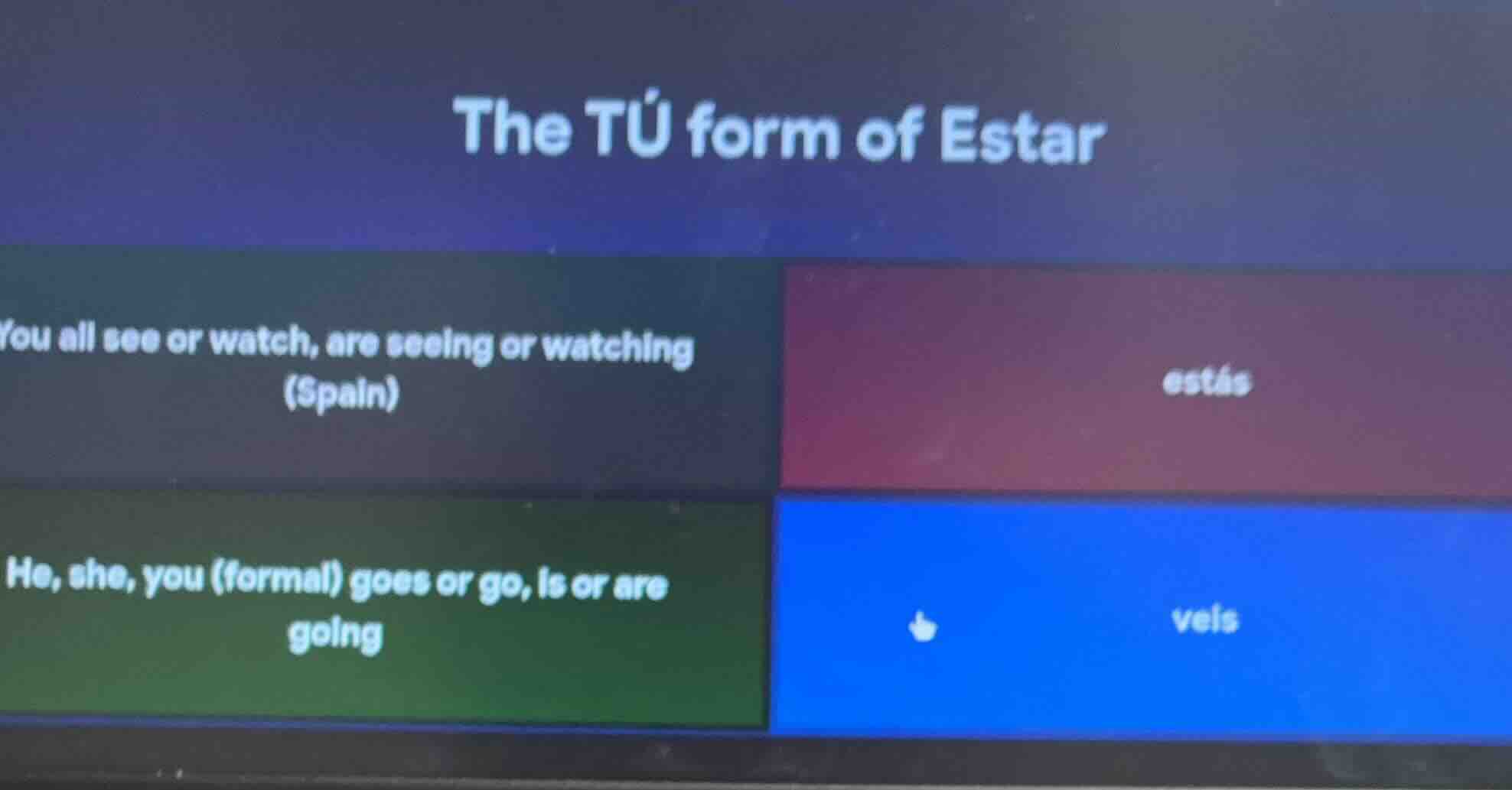
the tú form of estar
you all see or watch, are seeing or watching (spain)
estás
he, she, you (formal) goes or go, is or are going
veis
<pre_analysis>
{
"quality": "clear",
"question_count": 1,
"skills_matched": [
"direct_cot",
"multiple_choice_formatter",
"explain_then_answer",
"quick"
],
"needs_drawing": false,
"concepts_used": [
"Spanish Verb Conjugation",
"Spanish Verbs",
"Spanish Present Tense"
],
"new_concepts": [],
"current_concepts": [
"Spanish Verb Conjugation",
"Spanish Verbs",
"Spanish Present Tense"
]
}
</pre_analysis>
<reasoning>
Identify the target verb and subject pronoun
The prompt asks for the "TÚ" form of the Spanish verb "Estar" (to be).
Analyze the given options
- "estás" is the second-person singular present indicative form of "estar", which corresponds to "tú".
- "veis" is the second-person plural present indicative form of "ver" (to see), corresponding to "vosotros" (used in Spain).
- The other blocks contain English translations/definitions of other verb forms.
Select the correct match
The correct Spanish conjugation matching "The TÚ form of Estar" is "estás".
</reasoning>
<answer>
<mcq-option>You all see or watch, are seeing or watching (Spain)</mcq-option>
<mcq-correct>estás</mcq-correct>
<mcq-option>He, she, you (formal) goes or go, is or are going</mcq-option>
<mcq-option>veis</mcq-option>
</answer>
<post_analysis>
{
"subject": "Others",
"question_type": "Multiple Choice",
"knowledge_point": [
"Others",
"Spanish",
"Spanish Verb Conjugation"
]
}
</post_analysis>
Snap & solve any problem in the app
Get step-by-step solutions on Sovi AI
Photo-based solutions with guided steps
Explore more problems and detailed explanations
<pre_analysis>
{
"quality": "clear",
"question_count": 1,
"skills_matched": [
"direct_cot",
"multiple_choice_formatter",
"explain_then_answer",
"quick"
],
"needs_drawing": false,
"concepts_used": [
"Spanish Verb Conjugation",
"Spanish Verbs",
"Spanish Present Tense"
],
"new_concepts": [],
"current_concepts": [
"Spanish Verb Conjugation",
"Spanish Verbs",
"Spanish Present Tense"
]
}
</pre_analysis>
<reasoning>
Identify the target verb and subject pronoun
The prompt asks for the "TÚ" form of the Spanish verb "Estar" (to be).
Analyze the given options
- "estás" is the second-person singular present indicative form of "estar", which corresponds to "tú".
- "veis" is the second-person plural present indicative form of "ver" (to see), corresponding to "vosotros" (used in Spain).
- The other blocks contain English translations/definitions of other verb forms.
Select the correct match
The correct Spanish conjugation matching "The TÚ form of Estar" is "estás".
</reasoning>
<answer>
<mcq-option>You all see or watch, are seeing or watching (Spain)</mcq-option>
<mcq-correct>estás</mcq-correct>
<mcq-option>He, she, you (formal) goes or go, is or are going</mcq-option>
<mcq-option>veis</mcq-option>
</answer>
<post_analysis>
{
"subject": "Others",
"question_type": "Multiple Choice",
"knowledge_point": [
"Others",
"Spanish",
"Spanish Verb Conjugation"
]
}
</post_analysis>