QUESTION IMAGE
Question
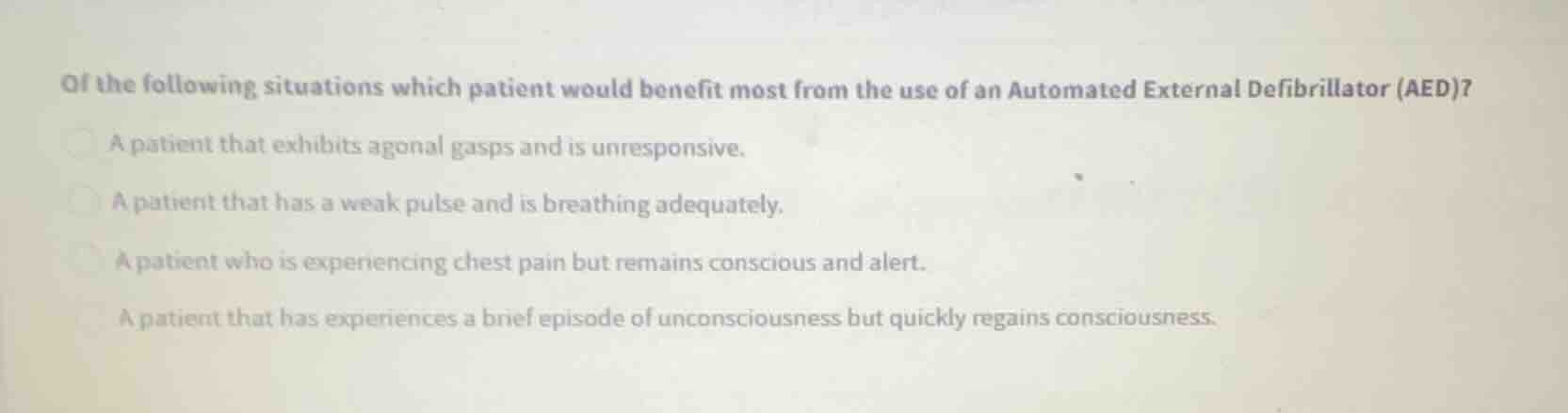
of the following situations which patient would benefit most from the use of an automated external defibrillator (aed)?
a patient that exhibits agonal gasps and is unresponsive.
a patient that has a weak pulse and is breathing adequately.
a patient who is experiencing chest pain but remains conscious and alert.
a patient that has experiences a brief episode of unconsciousness but quickly regains consciousness.
<pre_analysis>
{
"quality": "clear",
"question_count": 1,
"skills_matched": [
"direct_cot",
"multiple_choice_formatter",
"explain_then_answer",
"tutor",
"mastery_adaptive_brevity"
],
"needs_drawing": false,
"concepts_used": [
"AED Mechanism of Action"
],
"new_concepts": [
"AED Indications",
"Cardiac Arrest Assessment"
],
"current_concepts": [
"AED Mechanism of Action",
"AED Indications",
"Cardiac Arrest Assessment"
]
}
</pre_analysis>
<reasoning>
Identify the clinical indications for AED use
Using the AED Mechanism of Action knowledge point
An Automated External Defibrillator (AED) is indicated only for patients in cardiac arrest. The clinical signs of cardiac arrest are:
- Unresponsiveness
- Absence of normal breathing (or only agonal gasps)
- Absence of a palpable pulse
Evaluate the clinical scenarios
- Scenario 1: A patient with agonal gasps who is unresponsive. Agonal gasps are not adequate breathing and are a sign of cardiac arrest. This patient requires CPR and immediate AED application.
- Scenario 2: A patient with a weak pulse who is breathing adequately. This patient is not in cardiac arrest; an AED is not indicated.
- Scenario 3: A patient with chest pain who is conscious and alert. This patient is conscious and has a pulse; an AED is not indicated.
- Scenario 4: A patient who had a brief episode of unconsciousness but quickly regained consciousness (syncope). The patient is currently conscious; an AED is not indicated.
Determine the most beneficial situation
The unresponsive patient exhibiting agonal gasps is in cardiac arrest and will benefit most from immediate CPR and AED use.
</reasoning>
<answer>
<mcq-correct>A patient that exhibits agonal gasps and is unresponsive.</mcq-correct>
<mcq-option>A patient that has a weak pulse and is breathing adequately.</mcq-option>
<mcq-option>A patient who is experiencing chest pain but remains conscious and alert.</mcq-option>
<mcq-option>A patient that has experiences a brief episode of unconsciousness but quickly regains consciousness.</mcq-option>
</answer>
<post_analysis>
{
"subject": "Natural Science",
"question_type": "Multiple Choice",
"knowledge_point": [
"Natural Science",
"Medicine",
"Emergency Medical Services"
]
}
</post_analysis>
Snap & solve any problem in the app
Get step-by-step solutions on Sovi AI
Photo-based solutions with guided steps
Explore more problems and detailed explanations
<pre_analysis>
{
"quality": "clear",
"question_count": 1,
"skills_matched": [
"direct_cot",
"multiple_choice_formatter",
"explain_then_answer",
"tutor",
"mastery_adaptive_brevity"
],
"needs_drawing": false,
"concepts_used": [
"AED Mechanism of Action"
],
"new_concepts": [
"AED Indications",
"Cardiac Arrest Assessment"
],
"current_concepts": [
"AED Mechanism of Action",
"AED Indications",
"Cardiac Arrest Assessment"
]
}
</pre_analysis>
<reasoning>
Identify the clinical indications for AED use
Using the AED Mechanism of Action knowledge point
An Automated External Defibrillator (AED) is indicated only for patients in cardiac arrest. The clinical signs of cardiac arrest are:
- Unresponsiveness
- Absence of normal breathing (or only agonal gasps)
- Absence of a palpable pulse
Evaluate the clinical scenarios
- Scenario 1: A patient with agonal gasps who is unresponsive. Agonal gasps are not adequate breathing and are a sign of cardiac arrest. This patient requires CPR and immediate AED application.
- Scenario 2: A patient with a weak pulse who is breathing adequately. This patient is not in cardiac arrest; an AED is not indicated.
- Scenario 3: A patient with chest pain who is conscious and alert. This patient is conscious and has a pulse; an AED is not indicated.
- Scenario 4: A patient who had a brief episode of unconsciousness but quickly regained consciousness (syncope). The patient is currently conscious; an AED is not indicated.
Determine the most beneficial situation
The unresponsive patient exhibiting agonal gasps is in cardiac arrest and will benefit most from immediate CPR and AED use.
</reasoning>
<answer>
<mcq-correct>A patient that exhibits agonal gasps and is unresponsive.</mcq-correct>
<mcq-option>A patient that has a weak pulse and is breathing adequately.</mcq-option>
<mcq-option>A patient who is experiencing chest pain but remains conscious and alert.</mcq-option>
<mcq-option>A patient that has experiences a brief episode of unconsciousness but quickly regains consciousness.</mcq-option>
</answer>
<post_analysis>
{
"subject": "Natural Science",
"question_type": "Multiple Choice",
"knowledge_point": [
"Natural Science",
"Medicine",
"Emergency Medical Services"
]
}
</post_analysis>