QUESTION IMAGE
Question
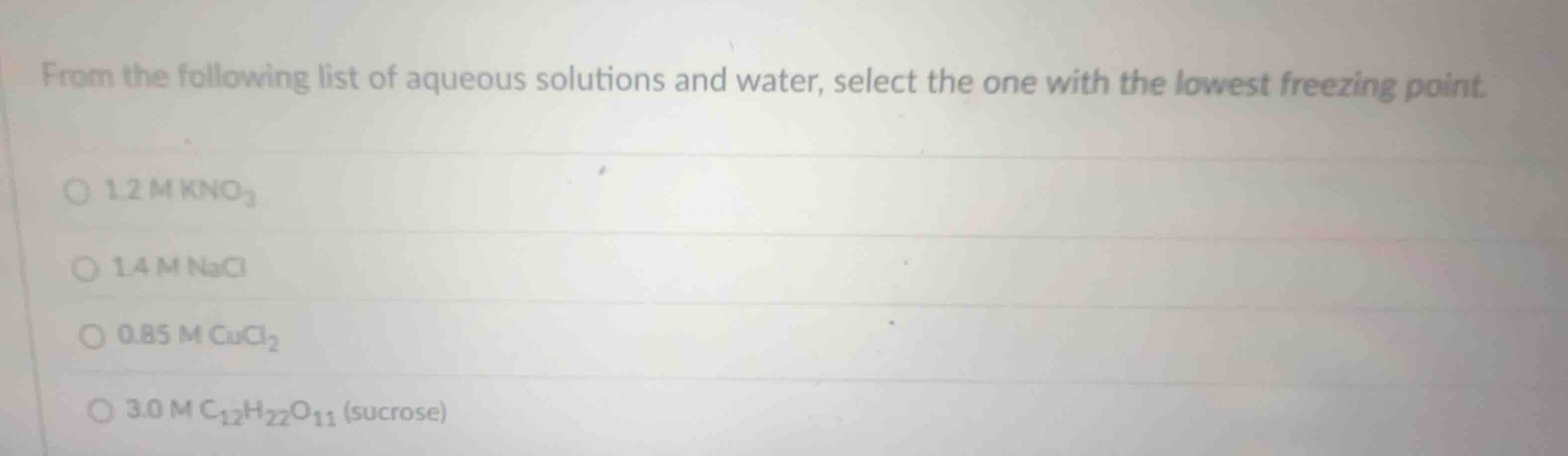
from the following list of aqueous solutions and water, select the one with the lowest freezing point.
\\(1.2\text{ m kno}_3\\)
\\(1.4\text{ m nacl}\\)
\\(0.85\text{ m cucl}_2\\)
\\(3.0\text{ m c}_{12}\text{h}_{22}\text{o}_{11}\\) (sucrose)
Understand freezing point depression
Freezing point depression is a colligative property, meaning it depends on the total concentration of solute particles in the solution rather than their chemical identity. The change in freezing point \(\Delta T_f\) is given by the formula:
For aqueous solutions, the solvent is water. To find the solution with the lowest freezing point, we need to find the one with the largest freezing point depression \(\Delta T_f\). This corresponds to the highest effective concentration of dissolved particles, which can be approximated by the product of the van 't Hoff factor \(i\) and the molarity \(M\):
Determine the van 't Hoff factor for each solute
The van 't Hoff factor \(i\) represents the number of particles a solute formula unit dissociates into when dissolved in water:
- \(\text{KNO}_3\) is a strong electrolyte that dissociates completely:
- \(\text{NaCl}\) is a strong electrolyte that dissociates completely:
- \(\text{CuCl}_2\) is a strong electrolyte that dissociates completely:
- \(\text{C}_{12}\text{H}_{22}\text{O}_{11}\) (sucrose) is a nonelectrolyte and does not dissociate:
Calculate the effective particle concentration
We calculate the product \(i \cdot M\) for each option to compare their relative freezing point depressions:
- For \(1.2\text{ M KNO}_3\):
- For \(1.4\text{ M NaCl}\):
- For \(0.85\text{ M CuCl}_2\):
- For \(3.0\text{ M C}_{12}\text{H}_{22}\text{O}_{11}\):
Identify the lowest freezing point
The solution with the highest effective particle concentration (\(i \cdot M\)) will experience the greatest freezing point depression, resulting in the lowest freezing point.
Comparing the calculated values:
The \(3.0\text{ M C}_{12}\text{H}_{22}\text{O}_{11}\) solution has the highest concentration of solute particles (\(3.0\text{ M}\)) and therefore has the lowest freezing point.

Snap & solve any problem in the app
Get step-by-step solutions on Sovi AI
Photo-based solutions with guided steps
Explore more problems and detailed explanations
- (A) 1.2 M KNO₃
- (B) 1.4 M NaCl
- (C) 0.85 M CuCl₂
- (D) 3.0 M C₁₂H₂₂O₁₁ (sucrose) (Correct answer)