QUESTION IMAGE
Question
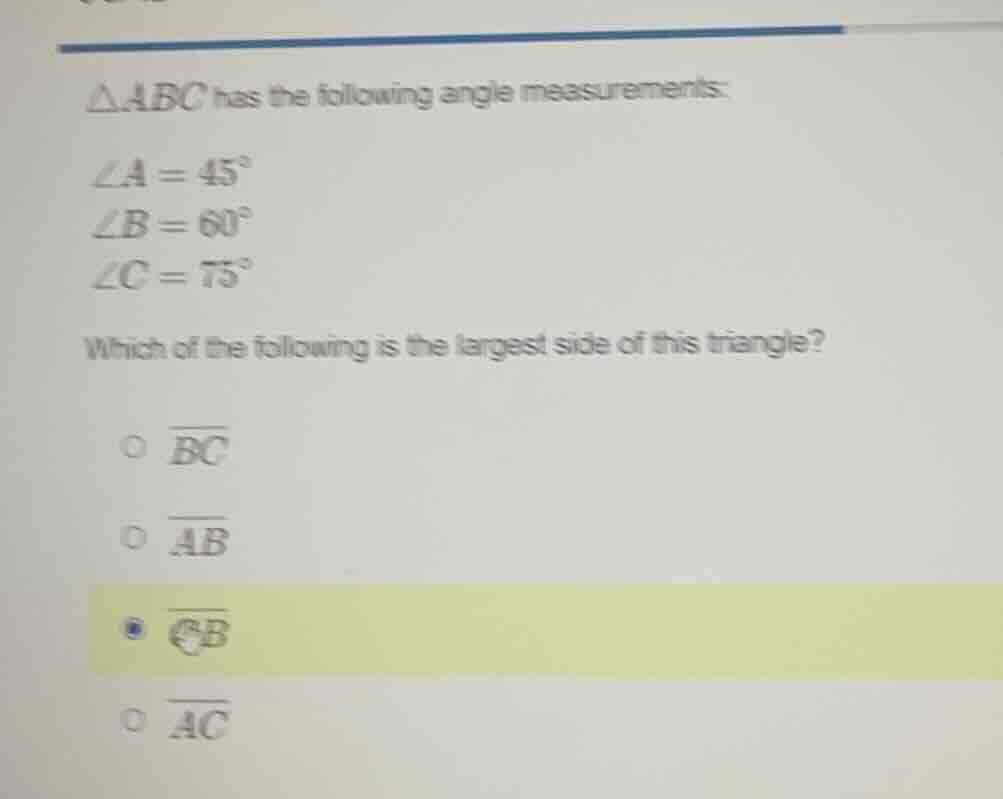
\\(\delta abc\\) has the following angle measurements:
\\(\angle a = 45^\circ\\)
\\(\angle b = 60^\circ\\)
\\(\angle c = 75^\circ\\)
which of the following is the largest side of this triangle?
- \\(\overline{bc}\\)
- \\(\overline{ab}\\)
- \\(\overline{cb}\\)
- \\(\overline{ac}\\)
<pre_analysis>
{
"quality": "clear",
"question_count": 1,
"skills_matched": [
"step_cot",
"multiple_choice_formatter",
"explain_then_answer",
"tutor"
],
"needs_drawing": true,
"concepts_used": [],
"new_concepts": [
"Triangle Inequality Theorem",
"Angle-Side Relationship"
],
"current_concepts": [
"Triangle Inequality Theorem",
"Angle-Side Relationship"
]
}
</pre_analysis>
<reasoning>
Identify the given angle measurements
We are given the interior angles of \(\triangle ABC\):
\[
\]
Determine the largest angle
Comparing the angle measures:
\[
75^\circ > 60^\circ > 45^\circ
\]
Thus, \(\angle C\) is the largest angle.
Apply the angle-side relationship
In any triangle, the longest side is always opposite the largest angle.
- The side opposite to \(\angle A\) is \(\overline{BC}\).
- The side opposite to \(\angle B\) is \(\overline{AC}\).
- The side opposite to \(\angle C\) is \(\overline{AB}\).
Since \(\angle C\) is the largest angle, the opposite side \(\overline{AB}\) must be the longest side.
</reasoning>
<answer>
<mcq-option>(A) \(\overline{BC}\)</mcq-option>
<mcq-correct>(B) \(\overline{AB}\)</mcq-correct>
<mcq-option>(C) \(\overline{CB}\)</mcq-option>
<mcq-option>(D) \(\overline{AC}\)</mcq-option>
</answer>
<plot>
{
"elements": [
{
"type": "point",
"params": [[0, 0]],
"properties": {
"name": "A",
"color": "#8C55F2",
"withLabel": true,
"labelPosition": "left"
}
},
{
"type": "point",
"params": [[4.48, 0]],
"properties": {
"name": "C",
"color": "#8C55F2",
"withLabel": true,
"labelPosition": "right"
}
},
{
"type": "point",
"params": [[3.28, 3.28]],
"properties": {
"name": "B",
"color": "#8C55F2",
"withLabel": true,
"labelPosition": "up"
}
},
{
"type": "polygon",
"params": [[0, 0], [4.48, 0], [3.28, 3.28]],
"properties": {
"fillColor": "rgba(140, 85, 242, 0.15)",
"strokeColor": "#583C87",
"strokeWidth": 2
}
},
{
"type": "text",
"params": [0.5, 0.3, "45°"],
"properties": {
"color": "#583C87"
}
},
{
"type": "text",
"params": [3.1, 2.8, "60°"],
"properties": {
"color": "#583C87"
}
},
{
"type": "text",
"params": [3.9, 0.3, "75°"],
"properties": {
"color": "#583C87"
}
}
]
}
</plot>
<post_analysis>
{
"subject": "Mathematics",
"question_type": "Multiple Choice",
"knowledge_point": [
"Mathematics",
"Geometry",
"Angle-Side Relationship"
]
}
</post_analysis>
Snap & solve any problem in the app
Get step-by-step solutions on Sovi AI
Photo-based solutions with guided steps
Explore more problems and detailed explanations
<pre_analysis>
{
"quality": "clear",
"question_count": 1,
"skills_matched": [
"step_cot",
"multiple_choice_formatter",
"explain_then_answer",
"tutor"
],
"needs_drawing": true,
"concepts_used": [],
"new_concepts": [
"Triangle Inequality Theorem",
"Angle-Side Relationship"
],
"current_concepts": [
"Triangle Inequality Theorem",
"Angle-Side Relationship"
]
}
</pre_analysis>
<reasoning>
Identify the given angle measurements
We are given the interior angles of \(\triangle ABC\):
\[
\]
Determine the largest angle
Comparing the angle measures:
\[
75^\circ > 60^\circ > 45^\circ
\]
Thus, \(\angle C\) is the largest angle.
Apply the angle-side relationship
In any triangle, the longest side is always opposite the largest angle.
- The side opposite to \(\angle A\) is \(\overline{BC}\).
- The side opposite to \(\angle B\) is \(\overline{AC}\).
- The side opposite to \(\angle C\) is \(\overline{AB}\).
Since \(\angle C\) is the largest angle, the opposite side \(\overline{AB}\) must be the longest side.
</reasoning>
<answer>
<mcq-option>(A) \(\overline{BC}\)</mcq-option>
<mcq-correct>(B) \(\overline{AB}\)</mcq-correct>
<mcq-option>(C) \(\overline{CB}\)</mcq-option>
<mcq-option>(D) \(\overline{AC}\)</mcq-option>
</answer>
<plot>
{
"elements": [
{
"type": "point",
"params": [[0, 0]],
"properties": {
"name": "A",
"color": "#8C55F2",
"withLabel": true,
"labelPosition": "left"
}
},
{
"type": "point",
"params": [[4.48, 0]],
"properties": {
"name": "C",
"color": "#8C55F2",
"withLabel": true,
"labelPosition": "right"
}
},
{
"type": "point",
"params": [[3.28, 3.28]],
"properties": {
"name": "B",
"color": "#8C55F2",
"withLabel": true,
"labelPosition": "up"
}
},
{
"type": "polygon",
"params": [[0, 0], [4.48, 0], [3.28, 3.28]],
"properties": {
"fillColor": "rgba(140, 85, 242, 0.15)",
"strokeColor": "#583C87",
"strokeWidth": 2
}
},
{
"type": "text",
"params": [0.5, 0.3, "45°"],
"properties": {
"color": "#583C87"
}
},
{
"type": "text",
"params": [3.1, 2.8, "60°"],
"properties": {
"color": "#583C87"
}
},
{
"type": "text",
"params": [3.9, 0.3, "75°"],
"properties": {
"color": "#583C87"
}
}
]
}
</plot>
<post_analysis>
{
"subject": "Mathematics",
"question_type": "Multiple Choice",
"knowledge_point": [
"Mathematics",
"Geometry",
"Angle-Side Relationship"
]
}
</post_analysis>