QUESTION IMAGE
Question
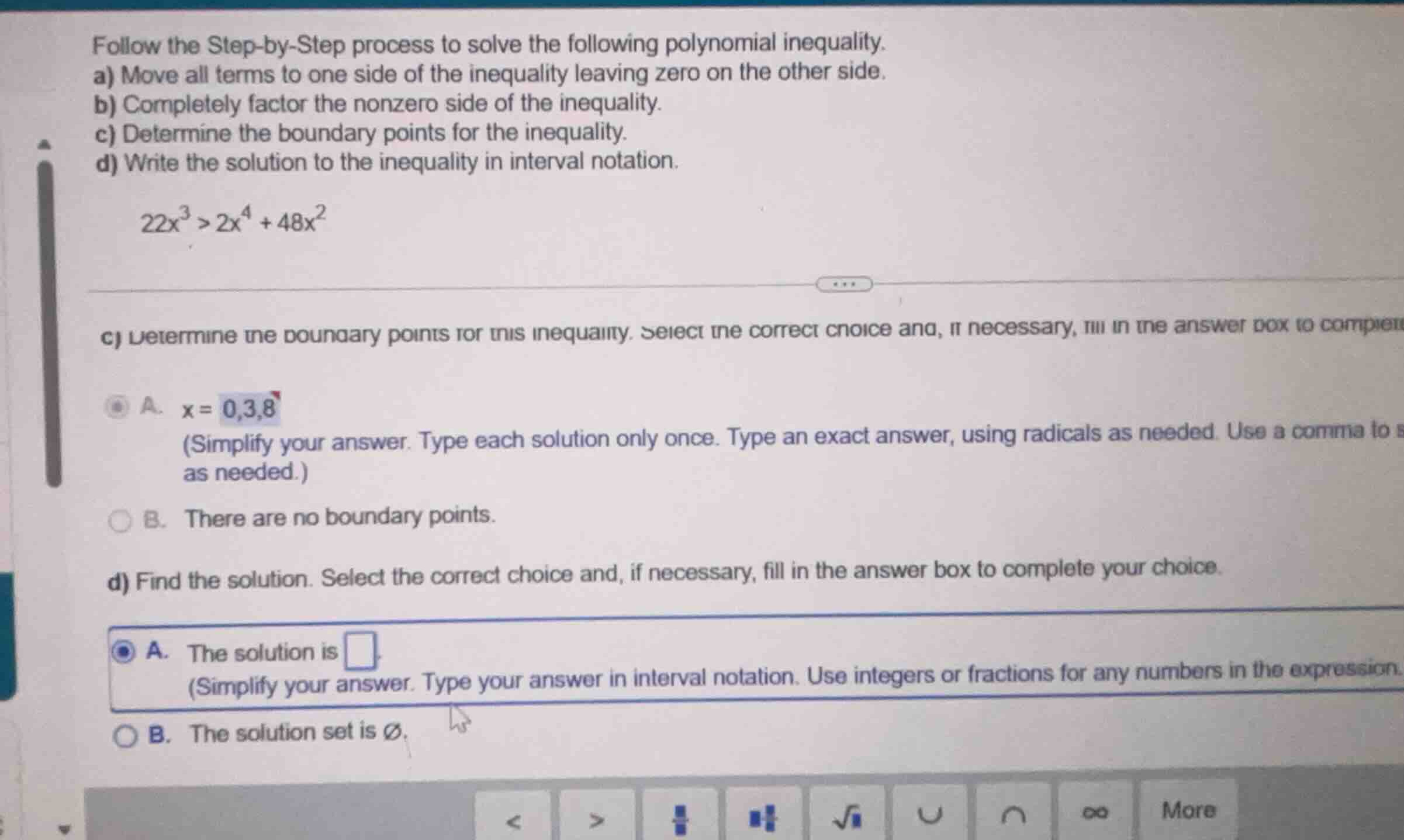
follow the step-by-step process to solve the following polynomial inequality.
a) move all terms to one side of the inequality leaving zero on the other side.
b) completely factor the nonzero side of the inequality.
c) determine the boundary points for the inequality.
d) write the solution to the inequality in interval notation.
\\22x^3 > 2x^4 + 48x^2\\
c) determine the boundary points for this inequality. select the correct choice and, if necessary, fill in the answer box to complete your choice.
a. \\(x = 0, 3, 8\\)
(simplify your answer. type each solution only once. type an exact answer, using radicals as needed. use a comma to separate answers as needed.)
b. there are no boundary points.
d) find the solution. select the correct choice and, if necessary, fill in the answer box to complete your choice.
a. the solution is
(simplify your answer. type your answer in interval notation. use integers or fractions for any numbers in the expression.)
b. the solution set is \\(\varnothing\\).
Rearrange the inequality
Move all terms to one side to leave zero on the other.
Subtract \(22x^3\) from both sides:
Rewrite with the polynomial on the left:
Factor the polynomial
Factor out the greatest common factor, which is \(2x^2\):
Factor the quadratic trinomial \(x^2 - 11x + 24\) by finding two numbers that multiply to \(24\) and add to \(-11\). These numbers are \(-3\) and \(-8\):
Find the boundary points
Set each factor equal to zero to find the boundary points:
The boundary points are \(x = 0, 3, 8\).
Determine the solution intervals
Test the intervals created by the boundary points: \((-\infty, 0)\), \((0, 3)\), \((3, 8)\), and \((8, \infty)\).
We want to find where \(2x^2(x - 3)(x - 8) < 0\).
Note that \(2x^2 > 0\) for all \(x
eq 0\). Thus, the sign of the product depends on \((x - 3)(x - 8)\).
- For \(x \in (-\infty, 0)\): \((x-3) < 0\) and \((x-8) < 0\), so the product is positive.
- For \(x \in (0, 3)\): \((x-3) < 0\) and \((x-8) < 0\), so the product is positive.
- For \(x \in (3, 8)\): \((x-3) > 0\) and \((x-8) < 0\), so the product is negative.
- For \(x \in (8, \infty)\): \((x-3) > 0\) and \((x-8) > 0\), so the product is positive.
The inequality is strictly less than zero, which is satisfied only in the interval \((3, 8)\).

Snap & solve any problem in the app
Get step-by-step solutions on Sovi AI
Photo-based solutions with guided steps
Explore more problems and detailed explanations
Question 1
- A. \(x = 0,3,8\) (Correct answer)
- B. There are no boundary points.
Question 2
- A. The solution is \((3, 8)\) (Correct answer)
- B. The solution set is \(\varnothing\).