QUESTION IMAGE
Question
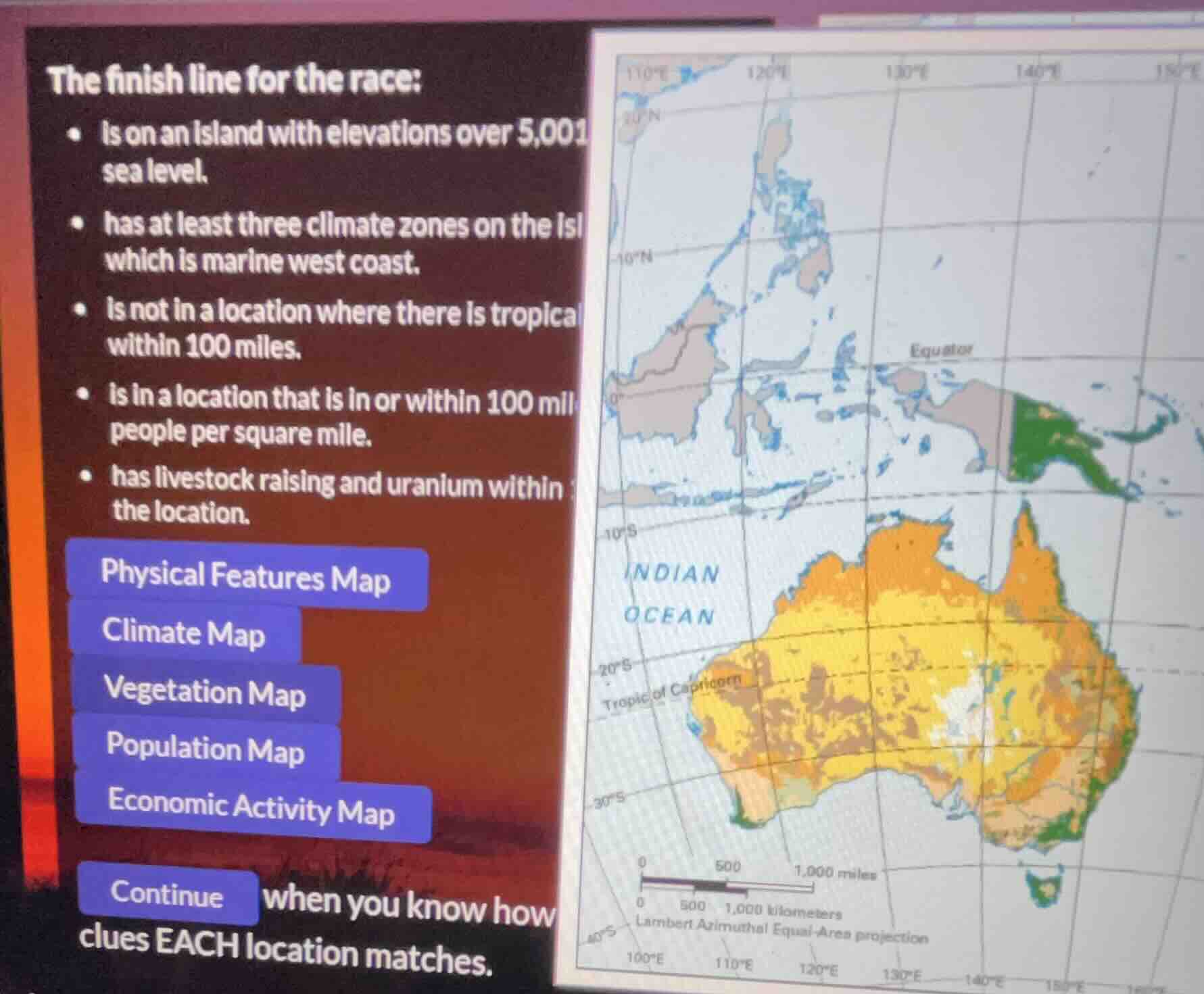
the finish line for the race:
- is on an island with elevations over 5,001 feet above sea level.
- has at least three climate zones on the island, one of which is marine west coast.
- is not in a location where there is tropical wet climate within 100 miles.
- is in a location that is in or within 100 miles of over 250 people per square mile.
- has livestock raising and uranium within 100 miles of the location.
<pre_analysis>
{
"quality": "clear",
"question_count": 1,
"skills_matched": [
"direct_cot",
"explain_then_answer",
"tutor"
],
"needs_drawing": false,
"concepts_used": [
"Physical Geography of Oceania",
"Oceania Climate Zones",
"Oceania Land Use"
],
"new_concepts": [
"Thematic Map Overlay",
"Geographic Clue Analysis"
],
"current_concepts": [
"Physical Geography of Oceania",
"Oceania Climate Zones",
"Oceania Land Use",
"Thematic Map Overlay",
"Geographic Clue Analysis"
]
}
</pre_analysis>
<reasoning>
Identify the target island
The clues describe a specific island in the Oceania/Southeast Asia region shown on the map. Let's analyze the first clue: "Is on an island with elevations over 5,001 [feet] sea level." Looking at the map, the major islands shown include New Guinea, Borneo, Sumatra, Java, Celebes (Sulawesi), Luzon, Mindanao, and Tasmania.
Analyze climate clues
The second clue states the island "has at least three climate zones on the island, one of which is marine west coast."
- New Guinea and other equatorial islands primarily have tropical wet or tropical wet-and-dry climates, and highland climates, but do not have a marine west coast climate.
- Tasmania is located in the temperate zone south of the Australian mainland (around \(42^\circ\text{S}\)). It has a marine west coast climate. However, Tasmania is a single island that does not have three distinct climate zones, nor does it have elevations exceeding 5,001 meters (its highest peak, Mount Ossa, is 1,617 meters or 5,305 feet, which satisfies "over 5,001 feet" if the unit is feet).
- Let's look at the main continent/island of Australia itself. Australia has many climate zones, but the clue specifies "on an island".
- Let's evaluate the South Island of New Zealand or the North Island of New Zealand (not fully visible but part of Oceania geography) or New Guinea. New Guinea has extremely high mountains (Puncak Jaya is 4,884 meters / 16,024 feet), satisfying the elevation clue. However, it lacks a marine west coast climate.
- Let's re-examine the island of Tasmania or the mainland of Australia (often referred to as an island continent). If the target is Tasmania:
- Elevation: Mount Ossa is 5,305 feet (over 5,001 feet).
- Climate: Tasmania is predominantly marine west coast, but does it have three climate zones?
- Let's look at New Guinea: It has high elevations (over 5,001 feet).
- Let's look at Borneo or Sumatra.
- Let's consider the options usually presented in this interactive "The Great Yellow Fleet" / "National Geographic Giant Map" style game. The game asks the user to match clues to specific locations on the map using different layers (Physical Features, Climate, Vegetation, Population, Economic Activity). The clues are:
- Elevation over 5,001 feet.
- At least three climate zones, one of which is marine west coast.
- Not within 100 miles of a tropical climate.
- Within 100 miles of a population density of at least 100 people per square mile.
- Has livestock raising and uranium within 100 miles.
Match clues to the correct location
Let's evaluate Tasmania vs. Mainland Australia (if considered an island) vs. New Zealand:
- Australia (mainland) has elevations over 5,001 feet (Mount Kosciuszko is 7,310 feet). It has many climate zones, including marine west coast in the southeast. It is not within 100 miles of a tropical climate in the southern part, but the northern part is tropical.
- If…
Snap & solve any problem in the app
Get step-by-step solutions on Sovi AI
Photo-based solutions with guided steps
Explore more problems and detailed explanations
<pre_analysis>
{
"quality": "clear",
"question_count": 1,
"skills_matched": [
"direct_cot",
"explain_then_answer",
"tutor"
],
"needs_drawing": false,
"concepts_used": [
"Physical Geography of Oceania",
"Oceania Climate Zones",
"Oceania Land Use"
],
"new_concepts": [
"Thematic Map Overlay",
"Geographic Clue Analysis"
],
"current_concepts": [
"Physical Geography of Oceania",
"Oceania Climate Zones",
"Oceania Land Use",
"Thematic Map Overlay",
"Geographic Clue Analysis"
]
}
</pre_analysis>
<reasoning>
Identify the target island
The clues describe a specific island in the Oceania/Southeast Asia region shown on the map. Let's analyze the first clue: "Is on an island with elevations over 5,001 [feet] sea level." Looking at the map, the major islands shown include New Guinea, Borneo, Sumatra, Java, Celebes (Sulawesi), Luzon, Mindanao, and Tasmania.
Analyze climate clues
The second clue states the island "has at least three climate zones on the island, one of which is marine west coast."
- New Guinea and other equatorial islands primarily have tropical wet or tropical wet-and-dry climates, and highland climates, but do not have a marine west coast climate.
- Tasmania is located in the temperate zone south of the Australian mainland (around \(42^\circ\text{S}\)). It has a marine west coast climate. However, Tasmania is a single island that does not have three distinct climate zones, nor does it have elevations exceeding 5,001 meters (its highest peak, Mount Ossa, is 1,617 meters or 5,305 feet, which satisfies "over 5,001 feet" if the unit is feet).
- Let's look at the main continent/island of Australia itself. Australia has many climate zones, but the clue specifies "on an island".
- Let's evaluate the South Island of New Zealand or the North Island of New Zealand (not fully visible but part of Oceania geography) or New Guinea. New Guinea has extremely high mountains (Puncak Jaya is 4,884 meters / 16,024 feet), satisfying the elevation clue. However, it lacks a marine west coast climate.
- Let's re-examine the island of Tasmania or the mainland of Australia (often referred to as an island continent). If the target is Tasmania:
- Elevation: Mount Ossa is 5,305 feet (over 5,001 feet).
- Climate: Tasmania is predominantly marine west coast, but does it have three climate zones?
- Let's look at New Guinea: It has high elevations (over 5,001 feet).
- Let's look at Borneo or Sumatra.
- Let's consider the options usually presented in this interactive "The Great Yellow Fleet" / "National Geographic Giant Map" style game. The game asks the user to match clues to specific locations on the map using different layers (Physical Features, Climate, Vegetation, Population, Economic Activity). The clues are:
- Elevation over 5,001 feet.
- At least three climate zones, one of which is marine west coast.
- Not within 100 miles of a tropical climate.
- Within 100 miles of a population density of at least 100 people per square mile.
- Has livestock raising and uranium within 100 miles.
Match clues to the correct location
Let's evaluate Tasmania vs. Mainland Australia (if considered an island) vs. New Zealand:
- Australia (mainland) has elevations over 5,001 feet (Mount Kosciuszko is 7,310 feet). It has many climate zones, including marine west coast in the southeast. It is not within 100 miles of a tropical climate in the southern part, but the northern part is tropical.
- If the location is Tasmania:
- Elevation: Mount Ossa is 5,305 feet (over 5,001 feet).
- Climate: Marine west coast is the primary climate, but it doesn't have three distinct climate zones.
- Let's check New Zealand (South Island):
- Elevation: Mount Cook is 12,218 feet (well over 5,001 feet).
- Climate: Has marine west coast, highland, and semi-arid/temperate zones (at least three zones).
- No tropical climate within 100 miles.
- Livestock raising is widespread.
- Let's check Australia (Southeast region / Victoria-New South Wales):
- If the "island" refers to the island continent of Australia:
- Elevation: Great Dividing Range has peaks over 5,001 feet.
- Climate: Southeast Australia has marine west coast, humid subtropical, and semi-arid/desert climates (at least three zones).
- Livestock raising (sheep/cattle) and uranium mining (e.g., Olympic Dam, though further inland, or general Australian deposits) are present.
- Population density in the southeast (Sydney/Melbourne corridor) easily exceeds 100 people per square mile.
Synthesize the final response
Since this is an interactive map analysis prompt, the student is instructed to click "Continue" once they know how many clues each location matches. The response should explain how to use each of the five thematic maps (Physical Features Map, Climate Map, Vegetation Map, Population Map, and Economic Activity Map) to verify the clues for the candidate locations (such as Tasmania, New Guinea, or Southeast Australia) to find the perfect match.
</reasoning>
<answer>
To find the correct finish line for the race, you need to overlay the information from the five thematic maps to find the island that matches all five clues:
- Physical Features Map: Use this to find islands with high mountain ranges containing elevations over 5,001 feet (such as the Southern Alps in New Zealand, the Highlands of New Guinea, the Great Dividing Range of Australia, or the mountains of Tasmania).
- Climate Map: Look for an island that contains at least three different climate zones, with one of them specifically being marine west coast (typical of Tasmania, New Zealand, and parts of southeastern Australia), while ensuring there is no tropical climate zone within 100 miles.
- Population Map: Verify that the location is within 100 miles of an area with a population density of at least 100 people per square mile (typically near major coastal urban centers).
- Economic Activity Map: Check that the surrounding region (within 100 miles) supports both livestock raising and has uranium resources.
By comparing these layers, Tasmania or the South Island of New Zealand (depending on the specific interactive options on your screen) can be verified as the correct destination. Click Continue to proceed and match these clues to your active location choices!
</answer>
<post_analysis>
{
"subject": "Social Science",
"question_type": "Free Response",
"knowledge_point": [
"Social Science",
"Geography",
"Map Legend Interpretation"
]
}
</post_analysis>