Sovi.AI - AI Math Tutor

Scan to solve math questions

QUESTION IMAGE

find the values of (x) and (y) in the following diagram: - (x = 12) and…

Question

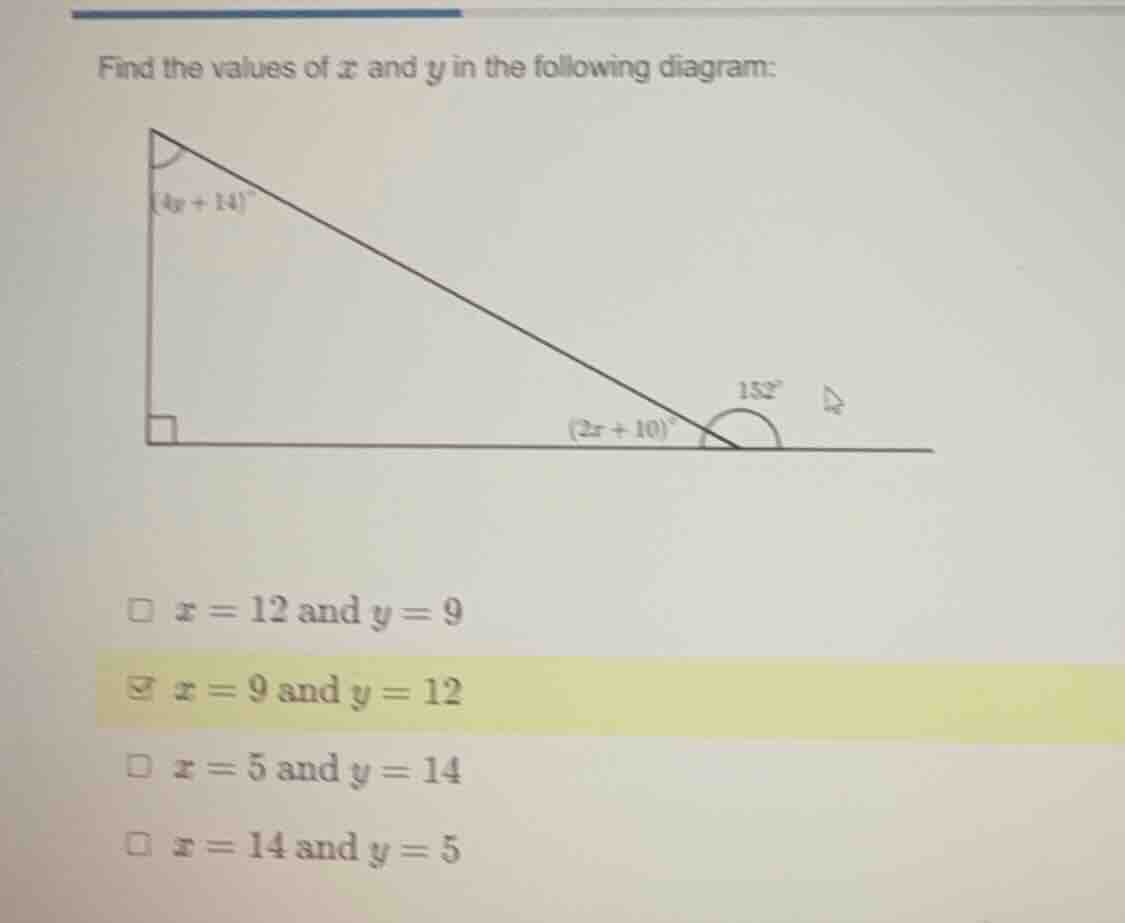
find the values of (x) and (y) in the following diagram:

  • (x = 12) and (y = 9)
  • (x = 9) and (y = 12)
  • (x = 5) and (y = 14)
  • (x = 14) and (y = 5)

Explanation:

Response

<pre_analysis>
{
"quality": "clear",
"question_count": 1,
"skills_matched": [
"step_cot",
"multiple_choice_formatter",
"explain_then_answer",
"tutor"
],
"needs_drawing": false,
"concepts_used": [
"Triangle Angle Sum Theorem"
],
"new_concepts": [
"Supplementary Angles"
],
"current_concepts": [
"Triangle Angle Sum Theorem",
"Supplementary Angles",
"Linear Equations"
]
}
</pre_analysis>

<reasoning>

Find the value of x

The angle \((2x + 10)^\circ\) and the adjacent angle \(152^\circ\) form a linear pair along a straight line.
\[
(2x + 10) + 152 = 180
\]
\[
2x + 162 = 180
\]
\[
2x = 18
\]
\[
x = 9
\]

Find the value of y

Using the Triangle Angle Sum Theorem, the sum of the interior angles of the right triangle must equal \(180^\circ\). The interior angles are \(90^\circ\), \((4y + 14)^\circ\), and \((2x + 10)^\circ\).
Substitute \(x = 9\) into the expression for the third angle:
\[
2(9) + 10 = 28^\circ
\]
Now, set up the sum of the angles:
\[
90 + (4y + 14) + 28 = 180
\]
\[
4y + 132 = 180
\]
\[
4y = 48
\]
\[
y = 12
\]
</reasoning>

<answer>
<mcq-option>\(x = 12\) and \(y = 9\)</mcq-option>
<mcq-correct>\(x = 9\) and \(y = 12\)</mcq-correct>
<mcq-option>\(x = 5\) and \(y = 14\)</mcq-option>
<mcq-option>\(x = 14\) and \(y = 5\)</mcq-option>
</answer>

<post_analysis>
{
"subject": "Mathematics",
"question_type": "Multiple Choice",
"knowledge_point": [
"Mathematics",
"Geometry",
"Triangle Angle Sum Theorem"
]
}
</post_analysis>

Answer:

<pre_analysis>
{
"quality": "clear",
"question_count": 1,
"skills_matched": [
"step_cot",
"multiple_choice_formatter",
"explain_then_answer",
"tutor"
],
"needs_drawing": false,
"concepts_used": [
"Triangle Angle Sum Theorem"
],
"new_concepts": [
"Supplementary Angles"
],
"current_concepts": [
"Triangle Angle Sum Theorem",
"Supplementary Angles",
"Linear Equations"
]
}
</pre_analysis>

<reasoning>

Find the value of x

The angle \((2x + 10)^\circ\) and the adjacent angle \(152^\circ\) form a linear pair along a straight line.
\[
(2x + 10) + 152 = 180
\]
\[
2x + 162 = 180
\]
\[
2x = 18
\]
\[
x = 9
\]

Find the value of y

Using the Triangle Angle Sum Theorem, the sum of the interior angles of the right triangle must equal \(180^\circ\). The interior angles are \(90^\circ\), \((4y + 14)^\circ\), and \((2x + 10)^\circ\).
Substitute \(x = 9\) into the expression for the third angle:
\[
2(9) + 10 = 28^\circ
\]
Now, set up the sum of the angles:
\[
90 + (4y + 14) + 28 = 180
\]
\[
4y + 132 = 180
\]
\[
4y = 48
\]
\[
y = 12
\]
</reasoning>

<answer>
<mcq-option>\(x = 12\) and \(y = 9\)</mcq-option>
<mcq-correct>\(x = 9\) and \(y = 12\)</mcq-correct>
<mcq-option>\(x = 5\) and \(y = 14\)</mcq-option>
<mcq-option>\(x = 14\) and \(y = 5\)</mcq-option>
</answer>

<post_analysis>
{
"subject": "Mathematics",
"question_type": "Multiple Choice",
"knowledge_point": [
"Mathematics",
"Geometry",
"Triangle Angle Sum Theorem"
]
}
</post_analysis>