Sovi.AI - AI Math Tutor

Scan to solve math questions

QUESTION IMAGE

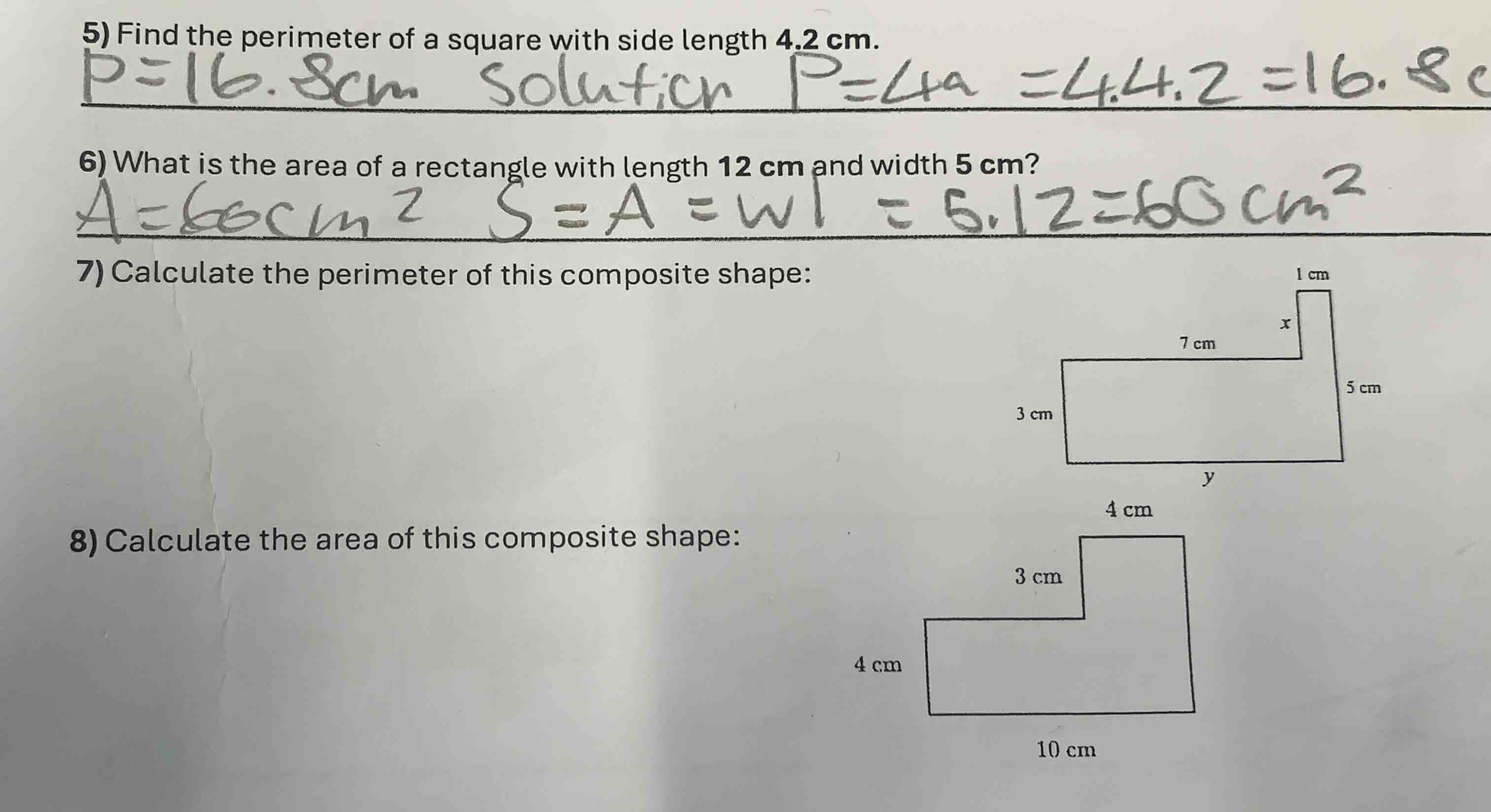
5) find the perimeter of a square with side length 4.2 cm. 6) what is t…

Question

  1. find the perimeter of a square with side length 4.2 cm.
  1. what is the area of a rectangle with length 12 cm and width 5 cm?
  1. calculate the perimeter of this composite shape:
  1. calculate the area of this composite shape:

Explanation:

Response

<pre_analysis>
{
"quality": "clear",
"question_count": 4,
"skills_matched": [
"step_cot",
"explain_then_answer",
"tutor"
],
"needs_drawing": false,
"concepts_used": [],
"new_concepts": [
"Composite Shapes",
"Perimeter Calculation",
"Area Decomposition"
],
"current_concepts": [
"Perimeter of Square",
"Area of Rectangle",
"Perimeter of Composite Shape",
"Area of Composite Shape"
]
}
</pre_analysis>

<reasoning>

Question 5: Perimeter of a square

Find the perimeter of a square with side length \(s = 4.2\text{ cm}\).
The formula for the perimeter \(P\) of a square is:
\[P = 4s\]
Substitute \(s = 4.2\text{ cm}\):
\[P = 4 \times 4.2 = 16.8\text{ cm}\]

Question 6: Area of a rectangle

Find the area of a rectangle with length \(l = 12\text{ cm}\) and width \(w = 5\text{ cm}\).
The formula for the area \(A\) of a rectangle is:
\[A = l \times w\]
Substitute \(l = 12\text{ cm}\) and \(w = 5\text{ cm}\):
\[A = 12 \times 5 = 60\text{ cm}^2\]

Question 7: Perimeter of a composite shape

Find the values of the unknown sides \(x\) and \(y\) first.
Looking at the horizontal dimensions:
The total bottom width is \(y\).
The top horizontal segments are \(7\text{ cm}\) and \(1\text{ cm}\).
\[y = 7 + 1 = 8\text{ cm}\]

Looking at the vertical dimensions:
The total rightmost height is \(5\text{ cm}\).
The leftmost height is \(3\text{ cm}\).
The inner vertical step is \(x\).
\[3 + x = 5 \implies x = 2\text{ cm}\]

Now, sum all the outer boundary segments to find the perimeter \(P\):
\[P = 3 + 7 + x + 1 + 5 + y\]
\[P = 3 + 7 + 2 + 1 + 5 + 8 = 26\text{ cm}\]

Question 8: Area of a composite shape

Divide the composite shape into two simpler rectangles.
Let's split it vertically or horizontally.
If we split it vertically from the inner corner down to the base:
The right rectangle has a top width of \(4\text{ cm}\).
The total bottom width is \(10\text{ cm}\), so the left rectangle has a width of:
\[10 - 4 = 6\text{ cm}\]

Now find the heights of each section:
The left section has a height of \(4\text{ cm}\).
The right section has a height equal to the left height plus the vertical step:
\[\text{Height of right section} = 4 + 3 = 7\text{ cm}\]

Calculate the area of each rectangle:
\[\text{Area of left rectangle} = 6\text{ cm} \times 4\text{ cm} = 24\text{ cm}^2\]
\[\text{Area of right rectangle} = 4\text{ cm} \times 7\text{ cm} = 28\text{ cm}^2\]

Sum the areas to find the total area \(A\):
\[A = 24 + 28 = 52\text{ cm}^2\]
</reasoning>

<answer>

Question 5

\(16.8\text{ cm}\)

Question 6

\(60\text{ cm}^2\)

Question 7

\(26\text{ cm}\)

Question 8

\(52\text{ cm}^2\)
</answer>

<post_analysis>
{
"subject": "Mathematics",
"question_type": "Multi-part",
"knowledge_point": [
"Mathematics",
"Geometry",
"Perimeter and Area of Composite Shapes"
]
}
</post_analysis>

Answer:

<pre_analysis>
{
"quality": "clear",
"question_count": 4,
"skills_matched": [
"step_cot",
"explain_then_answer",
"tutor"
],
"needs_drawing": false,
"concepts_used": [],
"new_concepts": [
"Composite Shapes",
"Perimeter Calculation",
"Area Decomposition"
],
"current_concepts": [
"Perimeter of Square",
"Area of Rectangle",
"Perimeter of Composite Shape",
"Area of Composite Shape"
]
}
</pre_analysis>

<reasoning>

Question 5: Perimeter of a square

Find the perimeter of a square with side length \(s = 4.2\text{ cm}\).
The formula for the perimeter \(P\) of a square is:
\[P = 4s\]
Substitute \(s = 4.2\text{ cm}\):
\[P = 4 \times 4.2 = 16.8\text{ cm}\]

Question 6: Area of a rectangle

Find the area of a rectangle with length \(l = 12\text{ cm}\) and width \(w = 5\text{ cm}\).
The formula for the area \(A\) of a rectangle is:
\[A = l \times w\]
Substitute \(l = 12\text{ cm}\) and \(w = 5\text{ cm}\):
\[A = 12 \times 5 = 60\text{ cm}^2\]

Question 7: Perimeter of a composite shape

Find the values of the unknown sides \(x\) and \(y\) first.
Looking at the horizontal dimensions:
The total bottom width is \(y\).
The top horizontal segments are \(7\text{ cm}\) and \(1\text{ cm}\).
\[y = 7 + 1 = 8\text{ cm}\]

Looking at the vertical dimensions:
The total rightmost height is \(5\text{ cm}\).
The leftmost height is \(3\text{ cm}\).
The inner vertical step is \(x\).
\[3 + x = 5 \implies x = 2\text{ cm}\]

Now, sum all the outer boundary segments to find the perimeter \(P\):
\[P = 3 + 7 + x + 1 + 5 + y\]
\[P = 3 + 7 + 2 + 1 + 5 + 8 = 26\text{ cm}\]

Question 8: Area of a composite shape

Divide the composite shape into two simpler rectangles.
Let's split it vertically or horizontally.
If we split it vertically from the inner corner down to the base:
The right rectangle has a top width of \(4\text{ cm}\).
The total bottom width is \(10\text{ cm}\), so the left rectangle has a width of:
\[10 - 4 = 6\text{ cm}\]

Now find the heights of each section:
The left section has a height of \(4\text{ cm}\).
The right section has a height equal to the left height plus the vertical step:
\[\text{Height of right section} = 4 + 3 = 7\text{ cm}\]

Calculate the area of each rectangle:
\[\text{Area of left rectangle} = 6\text{ cm} \times 4\text{ cm} = 24\text{ cm}^2\]
\[\text{Area of right rectangle} = 4\text{ cm} \times 7\text{ cm} = 28\text{ cm}^2\]

Sum the areas to find the total area \(A\):
\[A = 24 + 28 = 52\text{ cm}^2\]
</reasoning>

<answer>

Question 5

\(16.8\text{ cm}\)

Question 6

\(60\text{ cm}^2\)

Question 7

\(26\text{ cm}\)

Question 8

\(52\text{ cm}^2\)
</answer>

<post_analysis>
{
"subject": "Mathematics",
"question_type": "Multi-part",
"knowledge_point": [
"Mathematics",
"Geometry",
"Perimeter and Area of Composite Shapes"
]
}
</post_analysis>