QUESTION IMAGE
Question
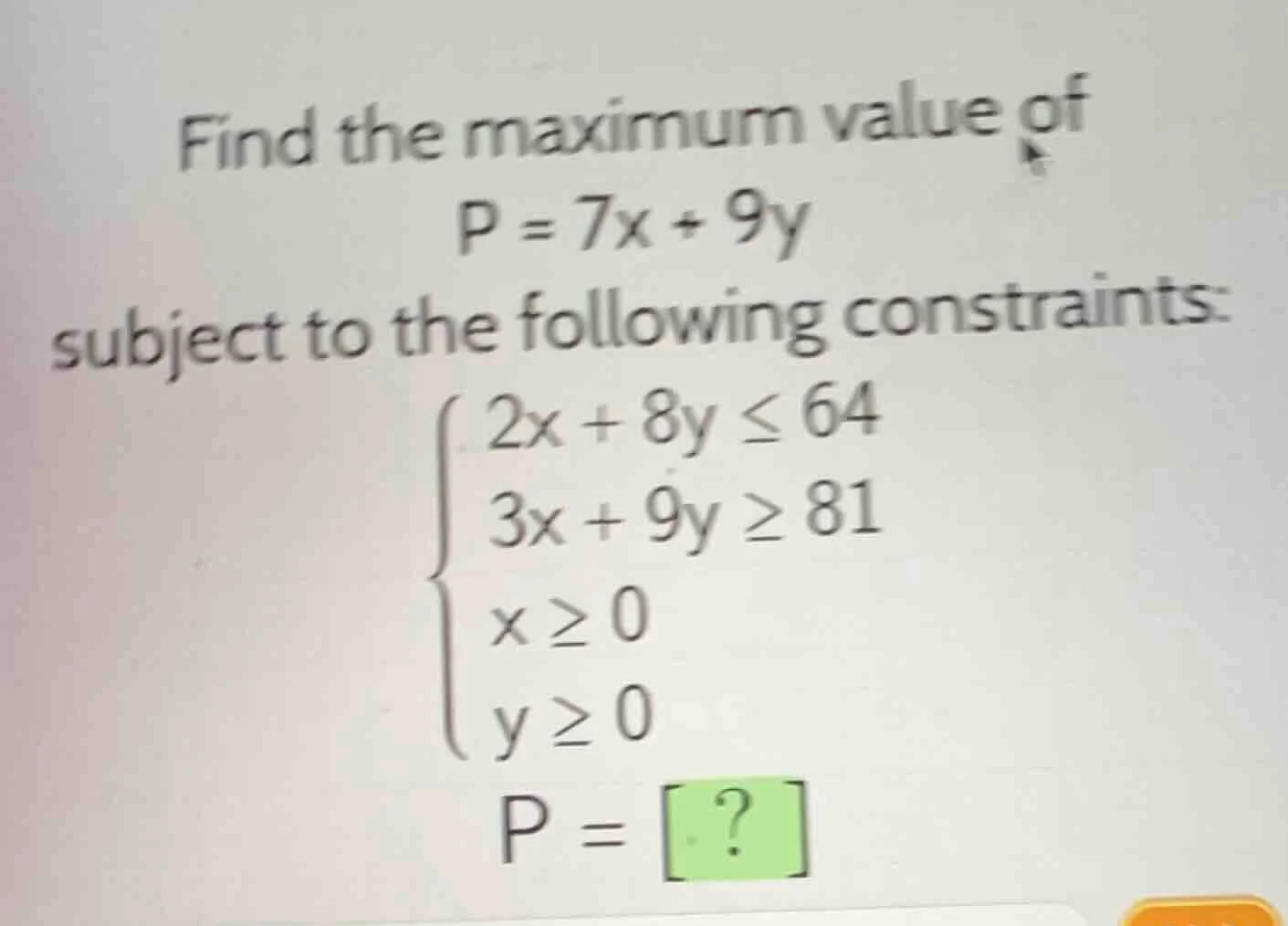
find the maximum value of
p = 7x + 9y
subject to the following constraints:
\
p = \boxed{?}
Step1: Simplify the constraints
First, simplify the inequality \(2x + 8y \leq 64\) by dividing both sides by 2: \(x + 4y \leq 32\), so \(x \leq 32 - 4y\).
Simplify \(3x + 9y \geq 81\) by dividing both sides by 3: \(x + 3y \geq 27\), so \(x \geq 27 - 3y\).
Also, we have \(x \geq 0\) and \(y \geq 0\).
Step2: Find the intersection of \(x + 4y = 32\) and \(x + 3y = 27\)
Subtract the second equation from the first:
\((x + 4y) - (x + 3y) = 32 - 27\)
\(y = 5\)
Substitute \(y = 5\) into \(x + 3y = 27\):
\(x + 3(5) = 27\)
\(x + 15 = 27\)
\(x = 12\)
So the intersection point is \((12, 5)\).
Step3: Analyze the feasible region boundaries
- For \(x + 4y = 32\) with \(y = 0\): \(x = 32\), so the point is \((32, 0)\).
- For \(x + 3y = 27\) with \(y = 0\): \(x = 27\), so the point is \((27, 0)\). But check if \((27, 0)\) satisfies \(x + 4y \leq 32\): \(27 + 0 = 27 \leq 32\), yes.
- For \(x = 0\) in \(x + 3y \geq 27\): \(3y \geq 27 \implies y \geq 9\). Check if \(y = 9\) satisfies \(x + 4y \leq 32\): \(0 + 36 = 36
ot\leq 32\), so no feasible point here.
- For \(y = 0\) in \(x + 4y \leq 32\): \(x \leq 32\), and \(x \geq 27\) (from \(x + 3y \geq 27\) with \(y = 0\)), so \(x\) ranges from 27 to 32 when \(y = 0\).
- The intersection point we found earlier is \((12, 5)\). Let's check if it's feasible: \(x = 12 \geq 0\), \(y = 5 \geq 0\), \(2(12) + 8(5) = 24 + 40 = 64 \leq 64\), \(3(12) + 9(5) = 36 + 45 = 81 \geq 81\), so it's feasible.
Now, evaluate \(P = 7x + 9y\) at the candidate points:
- At \((27, 0)\): \(P = 7(27) + 9(0) = 189 + 0 = 189\)
- At \((32, 0)\): \(P = 7(32) + 9(0) = 224 + 0 = 224\)
- At \((12, 5)\): \(P = 7(12) + 9(5) = 84 + 45 = 129\)
Wait, but we missed checking the boundary of \(x + 4y = 32\) with \(x \geq 27 - 3y\). Wait, maybe another approach: since \(x \geq 27 - 3y\) and \(x \leq 32 - 4y\), then \(27 - 3y \leq 32 - 4y\), which simplifies to \(y \leq 5\). And since \(y \geq 0\), let's check the maximum \(y\) is 5 (from the intersection). But when \(y = 5\), \(x = 12\). When \(y = 0\), \(x\) is between 27 and 32. Wait, but when \(y = 0\), \(x\) can be up to 32 (from \(x + 4y \leq 32\)) and at least 27 (from \(x + 3y \geq 27\)). So the feasible region has vertices at \((27, 0)\), \((32, 0)\), and \((12, 5)\) (since the other boundary \(x = 0\) or \(y = 0\) beyond that is not feasible). Wait, but when \(y\) increases from 0 to 5, \(x\) decreases from 27 - 0 = 27 to 27 - 15 = 12 (wait, no: \(x \geq 27 - 3y\), so when \(y = 0\), \(x \geq 27\); when \(y = 5\), \(x \geq 27 - 15 = 12\). And \(x \leq 32 - 4y\), so when \(y = 0\), \(x \leq 32\); when \(y = 5\), \(x \leq 32 - 20 = 12\). So at \(y = 5\), \(x\) must be 12 (since \(x \geq 12\) and \(x \leq 12\)). So the feasible region is a polygon with vertices at \((27, 0)\), \((32, 0)\), and \((12, 5)\)? Wait, no, let's check if \((32, 0)\) satisfies \(x + 3y \geq 27\): \(32 + 0 = 32 \geq 27\), yes. So \((32, 0)\) is feasible. \((27, 0)\) is feasible. \((12, 5)\) is feasible. Are there other vertices? Let's check \(x = 0\): \(0 + 3y \geq 27 \implies y \geq 9\), but \(0 + 4y \leq 32 \implies y \leq 8\), so no solution. \(y = 0\) gives the two points. The intersection of \(x + 4y = 32\) and \(x + 3y = 27\) is \((12, 5)\). So the feasible region is a triangle with vertices \((27, 0)\), \((32, 0)\), and \((12, 5)\).
Now, evaluate \(P\) at each vertex:
- \((27, 0)\): \(P = 7(27) + 9(0) = 189\)
- \((32, 0)\): \(P = 7(32) + 9(0) = 224\)
- \((12, 5)\): \(P = 7(12) + 9(5) = 84 + 45 = 129\)
Wait, but is \((32, 0)\) satisfying \(3x + 9y \geq 81\)? Let's check: \(3(32) + 9(0) = 96 \geq…

Snap & solve any problem in the app
Get step-by-step solutions on Sovi AI
Photo-based solutions with guided steps
Explore more problems and detailed explanations
Step1: Simplify the constraints
First, simplify the inequality \(2x + 8y \leq 64\) by dividing both sides by 2: \(x + 4y \leq 32\), so \(x \leq 32 - 4y\).
Simplify \(3x + 9y \geq 81\) by dividing both sides by 3: \(x + 3y \geq 27\), so \(x \geq 27 - 3y\).
Also, we have \(x \geq 0\) and \(y \geq 0\).
Step2: Find the intersection of \(x + 4y = 32\) and \(x + 3y = 27\)
Subtract the second equation from the first:
\((x + 4y) - (x + 3y) = 32 - 27\)
\(y = 5\)
Substitute \(y = 5\) into \(x + 3y = 27\):
\(x + 3(5) = 27\)
\(x + 15 = 27\)
\(x = 12\)
So the intersection point is \((12, 5)\).
Step3: Analyze the feasible region boundaries
- For \(x + 4y = 32\) with \(y = 0\): \(x = 32\), so the point is \((32, 0)\).
- For \(x + 3y = 27\) with \(y = 0\): \(x = 27\), so the point is \((27, 0)\). But check if \((27, 0)\) satisfies \(x + 4y \leq 32\): \(27 + 0 = 27 \leq 32\), yes.
- For \(x = 0\) in \(x + 3y \geq 27\): \(3y \geq 27 \implies y \geq 9\). Check if \(y = 9\) satisfies \(x + 4y \leq 32\): \(0 + 36 = 36
ot\leq 32\), so no feasible point here.
- For \(y = 0\) in \(x + 4y \leq 32\): \(x \leq 32\), and \(x \geq 27\) (from \(x + 3y \geq 27\) with \(y = 0\)), so \(x\) ranges from 27 to 32 when \(y = 0\).
- The intersection point we found earlier is \((12, 5)\). Let's check if it's feasible: \(x = 12 \geq 0\), \(y = 5 \geq 0\), \(2(12) + 8(5) = 24 + 40 = 64 \leq 64\), \(3(12) + 9(5) = 36 + 45 = 81 \geq 81\), so it's feasible.
Now, evaluate \(P = 7x + 9y\) at the candidate points:
- At \((27, 0)\): \(P = 7(27) + 9(0) = 189 + 0 = 189\)
- At \((32, 0)\): \(P = 7(32) + 9(0) = 224 + 0 = 224\)
- At \((12, 5)\): \(P = 7(12) + 9(5) = 84 + 45 = 129\)
Wait, but we missed checking the boundary of \(x + 4y = 32\) with \(x \geq 27 - 3y\). Wait, maybe another approach: since \(x \geq 27 - 3y\) and \(x \leq 32 - 4y\), then \(27 - 3y \leq 32 - 4y\), which simplifies to \(y \leq 5\). And since \(y \geq 0\), let's check the maximum \(y\) is 5 (from the intersection). But when \(y = 5\), \(x = 12\). When \(y = 0\), \(x\) is between 27 and 32. Wait, but when \(y = 0\), \(x\) can be up to 32 (from \(x + 4y \leq 32\)) and at least 27 (from \(x + 3y \geq 27\)). So the feasible region has vertices at \((27, 0)\), \((32, 0)\), and \((12, 5)\) (since the other boundary \(x = 0\) or \(y = 0\) beyond that is not feasible). Wait, but when \(y\) increases from 0 to 5, \(x\) decreases from 27 - 0 = 27 to 27 - 15 = 12 (wait, no: \(x \geq 27 - 3y\), so when \(y = 0\), \(x \geq 27\); when \(y = 5\), \(x \geq 27 - 15 = 12\). And \(x \leq 32 - 4y\), so when \(y = 0\), \(x \leq 32\); when \(y = 5\), \(x \leq 32 - 20 = 12\). So at \(y = 5\), \(x\) must be 12 (since \(x \geq 12\) and \(x \leq 12\)). So the feasible region is a polygon with vertices at \((27, 0)\), \((32, 0)\), and \((12, 5)\)? Wait, no, let's check if \((32, 0)\) satisfies \(x + 3y \geq 27\): \(32 + 0 = 32 \geq 27\), yes. So \((32, 0)\) is feasible. \((27, 0)\) is feasible. \((12, 5)\) is feasible. Are there other vertices? Let's check \(x = 0\): \(0 + 3y \geq 27 \implies y \geq 9\), but \(0 + 4y \leq 32 \implies y \leq 8\), so no solution. \(y = 0\) gives the two points. The intersection of \(x + 4y = 32\) and \(x + 3y = 27\) is \((12, 5)\). So the feasible region is a triangle with vertices \((27, 0)\), \((32, 0)\), and \((12, 5)\).
Now, evaluate \(P\) at each vertex:
- \((27, 0)\): \(P = 7(27) + 9(0) = 189\)
- \((32, 0)\): \(P = 7(32) + 9(0) = 224\)
- \((12, 5)\): \(P = 7(12) + 9(5) = 84 + 45 = 129\)
Wait, but is \((32, 0)\) satisfying \(3x + 9y \geq 81\)? Let's check: \(3(32) + 9(0) = 96 \geq 81\), yes. So that's valid.
But wait, maybe I made a mistake in the feasible region. Let's re-examine the constraints:
- \(2x + 8y \leq 64\) (or \(x + 4y \leq 32\))
- \(3x + 9y \geq 81\) (or \(x + 3y \geq 27\))
- \(x \geq 0\)
- \(y \geq 0\)
To find the feasible region, we can graph these inequalities:
- \(x + 4y \leq 32\): Below the line \(x + 4y = 32\) (intercepts: (32, 0) and (0, 8))
- \(x + 3y \geq 27\): Above the line \(x + 3y = 27\) (intercepts: (27, 0) and (0, 9))
- \(x \geq 0\), \(y \geq 0\): First quadrant
The intersection of \(x + 4y \leq 32\) and \(x + 3y \geq 27\) in the first quadrant:
The line \(x + 4y = 32\) and \(x + 3y = 27\) intersect at (12, 5) as found earlier.
Now, the feasible region is bounded by:
- From \(x + 3y = 27\) (above) and \(x + 4y = 32\) (below), and \(x \geq 0\), \(y \geq 0\).
But when \(y = 0\), \(x\) is between 27 (from \(x + 3y \geq 27\)) and 32 (from \(x + 4y \leq 32\)). So the feasible region has three vertices:
- Intersection of \(x + 3y = 27\) and \(y = 0\): (27, 0)
- Intersection of \(x + 4y = 32\) and \(y = 0\): (32, 0)
- Intersection of \(x + 4y = 32\) and \(x + 3y = 27\): (12, 5)
Now, evaluate \(P = 7x + 9y\) at each vertex:
- (27, 0): \(7(27) + 9(0) = 189\)
- (32, 0): \(7(32) + 9(0) = 224\)
- (12, 5): \(7(12) + 9(5) = 84 + 45 = 129\)
Wait, but (32, 0) is in the feasible region because it satisfies all constraints: \(2(32) + 8(0) = 64 \leq 64\), \(3(32) + 9(0) = 96 \geq 81\), \(x \geq 0\), \(y \geq 0\). So why is the value at (32, 0) higher? But let's check if there's a mistake in the constraint simplification. Wait, the original constraint is \(2x + 8y \leq 64\), which is correct as \(x + 4y \leq 32\). And \(3x + 9y \geq 81\) is \(x + 3y \geq 27\), correct.
Wait, but maybe the feasible region is not including (32, 0)? Wait, no—when \(y = 0\), \(x\) can be from 27 to 32, so (32, 0) is included. But let's check the direction of the objective function \(P = 7x + 9y\). The coefficients of \(x\) and \(y\) are positive, so to maximize \(P\), we want to maximize \(x\) and \(y\). But since \(y\) has a higher coefficient (9 vs 7), we might think to maximize \(y\), but in this case, when \(y\) increases, \(x\) decreases (from \(x \leq 32 - 4y\) and \(x \geq 27 - 3y\)). Let's check the slope of the objective function: the slope of \(P = 7x + 9y\) is \(-\frac{7}{9} \approx -0.777\). The slope of \(x + 4y = 32\) is \(-\frac{1}{4} = -0.25\), and the slope of \(x + 3y = 27\) is \(-\frac{1}{3} \approx -0.333\). Wait, the objective function has a steeper negative slope than both constraint lines? Wait, no: \(-\frac{7}{9} \approx -0.777\) is steeper (more negative) than \(-\frac{1}{3} \approx -0.333\) and \(-\frac{1}{4} = -0.25\). So the maximum of \(P\) should occur at the vertex where \(x\) is as large as possible, because the objective function is increasing in \(x\) and \(y\), but the constraint \(x + 4y \leq 32\) limits how much \(x\) and \(y\) can be. Wait, but when \(y = 0\), \(x\) can be 32, which is larger than the \(x\) when \(y = 5\) (which is 12). So (32, 0) gives a higher \(P\) than (12, 5). But let's confirm with the constraints:
At (32, 0):
- \(2(32) + 8(0) = 64 \leq 64\): satisfies.
- \(3(32) + 9(0) = 96 \geq 81\): satisfies.
- \(x \geq 0\), \(y \geq 0\): satisfies.
So that's valid. But wait, is there a mistake here? Let's check the other vertex (27, 0): \(P = 189\), (32, 0): \(P = 224\), (12, 5): \(P = 129\). So the maximum should be 224? But that seems too easy. Wait, maybe I made a mistake in the feasible region. Wait, the constraint \(3x + 9y \geq 81\) is a lower bound, so the feasible region is above \(x + 3y = 27\) and below \(x + 4y = 32\), and in the first quadrant. So when \(y = 0\), the feasible \(x\) is from 27 to 32, so (32, 0) is the rightmost point, which would maximize \(x\), and since \(y = 0\), but \(x\) is large, the \(P\) is higher.
Wait, but let's check with another point: suppose \(x = 32\), \(y = 0\): \(P = 7*32 + 9*0 = 224\). If we take \(x = 27\), \(y = 0\): \(P = 189\). If we take \(x = 12\), \(y = 5\): \(P = 129\). So indeed, (32, 0) gives the highest \(P\). But wait, is there a mistake in the intersection? Wait, no—when \(y = 0\), \(x\) can be up to 32 (from the first constraint) and at least 27 (from the second constraint), so that's correct.
Wait, but maybe the problem is that the feasible region is actually empty? No, because (32, 0) satisfies all constraints. So the maximum value of \(P\) is 224.
Wait, but let's re-express the constraints:
- \(2x + 8y \leq 64\)
- \(3x + 9y \geq 81\)
- \(x \geq 0\)
- \(y \geq 0\)
Let’s solve the first two equations as equalities to find the intersection:
\(2x + 8y = 64\)
\(3x + 9y = 81\)
Multiply the first equation by 3: \(6x + 24y = 192\)
Multiply the second equation by 2: \(6x + 18y = 162\)
Subtract the second from the first: \(6y = 30 \implies y = 5\), then \(x = (64 - 8*5)/2 = (64 - 40)/2 = 24/2 = 12\). So the intersection is (12, 5), as before.
Now, the feasible region is the set of points that satisfy:
- Below \(2x + 8y = 64\)
- Above \(3x + 9y = 81\)
- In the first quadrant
To find the vertices, we check the intersections of the boundary lines with the axes and with each other:
- Intersection of \(3x + 9y = 81\) and \(x = 0\): \(y = 9\), but check if (0, 9) satisfies