QUESTION IMAGE
Question
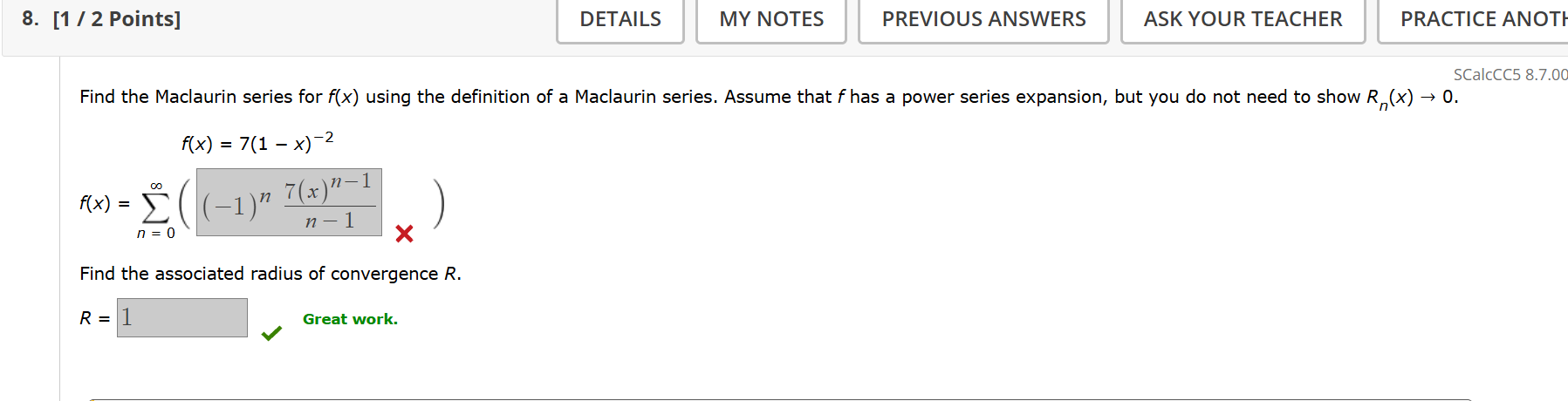
find the maclaurin series for \\(f(x)\\) using the definition of a maclaurin series. assume that \\(f\\) has a power series expansion, but you do not need to show \\(r_n(x) \to 0\\).
\\f(x) = 7(1 - x)^{-2}\\
\\f(x) = \sum_{n = 0}^{\infty} \left( \dots \
ight)\\
find the associated radius of convergence \\(r\\).
\
= 1\\
⚡ Using what you learned: Taylor and Maclaurin Series
Step 1: Find derivatives of \( f(x) \)
$$ f(x) = 7(1 - x)^{-2} $$
$$ f'(x) = 7 \cdot (-2)(1 - x)^{-3} \cdot (-1) = 7 \cdot 2(1 - x)^{-3} $$
$$ f''(x) = 7 \cdot 2 \cdot 3(1 - x)^{-4} $$
$$ f^{(n)}(x) = 7 \cdot (n+1)!(1 - x)^{-(n+2)} $$
Step 2: Evaluate derivatives at \( x = 0 \)
$$ f(0) = 7 $$
$$ f'(0) = 7 \cdot 2 $$
$$ f''(0) = 7 \cdot 6 $$
$$ f^{(n)}(0) = 7(n+1)! $$
Step 3: Write the Maclaurin series
$$ f(x) = \sum_{n=0}^{\infty} \frac{f^{(n)}(0)}{n!} x^n $$
$$ f(x) = \sum_{n=0}^{\infty} \frac{7(n+1)!}{n!} x^n $$
$$ f(x) = \sum_{n=0}^{\infty} 7(n+1)x^n $$

Snap & solve any problem in the app
Get step-by-step solutions on Sovi AI
Photo-based solutions with guided steps
Explore more problems and detailed explanations
$$ 7(n+1)x^n $$