QUESTION IMAGE
Question
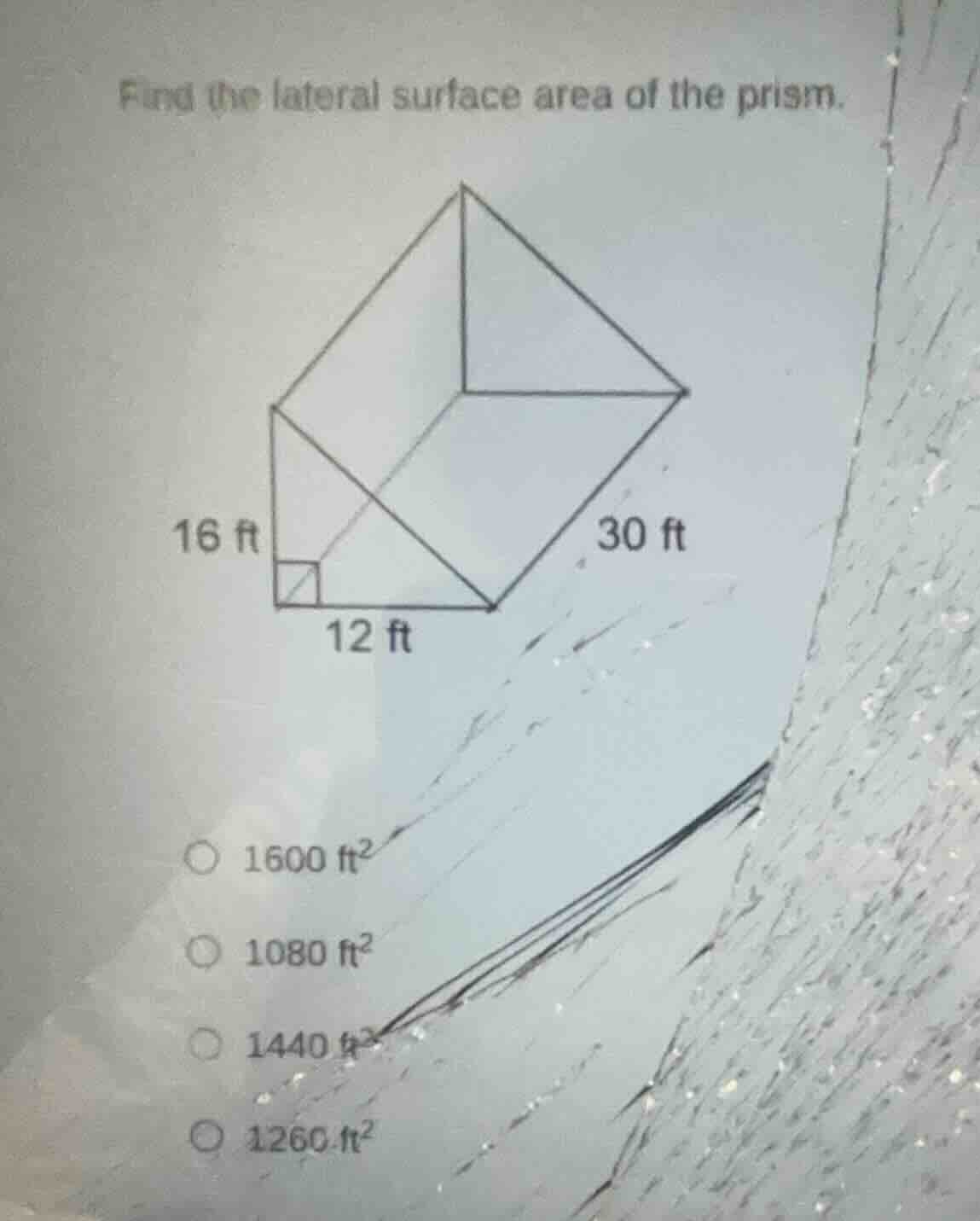
find the lateral surface area of the prism.
- 1600 \text{ ft}^2
- 1080 \text{ ft}^2
- 1440 \text{ ft}^2
- 1260 \text{ ft}^2
⚡ Using what you learned: surface area of prisms
Step 1: Find the missing side of the triangular base
The base of the prism is a right triangle with legs of \( 16\text{ ft} \) and \( 12\text{ ft} \). Use the Pythagorean theorem to find the hypotenuse \( c \):
$$
c = \sqrt{16^2 + 12^2} = \sqrt{256 + 144} = \sqrt{400} = 20\text{ ft}
$$
Step 2: Calculate the perimeter of the base
The perimeter \( P \) of the triangular base is the sum of its three sides:
$$
P = 16 + 12 + 20 = 48\text{ ft}
$$
Step 3: Calculate the lateral surface area
The lateral surface area \( L \) of a prism is the perimeter of the base multiplied by the height (length) of the prism \( h = 30\text{ ft} \):
$$
L = P \cdot h = 48 \cdot 30 = 1440\text{ ft}^2
$$

Snap & solve any problem in the app
Get step-by-step solutions on Sovi AI
Photo-based solutions with guided steps
Explore more problems and detailed explanations
\( 1440\text{ ft}^2 \)