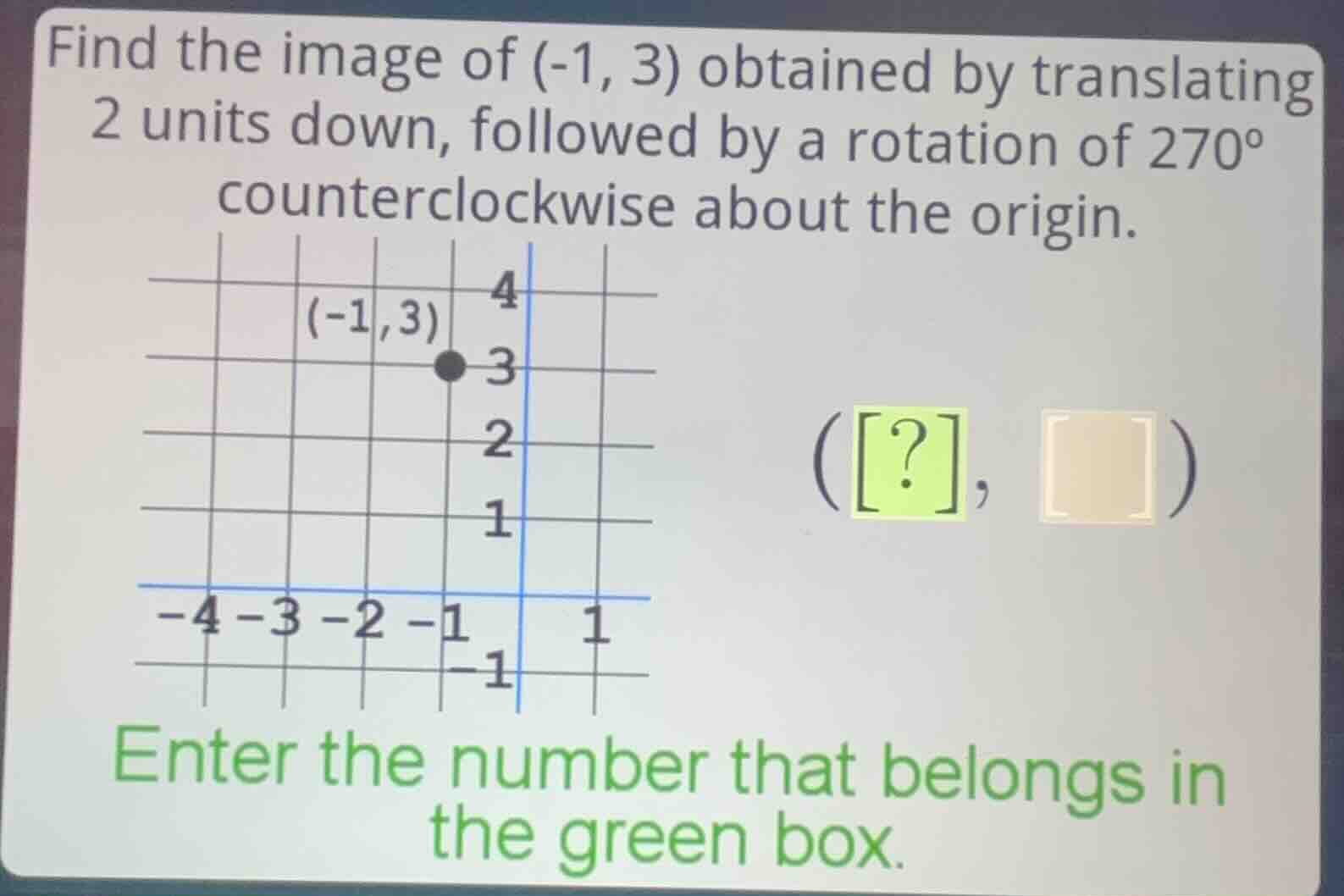
QUESTION IMAGE
Question
find the image of (-1, 3) obtained by translating 2 units down, followed by a rotation of 270° counterclockwise about the origin. (?, ) enter the number that belongs in the green box.
Step1: Translate the point 2 units down
To translate a point \((x, y)\) \(k\) units down, we subtract \(k\) from the \(y\)-coordinate. For the point \((-1, 3)\) and \(k = 2\), the new coordinates are \((-1, 3 - 2)=(-1, 1)\).
Step2: Rotate the translated point \(270^\circ\) counterclockwise about the origin
The rule for rotating a point \((x, y)\) \(270^\circ\) counterclockwise about the origin is \((x, y)\to(y, -x)\). Applying this rule to the point \((-1, 1)\), we get \((1, -(-1))=(1, 1)\)? Wait, no, wait. Wait, the rule for \(270^\circ\) counterclockwise rotation is \((x,y)\) becomes \((y, -x)\). Wait, let's recheck. The standard rotation rules:
- \(90^\circ\) counterclockwise: \((x,y)\to(-y,x)\)
- \(180^\circ\) counterclockwise: \((x,y)\to(-x,-y)\)
- \(270^\circ\) counterclockwise: \((x,y)\to(y, -x)\)
Wait, for the point \((-1, 1)\) (after translation), applying \(270^\circ\) counterclockwise rotation: \(x=-1\), \(y = 1\). So the new \(x\)-coordinate is \(y = 1\), new \(y\)-coordinate is \(-x=-(-1)=1\)? Wait, that can't be right. Wait, maybe I mixed up the rotation direction. Wait, \(270^\circ\) counterclockwise is the same as \(90^\circ\) clockwise. The rule for \(90^\circ\) clockwise rotation is \((x,y)\to(y, -x)\). Wait, let's take an example. Let's take a point \((1,0)\). Rotating \(270^\circ\) counterclockwise: the angle from positive x-axis is \(0^\circ\), adding \(270^\circ\) counterclockwise gives \(270^\circ\), so the point is \((0, -1)\). Using the rule \((x,y)\to(y, -x)\): \((1,0)\to(0, -1)\), which is correct. Another example: \((0,1)\) rotated \(270^\circ\) counterclockwise: angle is \(90^\circ\), adding \(270^\circ\) gives \(360^\circ\), so point is \((1,0)\). Using the rule: \((0,1)\to(1, -0)=(1,0)\), correct. So the rule is correct.
Wait, but our translated point is \((-1, 1)\). So applying the rule \((x,y)\to(y, -x)\): \(x=-1\), \(y = 1\), so new point is \((1, -(-1))=(1, 1)\)? Wait, no, wait: \(-x\) when \(x=-1\) is \(-(-1)=1\), so yes, \((1, 1)\)? Wait, but that seems off. Wait, maybe I made a mistake in the translation. Wait, the original point is \((-1, 3)\). Translating 2 units down: \(y\)-coordinate becomes \(3 - 2 = 1\), so the point is \((-1, 1)\). Then rotating \(270^\circ\) counterclockwise: the rule is \((x,y)\to(y, -x)\). So \(x=-1\), \(y = 1\), so new \(x\) is \(y = 1\), new \(y\) is \(-x = -(-1)=1\). So the image is \((1, 1)\). Wait, but the green box is for the \(x\)-coordinate? Wait, the question says "Enter the number that belongs in the green box" which is the \(x\)-coordinate of the final point. Wait, but let's re-examine the rotation rule. Wait, maybe I confused \(270^\circ\) counterclockwise with clockwise. Let's check the rotation matrix. The rotation matrix for \(\theta\) counterclockwise is \(
\). For \(\theta = 270^\circ\), \(\cos270^\circ = 0\), \(\sin270^\circ=-1\). So the matrix is \(
\) (wait, no: \(\cos270 = 0\), \(-\sin270 = -(-1)=1\); \(\sin270=-1\), \(\cos270 = 0\). So the matrix is \(
\). So applying to vector \(
\), we get \(
\), which matches the earlier rule. So for \((-1, 1)\), the rotation gives \(
=
\). So the \(x\)-coordinate is 1. Wait, but let's check again. Wait, original point \((-1,3)\). Translate 2 down: \((-1, 3 - 2)=(-1,1)\). Rotate \(270^\circ\) counterclockwise: using the rule \((x,y)\to…
Snap & solve any problem in the app
Get step-by-step solutions on Sovi AI
Photo-based solutions with guided steps
Explore more problems and detailed explanations
1