QUESTION IMAGE
Question
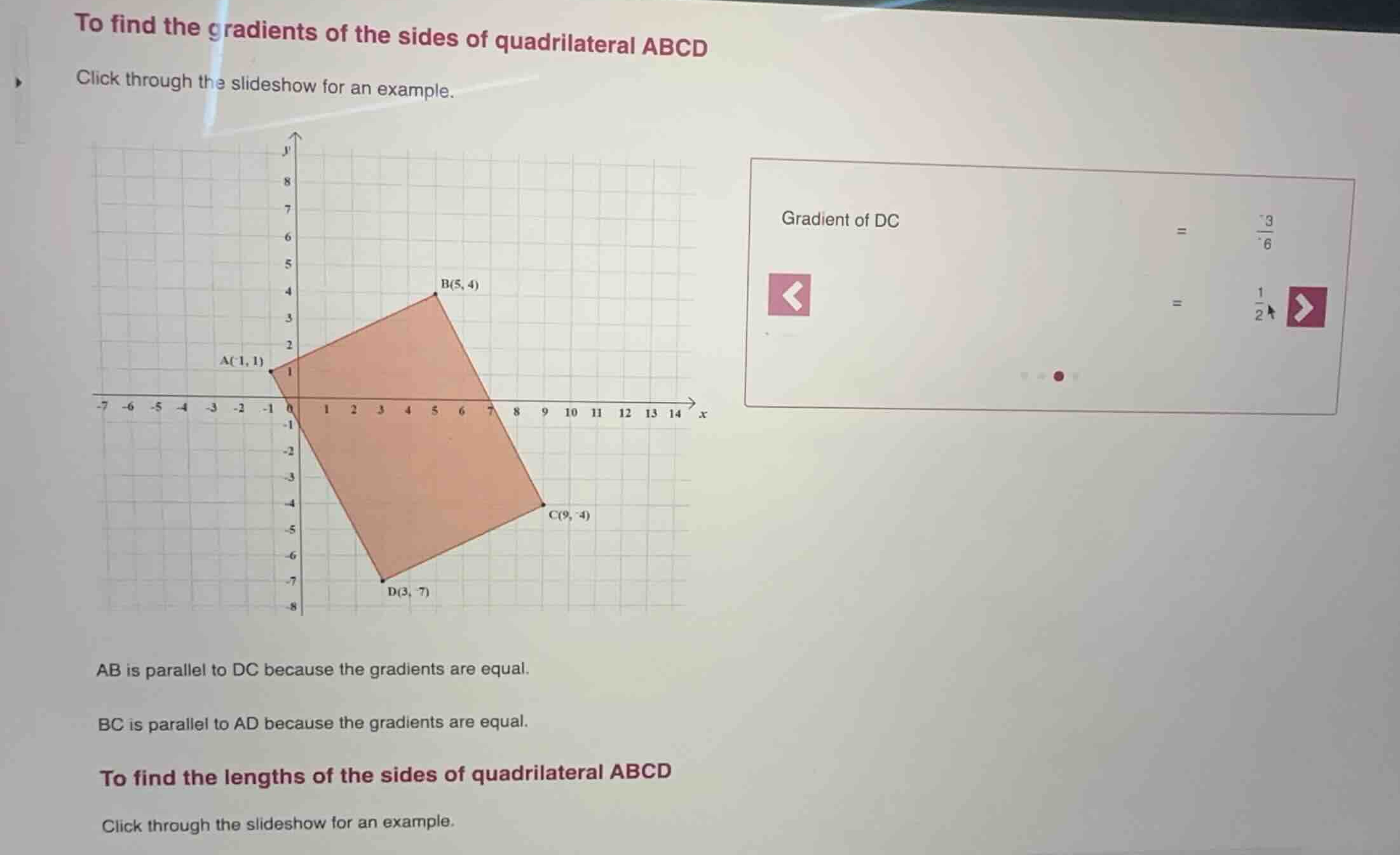
to find the gradients of the sides of quadrilateral abcd
click through the slideshow for an example.
gradient of dc = \frac{-3}{-6} = \frac{1}{2}
ab is parallel to dc because the gradients are equal.
bc is parallel to ad because the gradients are equal.
to find the lengths of the sides of quadrilateral abcd
click through the slideshow for an example.
Identify coordinates
Using the Coordinate Geometry knowledge point, we identify the vertices of the quadrilateral \(ABCD\) from the graph:
- \(A(-1, 1)\)
- \(B(5, 4)\)
- \(C(9, -4)\)
- \(D(3, -7)\)
Calculate gradient of AB
Using the Gradient of Line knowledge point, the formula is:
For side \(AB\) with \(A(-1, 1)\) and \(B(5, 4)\):
Calculate gradient of BC
For side \(BC\) with \(B(5, 4)\) and \(C(9, -4)\):
Calculate gradient of CD
For side \(CD\) with \(C(9, -4)\) and \(D(3, -7)\):
Calculate gradient of DA
For side \(DA\) with \(D(3, -7)\) and \(A(-1, 1)\):

Snap & solve any problem in the app
Get step-by-step solutions on Sovi AI
Photo-based solutions with guided steps
Explore more problems and detailed explanations
The gradients of the sides of quadrilateral \(ABCD\) are:
- Gradient of \(AB = \frac{1}{2}\)
- Gradient of \(BC = -2\)
- Gradient of \(CD = \frac{1}{2}\)
- Gradient of \(DA = -2\)