Sovi.AI - AI Math Tutor

Scan to solve math questions

QUESTION IMAGE

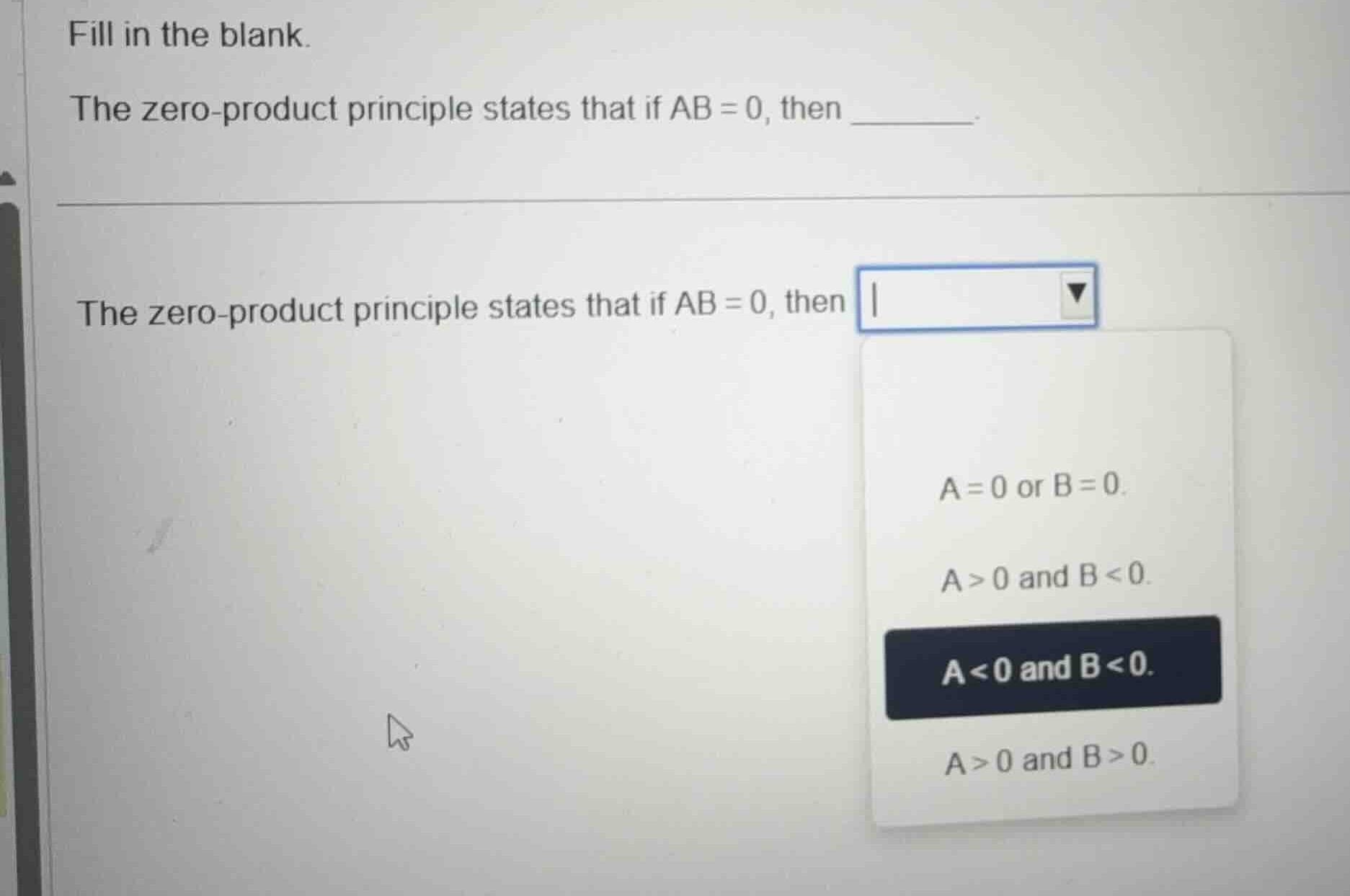
fill in the blank. the zero-product principle states that if \\(ab = 0\…

Question

fill in the blank.

the zero-product principle states that if \\(ab = 0\\), then ______.

the zero-product principle states that if \\(ab = 0\\), then

options:
\\(a = 0\\) or \\(b = 0\\).
\\(a > 0\\) and \\(b < 0\\).
\\(a < 0\\) and \\(b < 0\\).
\\(a > 0\\) and \\(b > 0\\).

Explanation:

Response

<pre_analysis>
{
"quality": "clear",
"question_count": 1,
"skills_matched": [
"direct_cot",
"multiple_choice_formatter",
"explain_then_answer",
"tutor",
"mastery_adaptive_brevity"
],
"needs_drawing": false,
"concepts_used": [
"Quadratic Equations"
],
"new_concepts": [
"Zero-Product Principle"
],
"current_concepts": [
"Quadratic Equations",
"Zero-Product Principle"
]
}
</pre_analysis>

<reasoning>

Define the zero-product principle

Using the Quadratic Equations knowledge point, we recall the algebraic properties used to solve factored equations. The zero-product principle states that if the product of two real numbers (or algebraic expressions) is zero, then at least one of the factors must be zero.

Analyze the given options

We evaluate the mathematical statement: if \(AB = 0\), then:

  • \(A = 0\) or \(B = 0\) (This matches the definition).
  • \(A > 0\) and \(B < 0\) (Incorrect, as their product would be negative, not zero).
  • \(A < 0\) and \(B < 0\) (Incorrect, as their product would be positive, not zero).
  • \(A > 0\) and \(B > 0\) (Incorrect, as their product would be positive, not zero).

</reasoning>

<answer>
<mcq-correct>(A) A = 0 or B = 0.</mcq-correct>
<mcq-option>(B) A > 0 and B < 0.</mcq-option>
<mcq-option>(C) A < 0 and B < 0.</mcq-option>
<mcq-option>(D) A > 0 and B > 0.</mcq-option>
</answer>

<post_analysis>
{
"subject": "Mathematics",
"question_type": "Multiple Choice",
"knowledge_point": [
"Mathematics",
"Algebra",
"Quadratic Equations"
]
}
</post_analysis>

Answer:

<pre_analysis>
{
"quality": "clear",
"question_count": 1,
"skills_matched": [
"direct_cot",
"multiple_choice_formatter",
"explain_then_answer",
"tutor",
"mastery_adaptive_brevity"
],
"needs_drawing": false,
"concepts_used": [
"Quadratic Equations"
],
"new_concepts": [
"Zero-Product Principle"
],
"current_concepts": [
"Quadratic Equations",
"Zero-Product Principle"
]
}
</pre_analysis>

<reasoning>

Define the zero-product principle

Using the Quadratic Equations knowledge point, we recall the algebraic properties used to solve factored equations. The zero-product principle states that if the product of two real numbers (or algebraic expressions) is zero, then at least one of the factors must be zero.

Analyze the given options

We evaluate the mathematical statement: if \(AB = 0\), then:

  • \(A = 0\) or \(B = 0\) (This matches the definition).
  • \(A > 0\) and \(B < 0\) (Incorrect, as their product would be negative, not zero).
  • \(A < 0\) and \(B < 0\) (Incorrect, as their product would be positive, not zero).
  • \(A > 0\) and \(B > 0\) (Incorrect, as their product would be positive, not zero).

</reasoning>

<answer>
<mcq-correct>(A) A = 0 or B = 0.</mcq-correct>
<mcq-option>(B) A > 0 and B < 0.</mcq-option>
<mcq-option>(C) A < 0 and B < 0.</mcq-option>
<mcq-option>(D) A > 0 and B > 0.</mcq-option>
</answer>

<post_analysis>
{
"subject": "Mathematics",
"question_type": "Multiple Choice",
"knowledge_point": [
"Mathematics",
"Algebra",
"Quadratic Equations"
]
}
</post_analysis>