QUESTION IMAGE
Question
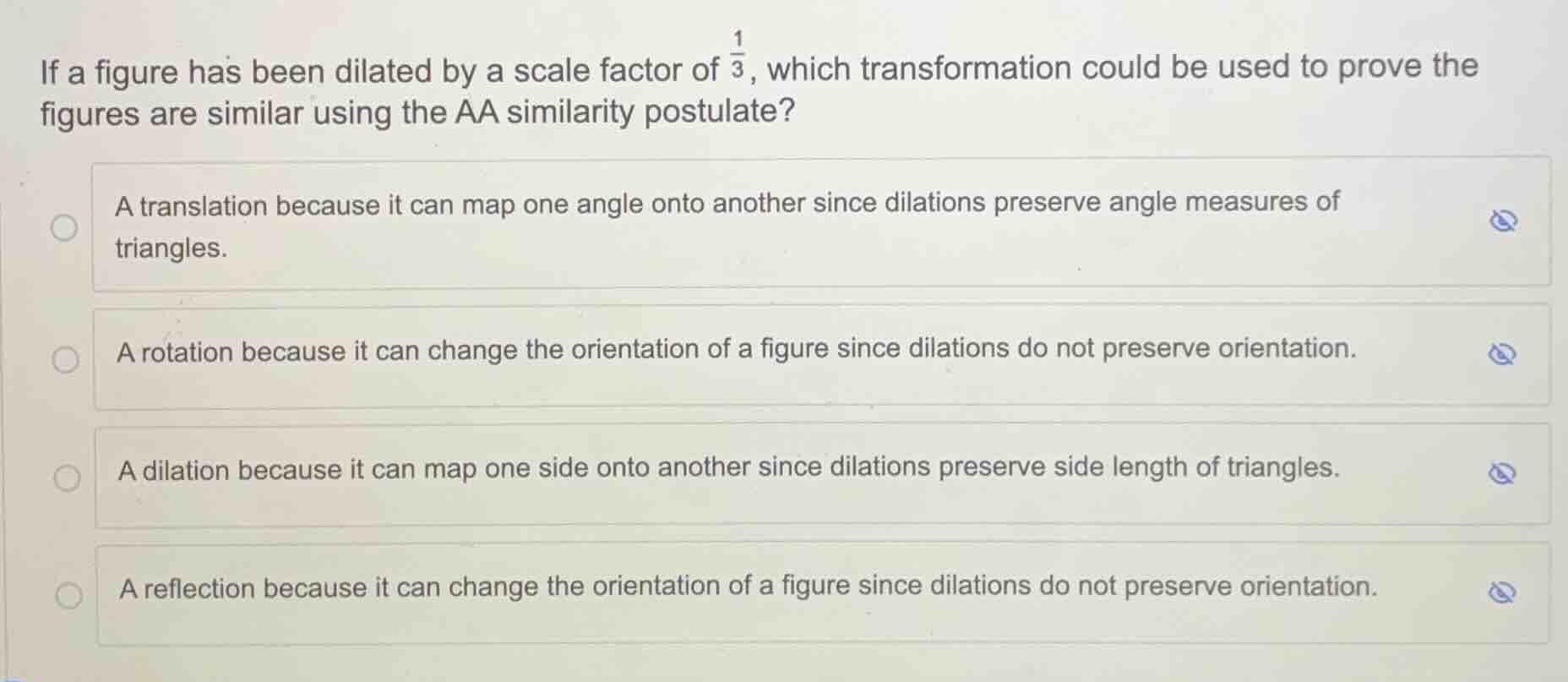
if a figure has been dilated by a scale factor of \\(\frac{1}{3}\\), which transformation could be used to prove the figures are similar using the aa similarity postulate?
a translation because it can map one angle onto another since dilations preserve angle measures of triangles.
a rotation because it can change the orientation of a figure since dilations do not preserve orientation.
a dilation because it can map one side onto another since dilations preserve side length of triangles.
a reflection because it can change the orientation of a figure since dilations do not preserve orientation.
Analyze the AA similarity postulate
The AA (Angle-Angle) similarity postulate states that two triangles are similar if they have two corresponding angles that are congruent. To prove similarity using this postulate, we must show that the angles of the original figure map onto the corresponding angles of the dilated figure.
Evaluate properties of dilations
A dilation is a transformation that produces an image that is the same shape as the original, but is a different size. Crucially, dilations preserve angle measures. This means that the angles of the original triangle are congruent to the corresponding angles of the dilated triangle.
Determine the role of translation
Since dilations preserve angle measures, the corresponding angles are congruent. A translation (a rigid motion) can be used to slide one figure onto the other to directly map one congruent angle onto its corresponding angle, demonstrating their congruence visually and geometrically.
Evaluate the given options
- Option 1: Correct. A translation can map one angle onto another because dilations preserve angle measures.
- Option 2: Incorrect. Dilations do preserve orientation (unless the scale factor is negative, which is not the case here, and even then, rotation is not the primary tool for proving AA similarity).
- Option 3: Incorrect. Dilations do not preserve side lengths; they scale them.
- Option 4: Incorrect. Dilations preserve orientation, and reflection is not used to prove AA similarity here.

Snap & solve any problem in the app
Get step-by-step solutions on Sovi AI
Photo-based solutions with guided steps
Explore more problems and detailed explanations
- (A) A translation because it can map one angle onto another since dilations preserve angle measures of triangles. (Correct answer)
- (B) A rotation because it can change the orientation of a figure since dilations do not preserve orientation.
- (C) A dilation because it can map one side onto another since dilations preserve side length of triangles.
- (D) A reflection because it can change the orientation of a figure since dilations do not preserve orientation.