Sovi.AI - AI Math Tutor

Scan to solve math questions

QUESTION IMAGE

federal and state governments protect victims of identity theft by crea…

Question

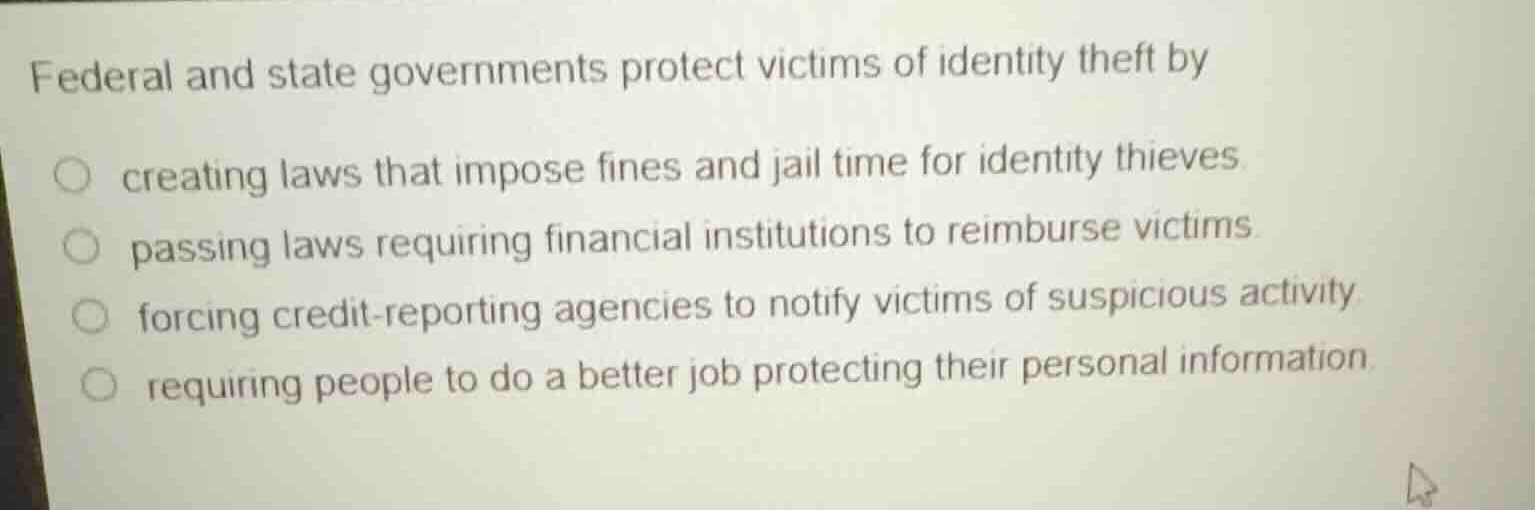
federal and state governments protect victims of identity theft by

creating laws that impose fines and jail time for identity thieves.
passing laws requiring financial institutions to reimburse victims.
forcing credit-reporting agencies to notify victims of suspicious activity.
requiring people to do a better job protecting their personal information.

Explanation:

Response

<pre_analysis>
{
"quality": "clear",
"question_count": 1,
"skills_matched": [
"direct_cot",
"multiple_choice_formatter",
"explain_then_answer",
"tutor"
],
"needs_drawing": false,
"concepts_used": [],
"new_concepts": [
"Identity Theft Protection",
"Consumer Protection Laws"
],
"current_concepts": [
"Identity Theft Protection",
"Consumer Protection Laws"
]
}
</pre_analysis>

<reasoning>

Analyze the question prompt

The question asks how federal and state governments protect victims of identity theft.

Evaluate the first option

Governments pass criminal laws (such as the federal Identity Theft and Assumption Deterrence Act) that make identity theft a federal crime, imposing strict fines and prison sentences on perpetrators to deter the crime and punish offenders.

Evaluate the second option

While some regulations limit consumer liability for unauthorized transactions (e.g., the Electronic Fund Transfer Act and Fair Credit Billing Act), there is no blanket law requiring financial institutions to fully reimburse all victims for all losses automatically.

Evaluate the third option

Credit-reporting agencies are required to place fraud alerts or freeze credit files upon a victim's request, but the law does not force these agencies to proactively monitor and notify victims of every suspicious activity automatically.

Evaluate the fourth option

Governments provide educational resources, but they cannot legally force or require individual citizens to do a better job protecting their personal information.
</reasoning>

<answer>
<mcq-correct>(A) creating laws that impose fines and jail time for identity thieves</mcq-correct>
<mcq-option>(B) passing laws requiring financial institutions to reimburse victims</mcq-option>
<mcq-option>(C) forcing credit-reporting agencies to notify victims of suspicious activity</mcq-option>
<mcq-option>(D) requiring people to do a better job protecting their personal information</mcq-option>
</answer>

<post_analysis>
{
"subject": "Social Science",
"question_type": "Multiple Choice",
"knowledge_point": [
"Social Science",
"Civics",
"Consumer Protection Laws"
]
}
</post_analysis>

Answer:

<pre_analysis>
{
"quality": "clear",
"question_count": 1,
"skills_matched": [
"direct_cot",
"multiple_choice_formatter",
"explain_then_answer",
"tutor"
],
"needs_drawing": false,
"concepts_used": [],
"new_concepts": [
"Identity Theft Protection",
"Consumer Protection Laws"
],
"current_concepts": [
"Identity Theft Protection",
"Consumer Protection Laws"
]
}
</pre_analysis>

<reasoning>

Analyze the question prompt

The question asks how federal and state governments protect victims of identity theft.

Evaluate the first option

Governments pass criminal laws (such as the federal Identity Theft and Assumption Deterrence Act) that make identity theft a federal crime, imposing strict fines and prison sentences on perpetrators to deter the crime and punish offenders.

Evaluate the second option

While some regulations limit consumer liability for unauthorized transactions (e.g., the Electronic Fund Transfer Act and Fair Credit Billing Act), there is no blanket law requiring financial institutions to fully reimburse all victims for all losses automatically.

Evaluate the third option

Credit-reporting agencies are required to place fraud alerts or freeze credit files upon a victim's request, but the law does not force these agencies to proactively monitor and notify victims of every suspicious activity automatically.

Evaluate the fourth option

Governments provide educational resources, but they cannot legally force or require individual citizens to do a better job protecting their personal information.
</reasoning>

<answer>
<mcq-correct>(A) creating laws that impose fines and jail time for identity thieves</mcq-correct>
<mcq-option>(B) passing laws requiring financial institutions to reimburse victims</mcq-option>
<mcq-option>(C) forcing credit-reporting agencies to notify victims of suspicious activity</mcq-option>
<mcq-option>(D) requiring people to do a better job protecting their personal information</mcq-option>
</answer>

<post_analysis>
{
"subject": "Social Science",
"question_type": "Multiple Choice",
"knowledge_point": [
"Social Science",
"Civics",
"Consumer Protection Laws"
]
}
</post_analysis>