QUESTION IMAGE
Question
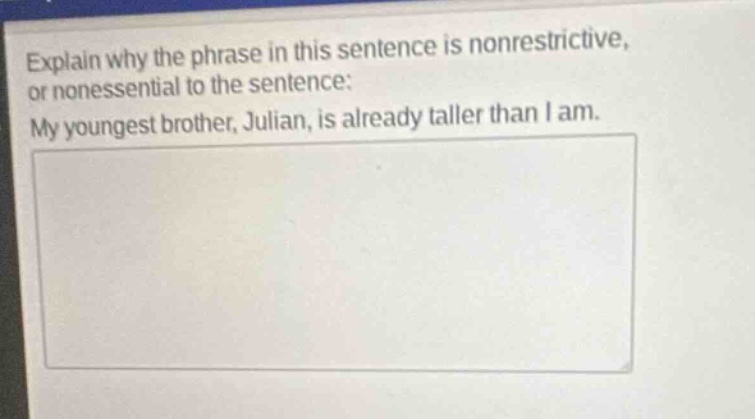
explain why the phrase in this sentence is nonrestrictive, or nonessential to the sentence:
my youngest brother, julian, is already taller than i am.
🆕 New Concept Discovered: Restrictive vs. Nonrestrictive Elements
Extra information set off by commas
Step 1: Identify the phrase and its grammatical role
The phrase in question is "Julian," which is set off by commas in the sentence:
"My youngest brother, Julian, is already taller than I am."
This phrase is an appositive, which is a noun or noun phrase that renames another noun right next to it (in this case, renaming "My youngest brother").
Step 2: Analyze the uniqueness of the subject
A phrase is nonrestrictive (nonessential) if the noun it describes is already fully identified and unique.
The subject is "My youngest brother." A person can only have one "youngest" brother. Because the description "my youngest brother" already identifies exactly one specific person, adding his name ("Julian") does not restrict, limit, or change who we are talking about.
Step 3: Test by removing the phrase
If we remove the nonessential phrase from the sentence, the core meaning and the identity of the subject remain perfectly clear:
"My youngest brother is already taller than I am."
Since the sentence still makes complete sense and we still know exactly which brother is being referred to, the name "Julian" is nonrestrictive and is correctly set off by commas.

Snap & solve any problem in the app
Get step-by-step solutions on Sovi AI
Photo-based solutions with guided steps
Explore more problems and detailed explanations
The phrase "Julian" is nonrestrictive (nonessential) because the noun phrase it modifies, "My youngest brother," already uniquely identifies a single specific person (you can only have one youngest brother). Since the identity of the brother is already clear, his name provides extra, nonessential information. Removing "Julian" leaves the core meaning of the sentence completely intact: "My youngest brother is already taller than I am."