QUESTION IMAGE
Question
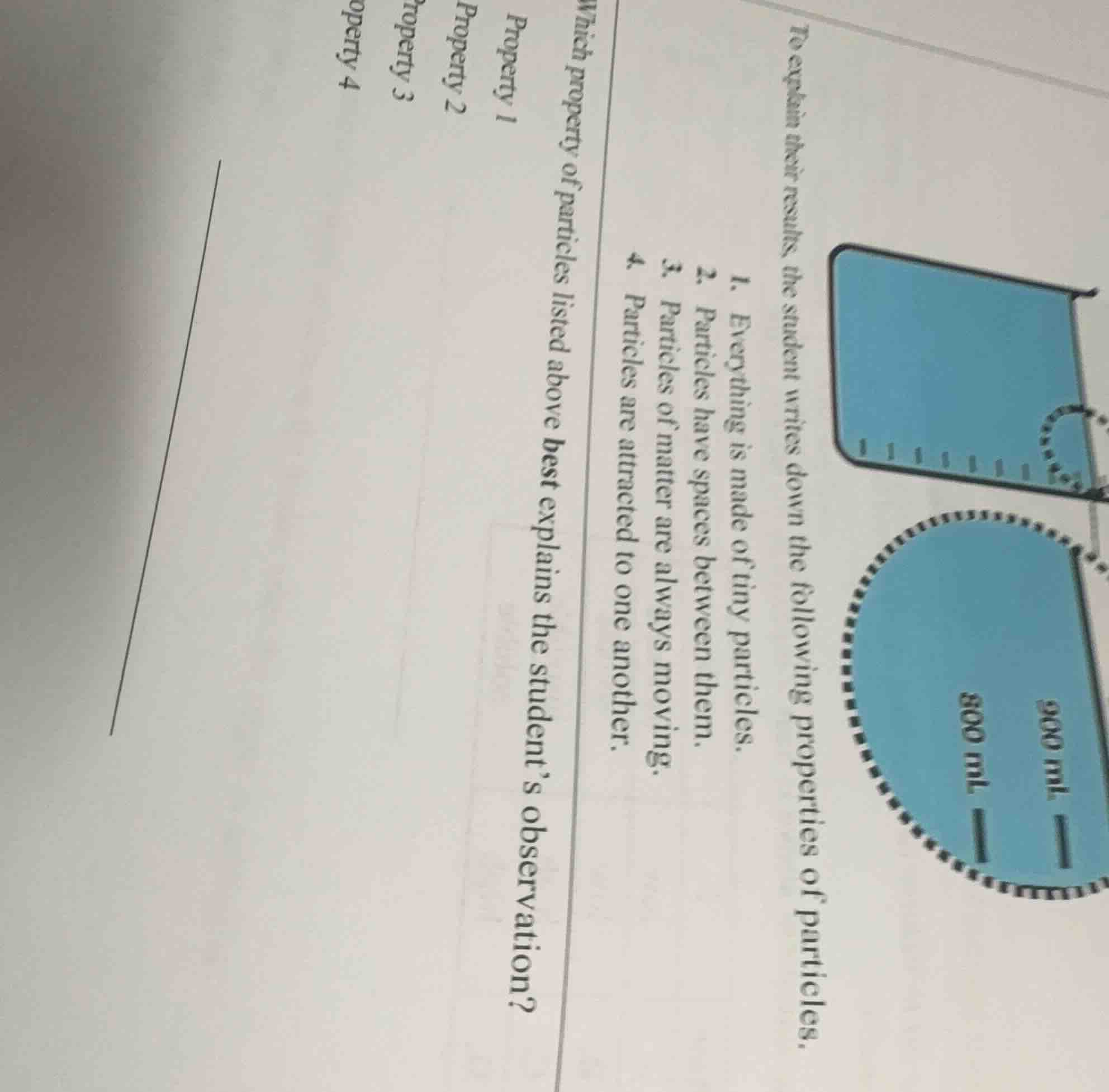
to explain their results, the student writes down the following properties of particles.
- everything is made of tiny particles.
- particles have spaces between them.
- particles of matter are always moving.
- particles are attracted to one another.
which property of particles listed above best explains the students observation?
property 1
property 2
property 3
property 4
<pre_analysis>
{
"quality": "clear",
"question_count": 1,
"skills_matched": [
"direct_cot",
"blank_filling_formatter",
"explain_then_answer",
"tutor"
],
"needs_drawing": false,
"concepts_used": [
"States of Matter"
],
"new_concepts": [
"Particle Theory of Matter",
"Spaces Between Particles"
],
"current_concepts": [
"States of Matter",
"Particle Theory of Matter",
"Spaces Between Particles"
]
}
</pre_analysis>
<reasoning>
Analyze the student's observation
The diagram shows a liquid being poured or mixed, resulting in a final volume that is less than the sum of the individual volumes (indicated by the zoom-in on the graduated markings showing a decrease from \(900\text{ mL}\) to \(800\text{ mL}\)). This is a classic demonstration of mixing two different substances (like water and ethanol), where the total volume decreases because the smaller particles of one substance fit into the spaces between the larger particles of the other.
Connect to the properties of particles
We evaluate the four listed properties of the particle theory of matter:
- Everything is made of tiny particles.
- Particles have spaces between them.
- Particles of matter are always moving.
- Particles are attracted to one another.
The observation that the total volume decreases upon mixing is best explained by the fact that there are spaces between the particles, allowing them to pack more closely together when mixed. This relates directly to the States of Matter concept.
Identify the correct property
Property 2 ("Particles have spaces between them") directly explains why the mixture occupies less volume than the individual components combined.
</reasoning>
<answer>
Which property of particles listed above best explains the student's observation? <blank>Property 2</blank>
</answer>
<post_analysis>
{
"subject": "Natural Science",
"question_type": "Fill-in-the-blank",
"knowledge_point": [
"Natural Science",
"Chemistry",
"Particle Theory of Matter"
]
}
</post_analysis>
Snap & solve any problem in the app
Get step-by-step solutions on Sovi AI
Photo-based solutions with guided steps
Explore more problems and detailed explanations
<pre_analysis>
{
"quality": "clear",
"question_count": 1,
"skills_matched": [
"direct_cot",
"blank_filling_formatter",
"explain_then_answer",
"tutor"
],
"needs_drawing": false,
"concepts_used": [
"States of Matter"
],
"new_concepts": [
"Particle Theory of Matter",
"Spaces Between Particles"
],
"current_concepts": [
"States of Matter",
"Particle Theory of Matter",
"Spaces Between Particles"
]
}
</pre_analysis>
<reasoning>
Analyze the student's observation
The diagram shows a liquid being poured or mixed, resulting in a final volume that is less than the sum of the individual volumes (indicated by the zoom-in on the graduated markings showing a decrease from \(900\text{ mL}\) to \(800\text{ mL}\)). This is a classic demonstration of mixing two different substances (like water and ethanol), where the total volume decreases because the smaller particles of one substance fit into the spaces between the larger particles of the other.
Connect to the properties of particles
We evaluate the four listed properties of the particle theory of matter:
- Everything is made of tiny particles.
- Particles have spaces between them.
- Particles of matter are always moving.
- Particles are attracted to one another.
The observation that the total volume decreases upon mixing is best explained by the fact that there are spaces between the particles, allowing them to pack more closely together when mixed. This relates directly to the States of Matter concept.
Identify the correct property
Property 2 ("Particles have spaces between them") directly explains why the mixture occupies less volume than the individual components combined.
</reasoning>
<answer>
Which property of particles listed above best explains the student's observation? <blank>Property 2</blank>
</answer>
<post_analysis>
{
"subject": "Natural Science",
"question_type": "Fill-in-the-blank",
"knowledge_point": [
"Natural Science",
"Chemistry",
"Particle Theory of Matter"
]
}
</post_analysis>