QUESTION IMAGE
Question
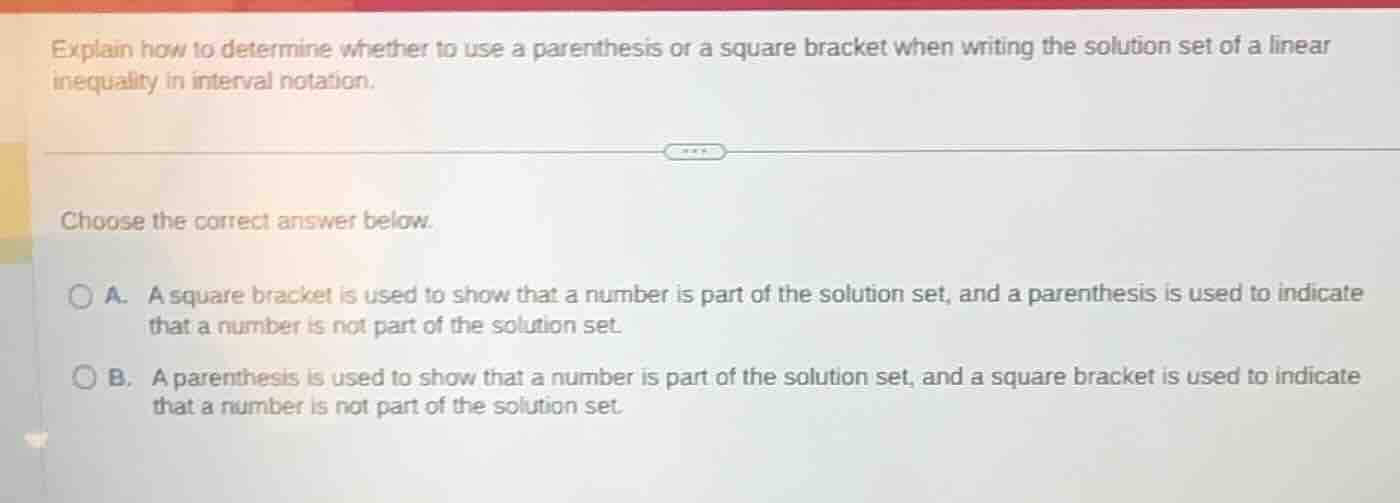
explain how to determine whether to use a parenthesis or a square bracket when writing the solution set of a linear inequality in interval notation.
choose the correct answer below.
a. a square bracket is used to show that a number is part of the solution set, and a parenthesis is used to indicate that a number is not part of the solution set.
b. a parenthesis is used to show that a number is part of the solution set, and a square bracket is used to indicate that a number is not part of the solution set.
To determine the correct answer, we recall the definition of interval notation for linear inequalities. Square brackets (e.g., \([a, b]\)) are used when the endpoint \(a\) or \(b\) is included in the solution set (corresponding to \(\leq\) or \(\geq\) inequalities). Parentheses (e.g., \((a, b)\)) are used when the endpoint is not included (corresponding to \(<\) or \(>\) inequalities).
Option A states that a square bracket shows a number is part of the solution set (included) and a parenthesis shows it is not (excluded), which matches the definition. Option B swaps the definitions, which is incorrect.

Snap & solve any problem in the app
Get step-by-step solutions on Sovi AI
Photo-based solutions with guided steps
Explore more problems and detailed explanations
A. A square bracket is used to show that a number is part of the solution set, and a parenthesis is used to indicate that a number is not part of the solution set.