QUESTION IMAGE
Question
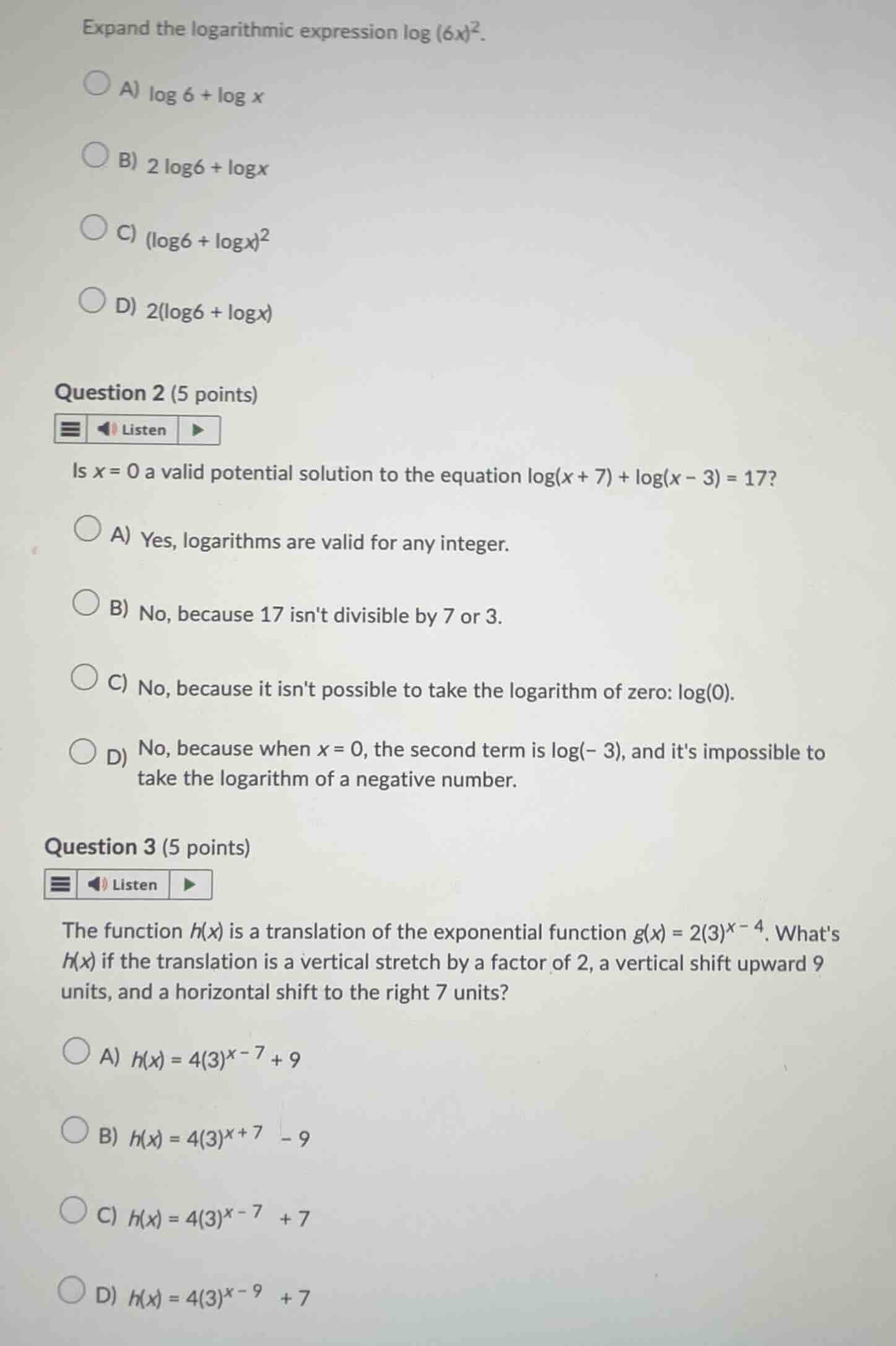
expand the logarithmic expression \\(\log (6x)^2\\).
a) \\(\log 6 + \log x\\)
b) \\(2 \log 6 + \log x\\)
c) \\((\log 6 + \log x)^2\\)
d) \\(2(\log 6 + \log x)\\)
question 2 (5 points)
is \\(x = 0\\) a valid potential solution to the equation \\(\log(x + 7) + \log(x - 3) = 17\\)?
a) yes, logarithms are valid for any integer.
b) no, because 17 isnt divisible by 7 or 3.
c) no, because it isnt possible to take the logarithm of zero: \\(\log(0)\\).
d) no, because when \\(x = 0\\), the second term is \\(\log(-3)\\), and its impossible to take the logarithm of a negative number.
question 3 (5 points)
the function \\(h(x)\\) is a translation of the exponential function \\(g(x) = 2(3)^{x - 4}\\). whats \\(h(x)\\) if the translation is a vertical stretch by a factor of 2, a vertical shift upward 9 units, and a horizontal shift to the right 7 units?
a) \\(h(x) = 4(3)^{x - 7} + 9\\)
b) \\(h(x) = 4(3)^{x + 7} - 9\\)
c) \\(h(x) = 4(3)^{x - 7} + 7\\)
d) \\(h(x) = 4(3)^{x - 9} + 7\\)
Expand the logarithmic expression \(\log (6x)^2\)
Evaluate \(x = 0\) in the logarithmic equation
Since \(\log(-3)\) is undefined because the domain of \(\log(u)\) requires \(u > 0\), \(x = 0\) is not a valid solution.
Apply transformations to \(g(x) = 2(3)^{x-4}\)
Note: Looking at the options, option A is \(h(x) = 4(3)^{x-7} + 9\). This corresponds to applying the horizontal shift of 7 units right directly to the base exponent \(x\) in a simplified form \(3^{x}\) or a typo in the question's original function offset. Let's re-verify the options:
- Option A: \(h(x) = 4(3)^{x-7} + 9\)
- Option B: \(h(x) = 4(3)^{x+7} - 9\)
- Option C: \(h(x) = 4(3)^{x-7} + 7\)
- Option D: \(h(x) = 4(3)^{x-9} + 7\)
If the shift right by 7 units is applied to a standard base \(3^x\), the exponent becomes \(x-7\). Combined with the vertical stretch by 2 (giving coefficient 4) and vertical shift up 9 (giving \(+9\)), this matches Option A.

Snap & solve any problem in the app
Get step-by-step solutions on Sovi AI
Photo-based solutions with guided steps
Explore more problems and detailed explanations
Question 1
- A) \(\log 6 + \log x\)
- B) \(2 \log 6 + \log x\)
- C) \((\log 6 + \log x)^2\)
- D) \(2(\log 6 + \log x)\) (Correct answer)
Question 2
- A) Yes, logarithms are valid for any integer.
- B) No, because 17 isn't divisible by 7 or 3.
- C) No, because it isn't possible to take the logarithm of zero: \(\log(0)\).
- D) No, because when \(x = 0\), the second term is \(\log(-3)\), and it's impossible to take the logarithm of a negative number. (Correct answer)
Question 3
- A) \(h(x) = 4(3)^{x-7} + 9\) (Correct answer)
- B) \(h(x) = 4(3)^{x+7} - 9\)
- C) \(h(x) = 4(3)^{x-7} + 7\)
- D) \(h(x) = 4(3)^{x-9} + 7\)