QUESTION IMAGE
Question
exercises:
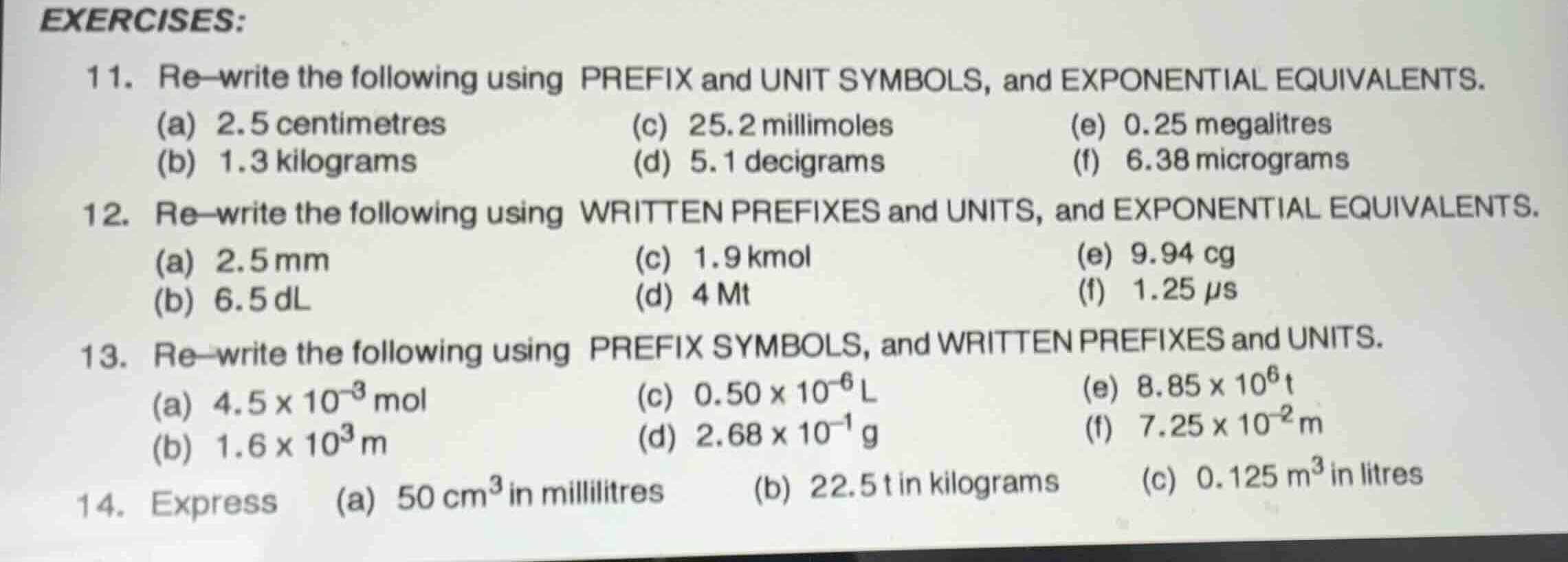
- re-write the following using prefix and unit symbols, and exponential equivalents.
(a) 2.5 centimetres
(b) 1.3 kilograms
(c) 25.2 millimoles
(d) 5.1 decigrams
(e) 0.25 megalitres
(f) 6.38 micrograms
- re-write the following using written prefixes and units, and exponential equivalents.
(a) 2.5 mm
(b) 6.5 dl
(c) 1.9 kmol
(d) 4 mt
(e) 9.94 cg
(f) 1.25 \\(\mu\\)s
- re-write the following using prefix symbols, and written prefixes and units.
(a) \\(4.5 \times 10^{-3}\\) mol
(b) \\(1.6 \times 10^{3}\\) m
(c) \\(0.50 \times 10^{-6}\\) l
(d) \\(2.68 \times 10^{-1}\\) g
(e) \\(8.85 \times 10^{6}\\) t
(f) \\(7.25 \times 10^{-2}\\) m
- express
(a) \\(50\text{ cm}^3\\) in millilitres
(b) 22.5 t in kilograms
(c) \\(0.125\text{ m}^3\\) in litres
Identify the requirements for Question 11
We need to rewrite each given quantity using prefix and unit symbols (e.g., \(2.5\text{ cm}\)) and exponential equivalents (using scientific notation with the base unit, e.g., \(2.5 \times 10^{-2}\text{ m}\)).
- (a) \(2.5\text{ centimetres}\): Symbol is \(\text{cm}\). Centi- means \(10^{-2}\), so \(2.5 \times 10^{-2}\text{ m}\).
- (b) \(1.3\text{ kilograms}\): Symbol is \(\text{kg}\). Kilo- means \(10^3\), so \(1.3 \times 10^3\text{ g}\).
- (c) \(25.2\text{ millimoles}\): Symbol is \(\text{mmol}\). Milli- means \(10^{-3}\), so \(25.2 \times 10^{-3}\text{ mol}\) (or \(2.52 \times 10^{-2}\text{ mol}\)).
- (d) \(5.1\text{ decigrams}\): Symbol is \(\text{dg}\). Deci- means \(10^{-1}\), so \(5.1 \times 10^{-1}\text{ g}\).
- (e) \(0.25\text{ megalitres}\): Symbol is \(\text{ML}\). Mega- means \(10^6\), so \(0.25 \times 10^6\text{ L}\) (or \(2.5 \times 10^5\text{ L}\)).
- (f) \(6.38\text{ micrograms}\): Symbol is \(\mu\text{g}\). Micro- means \(10^{-6}\), so \(6.38 \times 10^{-6}\text{ g}\).
We will apply the Metric Prefixes and Scientific Notation knowledge points.
Identify the requirements for Question 12
We need to rewrite each given symbol using written prefixes and units (e.g., millimetres) and exponential equivalents (e.g., \(10^{-3}\text{ m}\)).
- (a) \(2.5\text{ mm}\): Written is "millimetres". Exponential is \(2.5 \times 10^{-3}\text{ m}\).
- (b) \(6.5\text{ dL}\): Written is "decilitres". Exponential is \(6.5 \times 10^{-1}\text{ L}\).
- (c) \(1.9\text{ kmol}\): Written is "kilomoles". Exponential is \(1.9 \times 10^3\text{ mol}\).
- (d) \(4\text{ Mt}\): Written is "megatonnes". Exponential is \(4 \times 10^6\text{ t}\).
- (e) \(9.94\text{ cg}\): Written is "centigrams". Exponential is \(9.94 \times 10^{-2}\text{ g}\).
- (f) \(1.25\ \mu\text{s}\): Written is "microseconds". Exponential is \(1.25 \times 10^{-6}\text{ s}\).
Identify the requirements for Question 13
We need to rewrite each exponential expression using prefix symbols (e.g., \(\text{mmol}\)) and written prefixes and units (e.g., millimoles).
- (a) \(4.5 \times 10^{-3}\text{ mol}\): \(10^{-3}\) is milli (m). Symbol: \(4.5\text{ mmol}\). Written: \(4.5\text{ millimoles}\).
- (b) \(1.6 \times 10^3\text{ m}\): \(10^3\) is kilo (k). Symbol: \(1.6\text{ km}\). Written: \(1.6\text{ kilometres}\).
- (c) \(0.50 \times 10^{-6}\text{ L}\): \(10^{-6}\) is micro (\(\mu\)). Symbol: \(0.50\ \mu\text{L}\). Written: \(0.50\text{ microlitres}\).
- (d) \(2.68 \times 10^{-1}\text{ g}\): \(10^{-1}\) is deci (d). Symbol: \(2.68\text{ dg}\). Written: \(2.68\text{ decigrams}\).
- (e) \(8.85 \times 10^6\text{ t}\): \(10^6\) is mega (M). Symbol: \(8.85\text{ Mt}\). Written: \(8.85\text{ megatonnes}\).
- (f) \(7.25 \times 10^{-2}\text{ m}\): \(10^{-2}\) is centi (c). Symbol: \(7.25\text{ cm}\). Written: \(7.25\text{ centimetres}\).
Identify the requirements for Question 14
We need to perform Unit Conversions for the given values:
- (a) \(50\text{ cm}^3\) in millilitres: Since \(1\text{ cm}^3 = 1\text{ mL}\), \(50\text{ cm}^3 = 50\text{ mL}\).
- (b) \(22.5\text{ t}\) in kilograms: Since \(…

Snap & solve any problem in the app
Get step-by-step solutions on Sovi AI
Photo-based solutions with guided steps
Explore more problems and detailed explanations
Question 11
- (a) \(2.5\text{ cm}\); \(2.5 \times 10^{-2}\text{ m}\)
- (b) \(1.3\text{ kg}\); \(1.3 \times 10^3\text{ g}\)
- (c) \(25.2\text{ mmol}\); \(25.2 \times 10^{-3}\text{ mol}\) (or \(2.52 \times 10^{-2}\text{ mol}\))
- (d) \(5.1\text{ dg}\); \(5.1 \times 10^{-1}\text{ g}\)
- (e) \(0.25\text{ ML}\); \(0.25 \times 10^6\text{ L}\) (or \(2.5 \times 10^5\text{ L}\))
- (f) \(6.38\ \mu\text{g}\); \(6.38 \times 10^{-6}\text{ g}\)
Question 12
- (a) \(2.5\text{ millimetres}\); \(2.5 \times 10^{-3}\text{ m}\)
- (b) \(6.5\text{ decilitres}\); \(6.5 \times 10^{-1}\text{ L}\)
- (c) \(1.9\text{ kilomoles}\); \(1.9 \times 10^3\text{ mol}\)
- (d) \(4\text{ megatonnes}\); \(4 \times 10^6\text{ t}\)
- (e) \(9.94\text{ centigrams}\); \(9.94 \times 10^{-2}\text{ g}\)
- (f) \(1.25\text{ microseconds}\); \(1.25 \times 10^{-6}\text{ s}\)
Question 13
- (a) \(4.5\text{ mmol}\); \(4.5\text{ millimoles}\)
- (b) \(1.6\text{ km}\); \(1.6\text{ kilometres}\)
- (c) \(0.50\ \mu\text{L}\); \(0.50\text{ microlitres}\)
- (d) \(2.68\text{ dg}\); \(2.68\text{ decigrams}\)
- (e) \(8.85\text{ Mt}\); \(8.85\text{ megatonnes}\)
- (f) \(7.25\text{ cm}\); \(7.25\text{ centimetres}\)
Question 14
- (a) \(50\text{ mL}\)
- (b) \(22,500\text{ kg}\) (or \(2.25 \times 10^4\text{ kg}\))
- (c) \(125\text{ L}\)