QUESTION IMAGE
Question
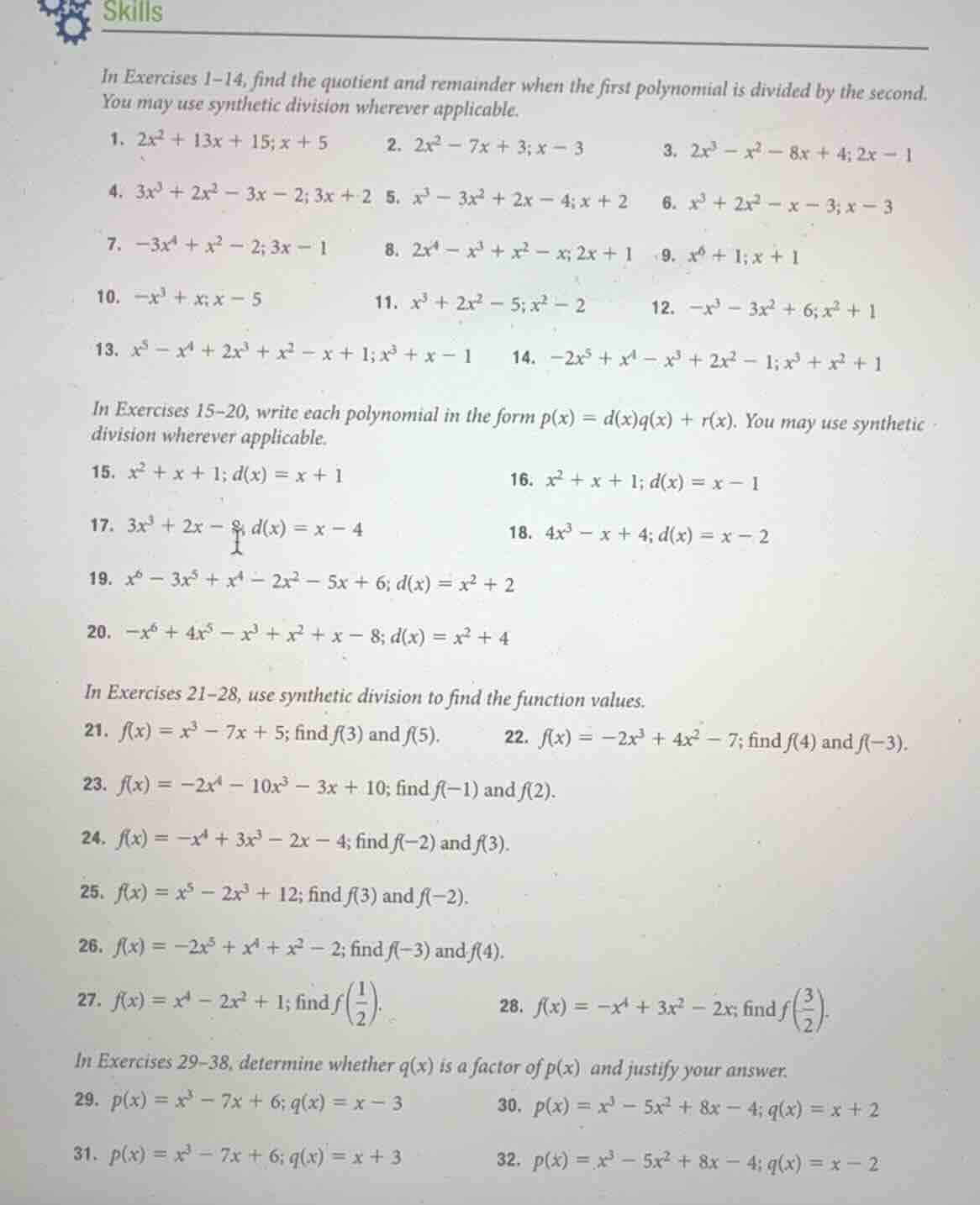
in exercises 1-14, find the quotient and remainder when the first polynomial is divided by the second. you may use synthetic division wherever applicable.
- (2x^2 + 13x + 15; x + 5)
- (2x^2 - 7x + 3; x - 3)
- (2x^3 - x^2 - 8x + 4; 2x - 1)
- (3x^3 + 2x^2 - 3x - 2; 3x + 2)
- (x^3 - 3x^2 + 2x - 4; x + 2)
- (x^3 + 2x^2 - x - 3; x - 3)
- (-3x^4 + x^2 - 2; 3x - 1)
- (2x^4 - x^3 + x^2 - x; 2x + 1)
- (x^6 + 1; x + 1)
- (-x^3 + x; x - 5)
- (x^3 + 2x^2 - 5; x^2 - 2)
- (-x^3 - 3x^2 + 6; x^2 + 1)
- (x^5 - x^4 + 2x^3 + x^2 - x + 1; x^3 + x - 1)
- (-2x^5 + x^4 - x^3 + 2x^2 - 1; x^3 + x^2 + 1)
in exercises 15-20, write each polynomial in the form (p(x) = d(x)q(x) + r(x)). you may use synthetic division wherever applicable.
- (x^2 + x + 1; d(x) = x + 1)
- (x^2 + x + 1; d(x) = x - 1)
- (3x^3 + 2x - 8; d(x) = x - 4)
- (4x^3 - x + 4; d(x) = x - 2)
- (x^6 - 3x^5 + x^4 - 2x^2 - 5x + 6; d(x) = x^2 + 2)
- (-x^6 + 4x^5 - x^3 + x^2 + x - 8; d(x) = x^2 + 4)
in exercises 21-28, use synthetic division to find the function values.
- (f(x) = x^3 - 7x + 5); find (f(3)) and (f(5)).
- (f(x) = -2x^3 + 4x^2 - 7); find (f(4)) and (f(-3)).
- (f(x) = -2x^4 - 10x^3 - 3x + 10); find (f(-1)) and (f(2)).
- (f(x) = -x^4 + 3x^3 - 2x - 4); find (f(-2)) and (f(3)).
- (f(x) = x^5 - 2x^3 + 12); find (f(3)) and (f(-2)).
- (f(x) = -2x^5 + x^4 + x^2 - 2); find (f(-3)) and (f(4)).
- (f(x) = x^4 - 2x^2 + 1); find (fleft(\frac{1}{2}
ight)).
- (f(x) = -x^4 + 3x^2 - 2x); find (fleft(\frac{3}{2}
ight)).
in exercises 29-38, determine whether (q(x)) is a factor of (p(x)) and justify your answer.
- (p(x) = x^3 - 7x + 6; q(x) = x - 3)
- (p(x) = x^3 - 5x^2 + 8x - 4; q(x) = x + 2)
- (p(x) = x^3 - 7x + 6; q(x) = x + 3)
- (p(x) = x^3 - 5x^2 + 8x - 4; q(x) = x - 2)
Identify the scope of the request
The user has provided an image containing a large set of exercises (Exercises 1–38) on polynomial division, synthetic division, the Remainder Theorem, and the Factor Theorem. Since the user did not specify a single problem, we will solve the very first representative problem, Exercise 1, to demonstrate the method clearly.
Exercise 1: Find the quotient and remainder when the first polynomial is divided by the second:
Set up synthetic division
Using the Synthetic Division knowledge point, we set up the division.
The divisor is \(x + 5\), so the test value is \(c = -5\).
The coefficients of the dividend \(2x^2 + 13x + 15\) are \(2\), \(13\), and \(15\).
Perform synthetic division calculations
Using the Synthetic Division knowledge point:
- Bring down the leading coefficient: \(2\).
- Multiply by \(-5\): \(-10\). Add to \(13\): \(13 + (-10) = 3\).
- Multiply by \(-5\): \(-15\). Add to \(15\): \(15 + (-15) = 0\).
The resulting coefficients are \(2\) and \(3\), with a remainder of \(0\).
Interpret the results
The quotient is \(2x + 3\) and the remainder is \(0\).

Snap & solve any problem in the app
Get step-by-step solutions on Sovi AI
Photo-based solutions with guided steps
Explore more problems and detailed explanations
For Exercise 1:
Quotient: \(2x + 3\)
Remainder: \(0\)