QUESTION IMAGE
Question
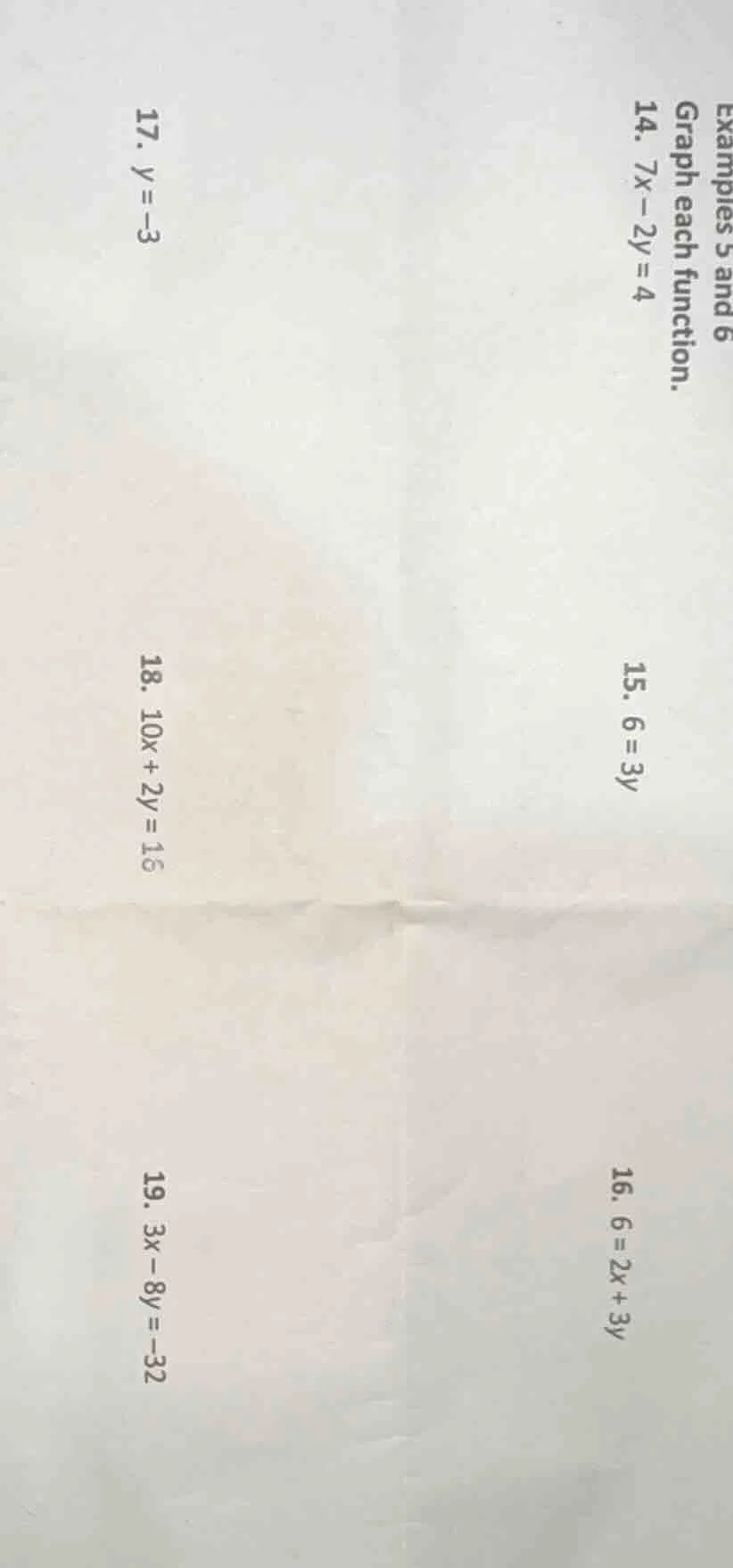
examples 5 and 6
graph each function.
- $7x - 2y = 4$
- $6 = 3y$
- $6 = 2x + 3y$
- $y = -3$
- $10x + 2y = 16$
- $3x - 8y = -32$
Let's solve problem 14: \( 7x - 2y = 4 \) (we'll find the intercepts to graph it).
Step 1: Find the x - intercept (set \( y = 0 \))
Substitute \( y = 0 \) into the equation \( 7x - 2y = 4 \).
We get \( 7x-2(0)=4 \), which simplifies to \( 7x = 4 \).
Then, solve for \( x \): \( x=\frac{4}{7}\approx0.57 \). So the x - intercept is \( (\frac{4}{7},0) \).
Step 2: Find the y - intercept (set \( x = 0 \))
Substitute \( x = 0 \) into the equation \( 7x - 2y = 4 \).
We get \( 7(0)-2y = 4 \), which simplifies to \( - 2y=4 \).
Solve for \( y \): Divide both sides by - 2, \( y=\frac{4}{-2}=-2 \). So the y - intercept is \( (0, - 2) \).
To graph the line, plot the points \( (\frac{4}{7},0) \) and \( (0, - 2) \) on the coordinate plane and draw a straight line through them.
(If we want to write it in slope - intercept form (\( y=mx + b \)):
Start with \( 7x-2y = 4 \).
Subtract \( 7x \) from both sides: \( - 2y=-7x + 4 \).
Divide every term by - 2: \( y=\frac{7}{2}x-2 \). The slope \( m = \frac{7}{2} \) and the y - intercept \( b=-2 \), which matches the y - intercept we found earlier. We can also use the slope to find another point. From \( (0,-2) \), since the slope is \( \frac{7}{2} \) (rise 7, run 2), we can move 2 units to the right and 7 units up to get the point \( (2,5) \), and then draw the line through \( (0, - 2) \) and \( (2,5) \))
For problem 17: \( y=-3 \)
This is a horizontal line. All points on this line have a y - coordinate of - 3. So we can plot points like \( (0,-3) \), \( (1,-3) \), \( ( - 1,-3) \) and draw a horizontal line through them.
For problem 18: \( 10x + 2y=16 \)
Step 1: Find x - intercept (set \( y = 0 \))
Substitute \( y = 0 \) into \( 10x + 2y=16 \): \( 10x+2(0)=16\Rightarrow10x = 16\Rightarrow x=\frac{16}{10}=\frac{8}{5}=1.6 \). So the x - intercept is \( (\frac{8}{5},0) \) or \( (1.6,0) \).
Step 2: Find y - intercept (set \( x = 0 \))
Substitute \( x = 0 \) into \( 10x + 2y=16 \): \( 10(0)+2y=16\Rightarrow2y = 16\Rightarrow y = 8 \). So the y - intercept is \( (0,8) \).
We can also write it in slope - intercept form:
\( 10x+2y = 16 \)
Subtract \( 10x \): \( 2y=-10x + 16 \)
Divide by 2: \( y=-5x + 8 \). The slope \( m=-5 \) and y - intercept \( b = 8 \).
For problem 19: \( 3x-8y=-32 \)
Step 1: Find x - intercept (set \( y = 0 \))
Substitute \( y = 0 \) into \( 3x-8y=-32 \): \( 3x-8(0)=-32\Rightarrow3x=-32\Rightarrow x=-\frac{32}{3}\approx - 10.67 \). So the x - intercept is \( (-\frac{32}{3},0) \).
Step 2: Find y - intercept (set \( x = 0 \))
Substitute \( x = 0 \) into \( 3x-8y=-32 \): \( 3(0)-8y=-32\Rightarrow - 8y=-32\Rightarrow y=\frac{-32}{-8}=4 \). So the y - intercept is \( (0,4) \).
In slope - intercept form:
\( 3x-8y=-32 \)
Subtract \( 3x \): \( - 8y=-3x - 32 \)
Divide by - 8: \( y=\frac{3}{8}x + 4 \). The slope \( m=\frac{3}{8} \) and y - intercept \( b = 4 \).
For problem 15: \( 6 = 3y \) (or \( 3y=6 \))
Step 1: Solve for y
Divide both sides by 3: \( y=\frac{6}{3}=2 \). This is a horizontal line where all points have a y - coordinate of 2. Plot points like \( (0,2) \), \( (1,2) \), \( (-1,2) \) and draw a horizontal line through them.
For problem 16: \( 6=2x + 3y \) (or \( 2x+3y = 6 \))
Step 1: Find x - intercept (set \( y = 0 \))
Substitute \( y = 0 \) into \( 2x+3y = 6 \): \( 2x+3(0)=6\Rightarrow2x = 6\Rightarrow x = 3 \). So the x - intercept is \( (3,0) \).
Step 2: Find y - intercept (set \( x = 0 \))
Substitute \( x = 0 \) into \( 2x+3y = 6 \): \( 2(0)+3y=6\Rightarrow3y = 6\Rightarrow y = 2 \). So the y - intercept is \( (0,2) \).
In slope - intercept form:
\( 2x+3y = 6 \)
Subtract \( 2x \): \( 3y=-2x + 6 \)
Divide by 3: \( y=-\frac{2}{3}x…

Snap & solve any problem in the app
Get step-by-step solutions on Sovi AI
Photo-based solutions with guided steps
Explore more problems and detailed explanations
Step 1: Find the x - intercept (set \( y = 0 \))
Substitute \( y = 0 \) into the equation \( 7x - 2y = 4 \).
We get \( 7x-2(0)=4 \), which simplifies to \( 7x = 4 \).
Then, solve for \( x \): \( x=\frac{4}{7}\approx0.57 \). So the x - intercept is \( (\frac{4}{7},0) \).
Step 2: Find the y - intercept (set \( x = 0 \))
Substitute \( x = 0 \) into the equation \( 7x - 2y = 4 \).
We get \( 7(0)-2y = 4 \), which simplifies to \( - 2y=4 \).
Solve for \( y \): Divide both sides by - 2, \( y=\frac{4}{-2}=-2 \). So the y - intercept is \( (0, - 2) \).
To graph the line, plot the points \( (\frac{4}{7},0) \) and \( (0, - 2) \) on the coordinate plane and draw a straight line through them.
(If we want to write it in slope - intercept form (\( y=mx + b \)):
Start with \( 7x-2y = 4 \).
Subtract \( 7x \) from both sides: \( - 2y=-7x + 4 \).
Divide every term by - 2: \( y=\frac{7}{2}x-2 \). The slope \( m = \frac{7}{2} \) and the y - intercept \( b=-2 \), which matches the y - intercept we found earlier. We can also use the slope to find another point. From \( (0,-2) \), since the slope is \( \frac{7}{2} \) (rise 7, run 2), we can move 2 units to the right and 7 units up to get the point \( (2,5) \), and then draw the line through \( (0, - 2) \) and \( (2,5) \))
For problem 17: \( y=-3 \)
This is a horizontal line. All points on this line have a y - coordinate of - 3. So we can plot points like \( (0,-3) \), \( (1,-3) \), \( ( - 1,-3) \) and draw a horizontal line through them.
For problem 18: \( 10x + 2y=16 \)
Step 1: Find x - intercept (set \( y = 0 \))
Substitute \( y = 0 \) into \( 10x + 2y=16 \): \( 10x+2(0)=16\Rightarrow10x = 16\Rightarrow x=\frac{16}{10}=\frac{8}{5}=1.6 \). So the x - intercept is \( (\frac{8}{5},0) \) or \( (1.6,0) \).
Step 2: Find y - intercept (set \( x = 0 \))
Substitute \( x = 0 \) into \( 10x + 2y=16 \): \( 10(0)+2y=16\Rightarrow2y = 16\Rightarrow y = 8 \). So the y - intercept is \( (0,8) \).
We can also write it in slope - intercept form:
\( 10x+2y = 16 \)
Subtract \( 10x \): \( 2y=-10x + 16 \)
Divide by 2: \( y=-5x + 8 \). The slope \( m=-5 \) and y - intercept \( b = 8 \).
For problem 19: \( 3x-8y=-32 \)
Step 1: Find x - intercept (set \( y = 0 \))
Substitute \( y = 0 \) into \( 3x-8y=-32 \): \( 3x-8(0)=-32\Rightarrow3x=-32\Rightarrow x=-\frac{32}{3}\approx - 10.67 \). So the x - intercept is \( (-\frac{32}{3},0) \).
Step 2: Find y - intercept (set \( x = 0 \))
Substitute \( x = 0 \) into \( 3x-8y=-32 \): \( 3(0)-8y=-32\Rightarrow - 8y=-32\Rightarrow y=\frac{-32}{-8}=4 \). So the y - intercept is \( (0,4) \).
In slope - intercept form:
\( 3x-8y=-32 \)
Subtract \( 3x \): \( - 8y=-3x - 32 \)
Divide by - 8: \( y=\frac{3}{8}x + 4 \). The slope \( m=\frac{3}{8} \) and y - intercept \( b = 4 \).
For problem 15: \( 6 = 3y \) (or \( 3y=6 \))
Step 1: Solve for y
Divide both sides by 3: \( y=\frac{6}{3}=2 \). This is a horizontal line where all points have a y - coordinate of 2. Plot points like \( (0,2) \), \( (1,2) \), \( (-1,2) \) and draw a horizontal line through them.
For problem 16: \( 6=2x + 3y \) (or \( 2x+3y = 6 \))
Step 1: Find x - intercept (set \( y = 0 \))
Substitute \( y = 0 \) into \( 2x+3y = 6 \): \( 2x+3(0)=6\Rightarrow2x = 6\Rightarrow x = 3 \). So the x - intercept is \( (3,0) \).
Step 2: Find y - intercept (set \( x = 0 \))
Substitute \( x = 0 \) into \( 2x+3y = 6 \): \( 2(0)+3y=6\Rightarrow3y = 6\Rightarrow y = 2 \). So the y - intercept is \( (0,2) \).
In slope - intercept form:
\( 2x+3y = 6 \)
Subtract \( 2x \): \( 3y=-2x + 6 \)
Divide by 3: \( y=-\frac{2}{3}x + 2 \). The slope \( m =-\frac{2}{3} \) and y - intercept \( b = 2 \).
Since the question was to graph each function, the key steps involve finding intercepts (or converting to slope - intercept form) to determine points on the line for graphing. If you need more detailed graphing instructions or have a specific sub - problem (e.g., only graph problem 14), please let me know.