QUESTION IMAGE
Question
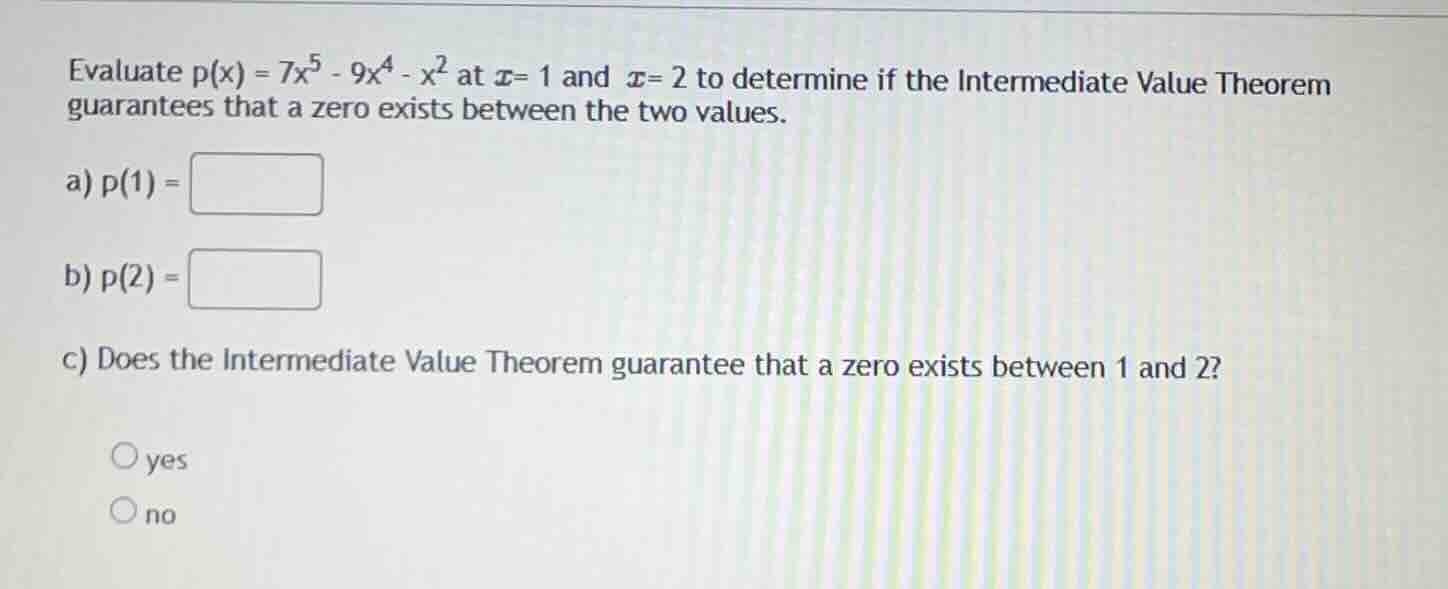
evaluate (p(x) = 7x^5 - 9x^4 - x^2) at (x = 1) and (x = 2) to determine if the intermediate value theorem guarantees that a zero exists between the two values.
a) (p(1) = )
b) (p(2) = )
c) does the intermediate value theorem guarantee that a zero exists between 1 and 2?
- yes
- no
Step1: Evaluate \(p(x)\) at \(x = 1\)
$$p(1) = 7(1)^5 - 9(1)^4 - (1)^2 = 7 - 9 - 1 = -3$$
Step2: Evaluate \(p(x)\) at \(x = 2\)
$$p(2) = 7(2)^5 - 9(2)^4 - (2)^2 = 7(32) - 9(16) - 4 = 224 - 144 - 4 = 76$$
Step3: Apply Intermediate Value Theorem
Since \(p(1) = -3 < 0\) and \(p(2) = 76 > 0\), the signs differ, guaranteeing a zero exists.

Snap & solve any problem in the app
Get step-by-step solutions on Sovi AI
Photo-based solutions with guided steps
Explore more problems and detailed explanations
a) \(p(1) = -3\)
b) \(p(2) = 76\)
c) yes