QUESTION IMAGE
Question
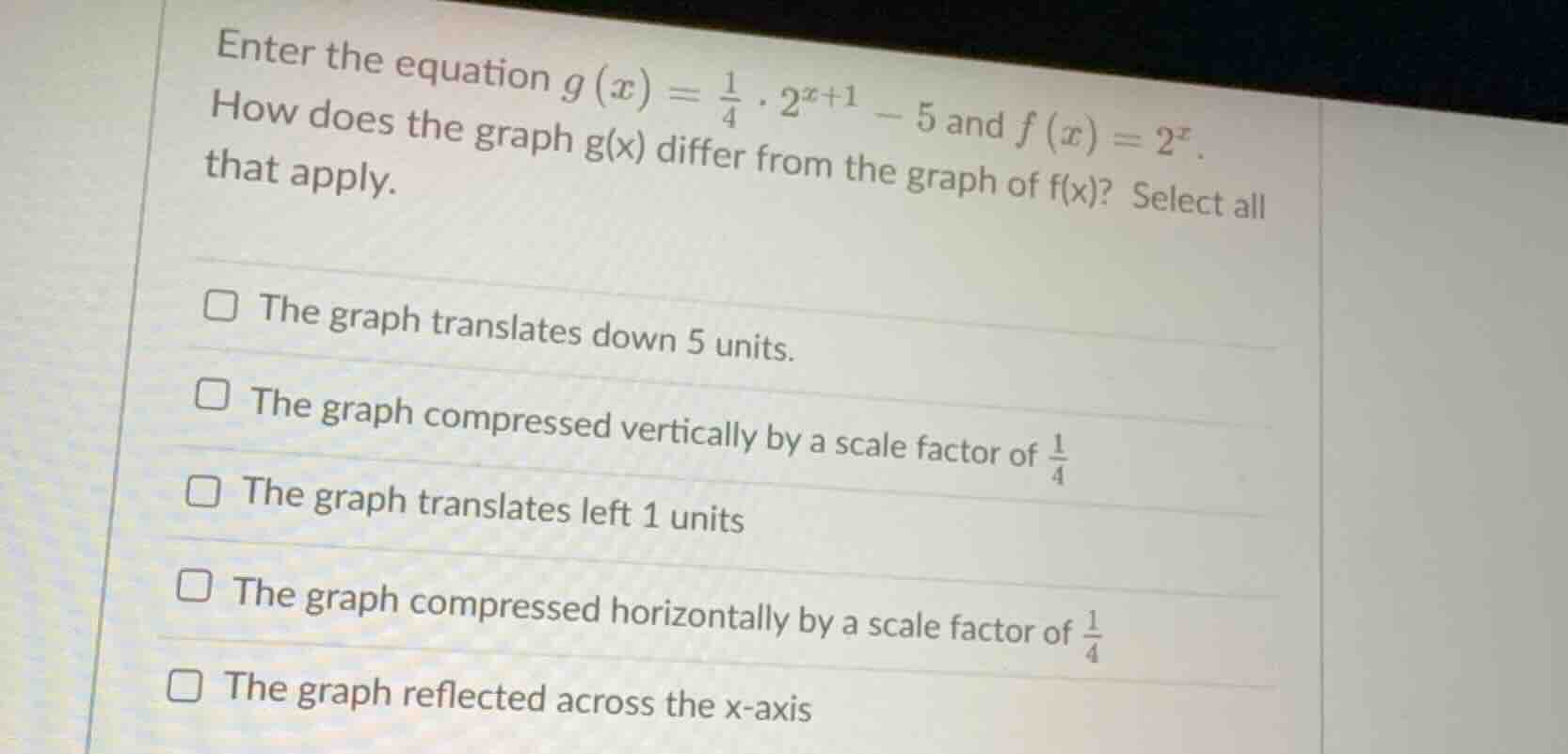
enter the equation \\(g(x) = \frac{1}{4} \cdot 2^{x+1} - 5\\) and \\(f(x) = 2^x\\).
how does the graph g(x) differ from the graph of f(x)? select all that apply.
the graph translates down 5 units.
the graph compressed vertically by a scale factor of \\(\frac{1}{4}\\)
the graph translates left 1 units
the graph compressed horizontally by a scale factor of \\(\frac{1}{4}\\)
the graph reflected across the x-axis
Analyze the vertical translation
The constant term \(-5\) subtracted at the end of the function shifts the entire graph vertically downward by \(5\) units.
Analyze the vertical compression
Multiplying the base function by a factor of \(a\) where \(0 < a < 1\) results in a vertical compression. Here, the factor is \(\frac{1}{4}\), which compresses the graph vertically by a scale factor of \(\frac{1}{4}\).
Analyze the horizontal translation
Replacing \(x\) with \(x + 1\) in the exponent shifts the graph horizontally to the left by \(1\) unit.

Snap & solve any problem in the app
Get step-by-step solutions on Sovi AI
Photo-based solutions with guided steps
Explore more problems and detailed explanations
- The graph translates down 5 units. (Correct answer)
- The graph compressed vertically by a scale factor of \(\frac{1}{4}\) (Correct answer)
- The graph translates left 1 units (Correct answer)
- The graph compressed horizontally by a scale factor of \(\frac{1}{4}\)
- The graph reflected across the x-axis