QUESTION IMAGE
Question
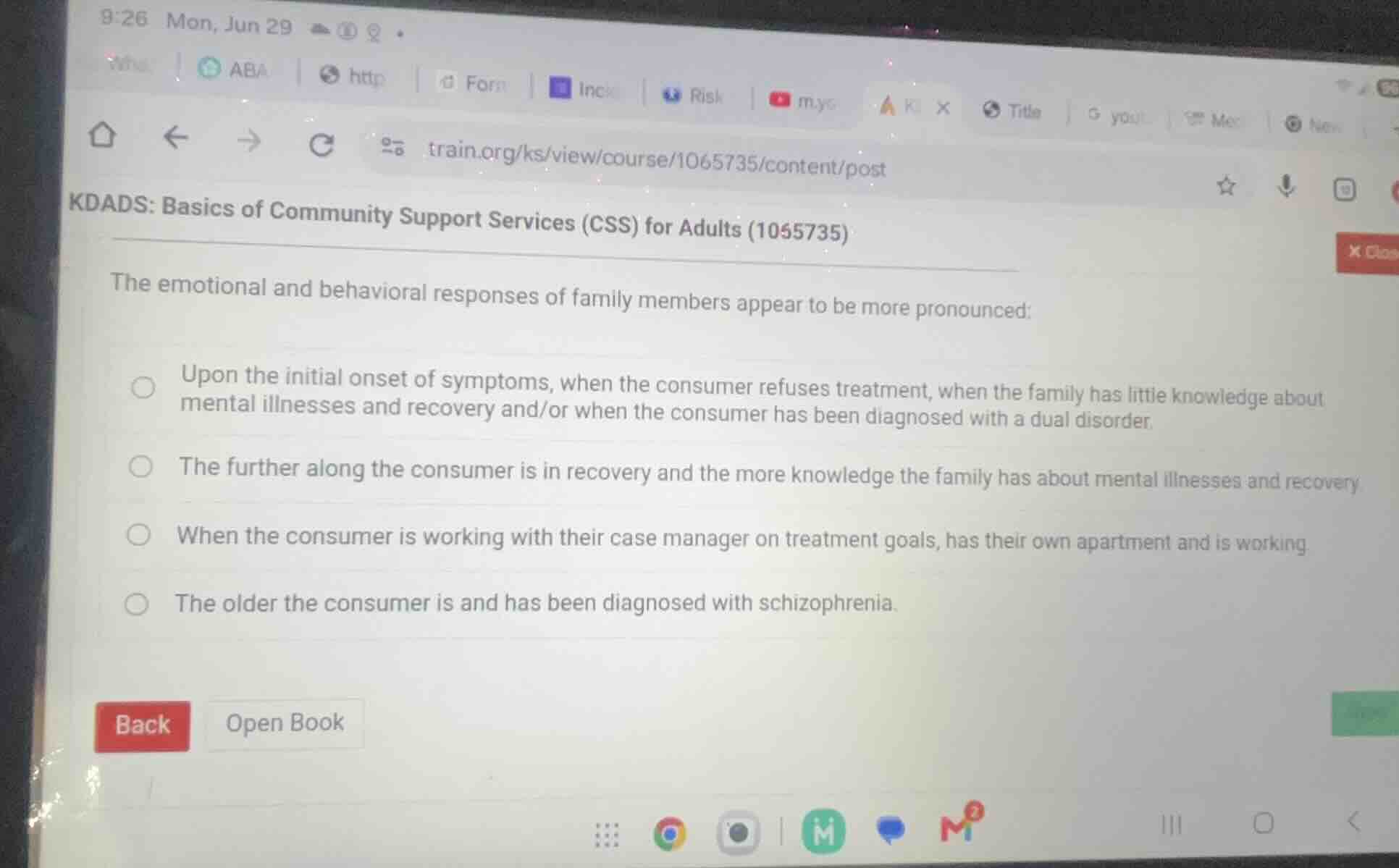
the emotional and behavioral responses of family members appear to be more pronounced:
- upon the initial onset of symptoms, when the consumer refuses treatment, when the family has little knowledge about mental illnesses and recovery and/or when the consumer has been diagnosed with a dual disorder.
- the further along the consumer is in recovery and the more knowledge the family has about mental illnesses and recovery.
- when the consumer is working with their case manager on treatment goals, has their own apartment and is working.
- the older the consumer is and has been diagnosed with schizophrenia.
Analyze the question context
The question asks when the emotional and behavioral responses of family members appear to be more pronounced in the context of community support services and mental health recovery.
Evaluate the options
- Option 1: "Upon the initial onset of symptoms, when the consumer refuses treatment, when the family has little knowledge about mental illnesses and recovery and/or when the consumer has been diagnosed with a dual disorder." This represents periods of high uncertainty, crisis, lack of information, and complex clinical presentations, which naturally trigger the most pronounced emotional and behavioral reactions in family members.
- Option 2: "The further along the consumer is in recovery..." Recovery and increased knowledge typically stabilize and reduce acute emotional/behavioral distress for family members.
- Option 3: "When the consumer is working with their case manager on treatment goals, has their own apartment and is working." This represents stable, positive progress, which correlates with lower crisis-level responses.
- Option 4: "The older the consumer is and has been diagnosed with schizophrenia." Age and a single diagnosis do not inherently make family responses more pronounced compared to the acute crisis situations described in Option 1.
Select the correct option
Option 1 is the most comprehensive and logically sound choice, as initial onset, treatment refusal, lack of knowledge, and dual diagnoses are well-documented triggers for intense family distress and behavioral responses.

Snap & solve any problem in the app
Get step-by-step solutions on Sovi AI
Photo-based solutions with guided steps
Explore more problems and detailed explanations
- (A) Upon the initial onset of symptoms, when the consumer refuses treatment, when the family has little knowledge about mental illnesses and recovery and/or when the consumer has been diagnosed with a dual disorder. (Correct answer)
- (B) The further along the consumer is in recovery and the more knowledge the family has about mental illnesses and recovery.
- (C) When the consumer is working with their case manager on treatment goals, has their own apartment and is working.
- (D) The older the consumer is and has been diagnosed with schizophrenia.