QUESTION IMAGE
Question
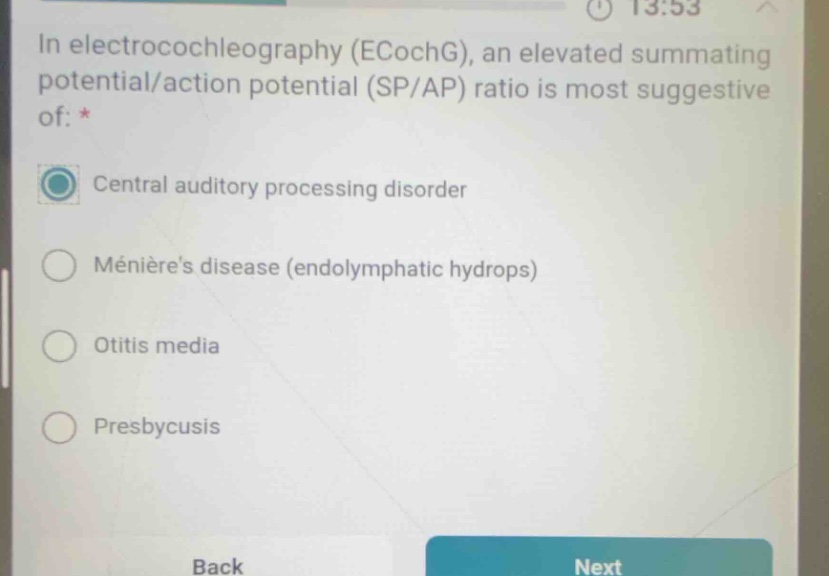
in electrocochleography (ecochg), an elevated summating potential/action potential (sp/ap) ratio is most suggestive of: *
central auditory processing disorder
ménières disease (endolymphatic hydrops)
otitis media
presbycusis
<pre_analysis>
{
"quality": "clear",
"question_count": 1,
"skills_matched": [
"direct_cot",
"multiple_choice_formatter",
"explain_then_answer",
"tutor",
"mastery_adaptive_brevity"
],
"needs_drawing": false,
"concepts_used": [
"Electrocochleography",
"Summating Potential",
"Ménières Disease"
],
"new_concepts": [],
"current_concepts": [
"Electrocochleography",
"Summating Potential",
"Ménières Disease"
]
}
</pre_analysis>
<reasoning>
Analyze the clinical diagnostic test
Using the Electrocochleography knowledge point, we evaluate the components of the evoked potential response recorded from the cochlea and auditory nerve.
Evaluate the physiological markers
Using the Summating Potential knowledge point, we identify that an enlargement of this direct-current receptor potential relative to the action potential (AP) indicates basilar membrane displacement.
Correlate with clinical pathology
Using the Ménières Disease knowledge point, we link an elevated SP/AP ratio (typically greater than 0.35 to 0.40) directly to endolymphatic hydrops.
Rule out alternative options
We confirm that central auditory processing disorder, otitis media, and presbycusis do not characteristically alter the peripheral SP/AP ratio.
</reasoning>
<answer>
<mcq-option>(A) Central auditory processing disorder</mcq-option>
<mcq-correct>(B) Ménière's disease (endolymphatic hydrops)</mcq-correct>
<mcq-option>(C) Otitis media</mcq-option>
<mcq-option>(D) Presbycusis</mcq-option>
</answer>
<post_analysis>
{
"subject": "Natural Science",
"question_type": "Multiple Choice",
"knowledge_point": [
"Natural Science",
"Medicine",
"Audiology"
]
}
</post_analysis>
Snap & solve any problem in the app
Get step-by-step solutions on Sovi AI
Photo-based solutions with guided steps
Explore more problems and detailed explanations
<pre_analysis>
{
"quality": "clear",
"question_count": 1,
"skills_matched": [
"direct_cot",
"multiple_choice_formatter",
"explain_then_answer",
"tutor",
"mastery_adaptive_brevity"
],
"needs_drawing": false,
"concepts_used": [
"Electrocochleography",
"Summating Potential",
"Ménières Disease"
],
"new_concepts": [],
"current_concepts": [
"Electrocochleography",
"Summating Potential",
"Ménières Disease"
]
}
</pre_analysis>
<reasoning>
Analyze the clinical diagnostic test
Using the Electrocochleography knowledge point, we evaluate the components of the evoked potential response recorded from the cochlea and auditory nerve.
Evaluate the physiological markers
Using the Summating Potential knowledge point, we identify that an enlargement of this direct-current receptor potential relative to the action potential (AP) indicates basilar membrane displacement.
Correlate with clinical pathology
Using the Ménières Disease knowledge point, we link an elevated SP/AP ratio (typically greater than 0.35 to 0.40) directly to endolymphatic hydrops.
Rule out alternative options
We confirm that central auditory processing disorder, otitis media, and presbycusis do not characteristically alter the peripheral SP/AP ratio.
</reasoning>
<answer>
<mcq-option>(A) Central auditory processing disorder</mcq-option>
<mcq-correct>(B) Ménière's disease (endolymphatic hydrops)</mcq-correct>
<mcq-option>(C) Otitis media</mcq-option>
<mcq-option>(D) Presbycusis</mcq-option>
</answer>
<post_analysis>
{
"subject": "Natural Science",
"question_type": "Multiple Choice",
"knowledge_point": [
"Natural Science",
"Medicine",
"Audiology"
]
}
</post_analysis>