QUESTION IMAGE
Question
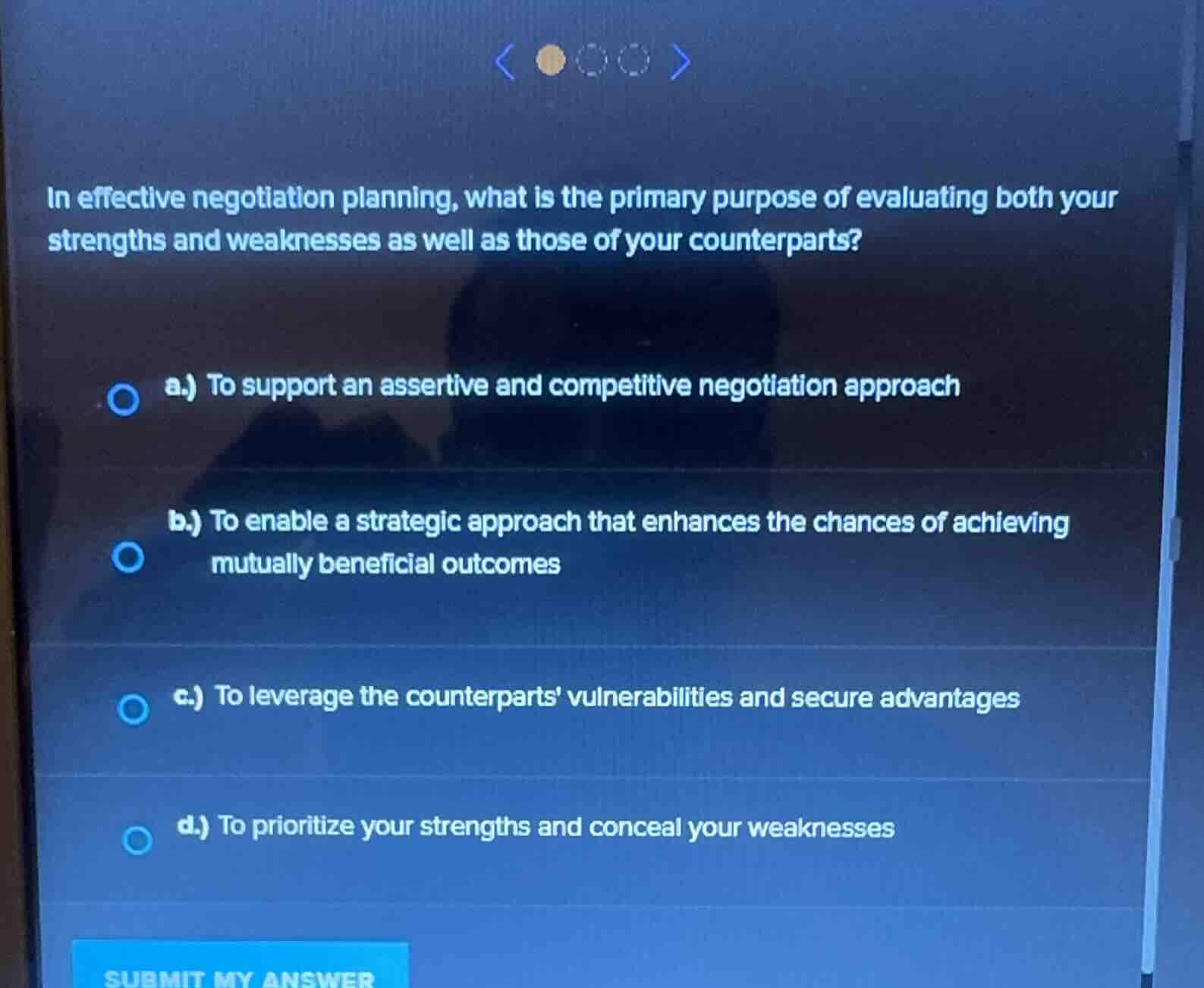
in effective negotiation planning, what is the primary purpose of evaluating both your strengths and weaknesses as well as those of your counterparts?
a.) to support an assertive and competitive negotiation approach
b.) to enable a strategic approach that enhances the chances of achieving mutually beneficial outcomes
c.) to leverage the counterparts vulnerabilities and secure advantages
d.) to prioritize your strengths and conceal your weaknesses
Analyze the purpose of evaluation in negotiation
Using the Negotiation Preparation knowledge point
Evaluating both your own strengths and weaknesses and those of your counterpart is a fundamental step in preparation. This comprehensive assessment allows negotiators to understand the full landscape of the negotiation, move away from purely adversarial tactics, and design a strategy that identifies shared interests and potential trade-offs. Consequently, this balanced understanding facilitates a strategic approach aimed at creating value and achieving mutually beneficial, win-win outcomes rather than merely exploiting the other side or dominating the discussion.
Evaluate the given options
Using the Negotiation Preparation knowledge point
- Option a focuses solely on a competitive, assertive approach, which ignores the collaborative potential of understanding both sides.
- Option b correctly identifies that a balanced evaluation enables a strategic approach to achieve mutually beneficial (win-win) outcomes.
- Option c focuses purely on exploitation ("leveraging vulnerabilities"), which is a distributive, win-lose tactic rather than the primary purpose of comprehensive planning.
- Option d suggests a defensive, one-sided posture ("conceal your weaknesses") rather than a strategic, integrative planning framework.

Snap & solve any problem in the app
Get step-by-step solutions on Sovi AI
Photo-based solutions with guided steps
Explore more problems and detailed explanations
- a.) To support an assertive and competitive negotiation approach
- b.) To enable a strategic approach that enhances the chances of achieving mutually beneficial outcomes (Correct answer)
- c.) To leverage the counterparts' vulnerabilities and secure advantages
- d.) To prioritize your strengths and conceal your weaknesses