QUESTION IMAGE
Question
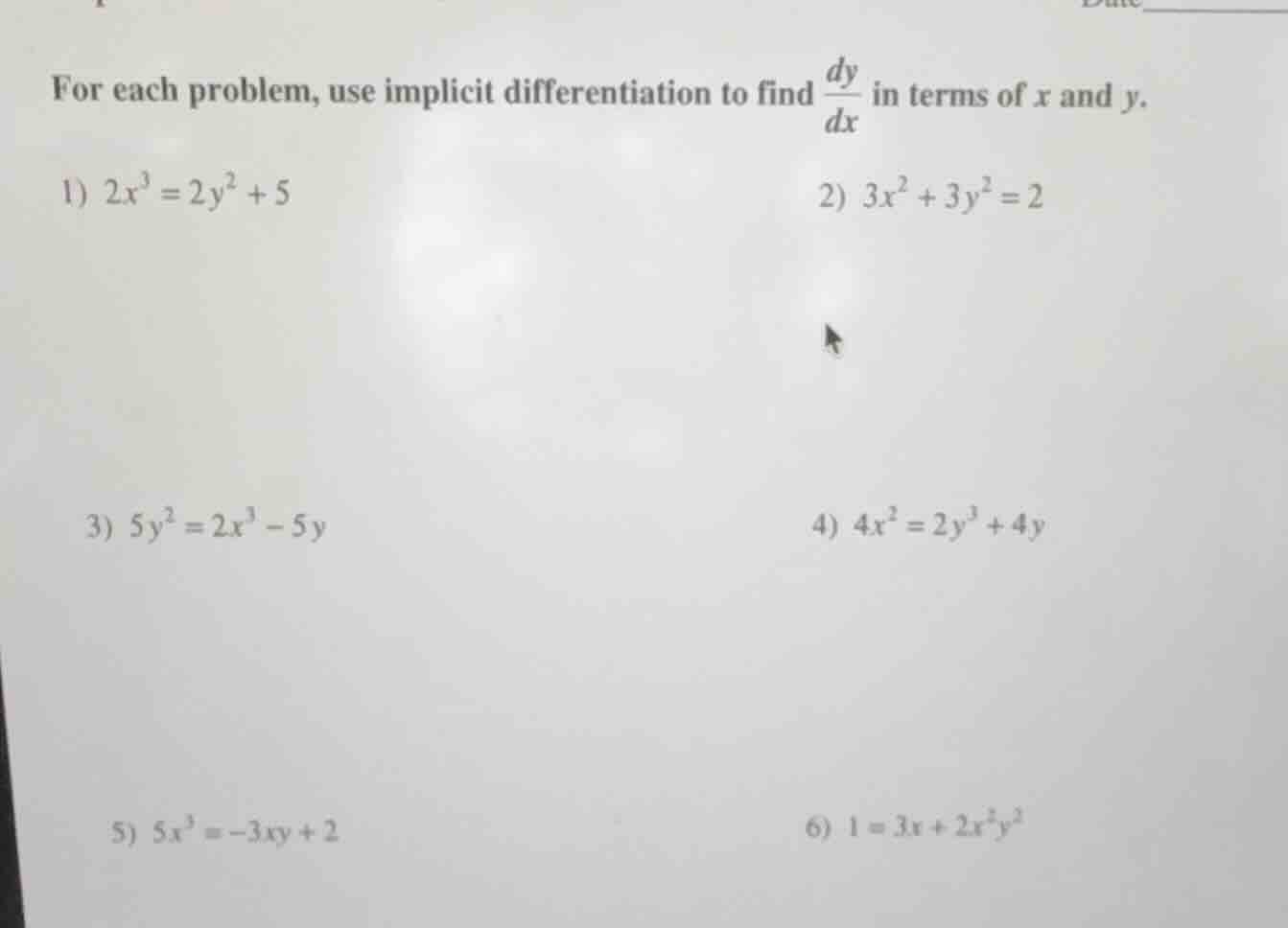
for each problem, use implicit differentiation to find \\(\frac{dy}{dx}\\) in terms of \\(x\\) and \\(y\\).
- \\(2x^3 = 2y^2 + 5\\)
- \\(3x^2 + 3y^2 = 2\\)
- \\(5y^2 = 2x^3 - 5y\\)
- \\(4x^2 = 2y^3 + 4y\\)
- \\(5x^3 = -3xy + 2\\)
- \\(1 = 3x + 2x^2y^2\\)
Differentiate problem 1
We differentiate both sides of \(2x^3 = 2y^2 + 5\) with respect to \(x\).
Using the power rule and chain rule:
Solving for \(\frac{dy}{dx}\):
Differentiate problem 2
We differentiate both sides of \(3x^2 + 3y^2 = 2\) with respect to \(x\).
Using the power rule and chain rule:
Solving for \(\frac{dy}{dx}\):
Differentiate problem 3
We differentiate both sides of \(5y^2 = 2x^3 - 5y\) with respect to \(x\).
Using the power rule and chain rule:
Grouping the \(\frac{dy}{dx}\) terms:
Differentiate problem 4
We differentiate both sides of \(4x^2 = 2y^3 + 4y\) with respect to \(x\).
Using the power rule and chain rule:
Factoring out \(\frac{dy}{dx}\):
Differentiate problems 5 and 6
For problem 5, \(5x^3 = -3xy + 2\). Differentiating with respect to \(x\) using the product rule:
For problem 6, \(1 = 3x + 2x^2y^2\). Differentiating with respect to \(x\) using the product rule:

Snap & solve any problem in the app
Get step-by-step solutions on Sovi AI
Photo-based solutions with guided steps
Explore more problems and detailed explanations