QUESTION IMAGE
Question
for each multiple choice or true/false question, choose the best answer. for each matching question, click on the dropdown box beside each choice and click on the number. for each short answer, type your responses in appropriate box numbers below the questions.
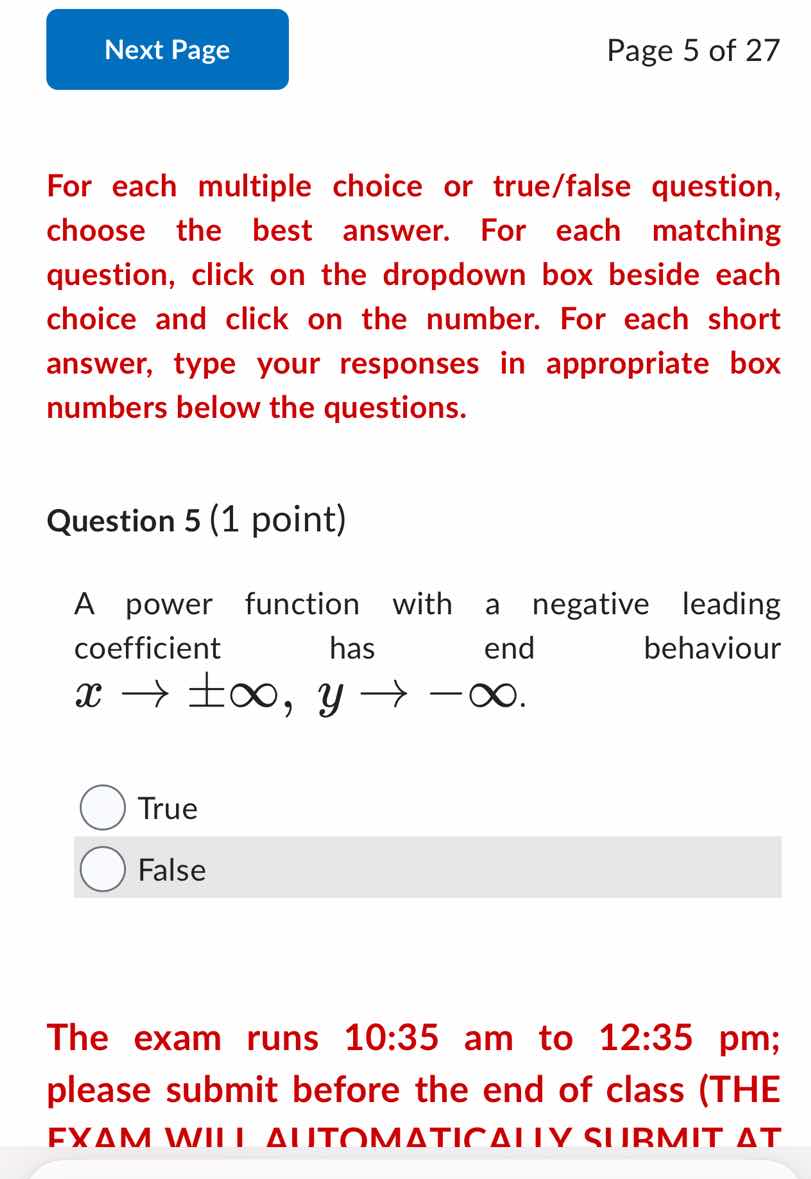
question 5 (1 point)
a power function with a negative leading coefficient has end behaviour (x
ightarrow pminfty, y
ightarrow -infty).
true
false
🆕 New Concept Discovered: End Behavior of Power Functions
How a function behaves as x goes to positive or negative infinity.
Step 1: Understand the definition of a power function
A power function is a single-term function of the form:
where \( a \) is the leading coefficient and \( n \) is a positive integer (the degree).
Step 2: Analyze the given end behavior
The statement claims that the end behavior is:
This means:
- As \( x \to \infty \), \( y \to -\infty \)
- As \( x \to -\infty \), \( y \to -\infty \)
For both ends to point downwards towards \( -\infty \), the function must have:
- An even degree (\( n \) is even, like \( y = -x^2 \) or \( y = -x^4 \)).
- A negative leading coefficient (\( a < 0 \)).
Step 3: Evaluate the statement's generality
The statement says: "A power function with a negative leading coefficient has end behaviour \( x \to \pm\infty, y \to -\infty \)."
However, if the power function has an odd degree (such as \( y = -x^3 \)):
- As \( x \to \infty \), \( y \to -\infty \)
- As \( x \to -\infty \), \( y \to \infty \)
Because this end behavior only applies to power functions with even degrees and not all power functions with a negative leading coefficient, the general statement is false.

Snap & solve any problem in the app
Get step-by-step solutions on Sovi AI
Photo-based solutions with guided steps
Explore more problems and detailed explanations
False