QUESTION IMAGE
Question
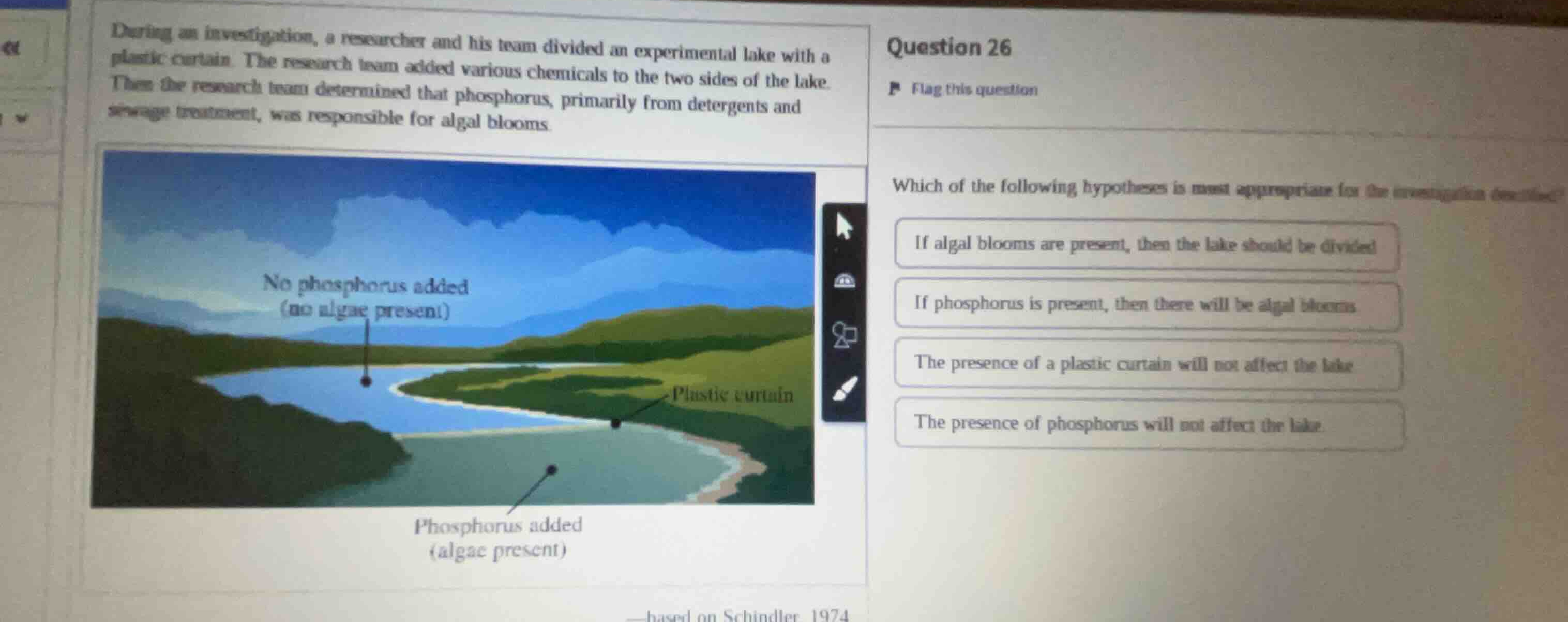
during an investigation, a researcher and his team divided an experimental lake with a plastic curtain. the research team added various chemicals to the two sides of the lake. then the research team determined that phosphorus, primarily from detergents and sewage treatment, was responsible for algal blooms.
question 26
which of the following hypotheses is most appropriate for the investigation described?
- if algal blooms are present, then the lake should be divided
- if phosphorus is present, then there will be algal blooms
- the presence of a plastic curtain will not affect the lake
- the presence of phosphorus will not affect the lake
<pre_analysis>
{
"quality": "clear",
"question_count": 1,
"skills_matched": [
"direct_cot",
"multiple_choice_formatter",
"explain_then_answer",
"tutor",
"mastery_adaptive_brevity"
],
"needs_drawing": false,
"concepts_used": [
"Experimental Design",
"Scientific Method"
],
"new_concepts": [
"Hypothesis Formulation"
],
"current_concepts": [
"Experimental Design",
"Scientific Method",
"Hypothesis Formulation"
]
}
</pre_analysis>
<reasoning>
Analyze the experimental setup
Using the Experimental Design and Scientific Method knowledge points:
- Independent Variable: The presence or addition of phosphorus (one side of the lake has no phosphorus added, while the other side has phosphorus added).
- Dependent Variable: The presence of algal blooms (no algae present vs. algae present).
- Purpose: To test if phosphorus is responsible for causing algal blooms.
Evaluate the hypothesis options
Using the Scientific Method knowledge point:
- A proper hypothesis proposes a testable relationship between the independent variable (cause) and the dependent variable (effect), often in an "If... then..." format.
- Option 1: "If algal blooms are present, then the lake should be divided" reverses cause and effect, focusing on the physical setup rather than the biological relationship.
- Option 2: "If phosphorus is present, then there will be algal blooms" correctly links the independent variable (phosphorus) to the predicted outcome (algal blooms).
- Option 3: "The presence of a plastic curtain will not affect the lake" is a control assumption rather than the primary hypothesis being tested.
- Option 4: "The presence of phosphorus will not affect the lake" represents a null hypothesis, but the positive testable prediction is more appropriate for the described investigation.
</reasoning>
<answer>
<mcq-option>If algal blooms are present, then the lake should be divided</mcq-option>
<mcq-correct>If phosphorus is present, then there will be algal blooms</mcq-correct>
<mcq-option>The presence of a plastic curtain will not affect the lake</mcq-option>
<mcq-option>The presence of phosphorus will not affect the lake</mcq-option>
</answer>
<post_analysis>
{
"subject": "Natural Science",
"question_type": "Multiple Choice",
"knowledge_point": [
"Natural Science",
"Biology",
"Scientific Method"
]
}
</post_analysis>
Snap & solve any problem in the app
Get step-by-step solutions on Sovi AI
Photo-based solutions with guided steps
Explore more problems and detailed explanations
<pre_analysis>
{
"quality": "clear",
"question_count": 1,
"skills_matched": [
"direct_cot",
"multiple_choice_formatter",
"explain_then_answer",
"tutor",
"mastery_adaptive_brevity"
],
"needs_drawing": false,
"concepts_used": [
"Experimental Design",
"Scientific Method"
],
"new_concepts": [
"Hypothesis Formulation"
],
"current_concepts": [
"Experimental Design",
"Scientific Method",
"Hypothesis Formulation"
]
}
</pre_analysis>
<reasoning>
Analyze the experimental setup
Using the Experimental Design and Scientific Method knowledge points:
- Independent Variable: The presence or addition of phosphorus (one side of the lake has no phosphorus added, while the other side has phosphorus added).
- Dependent Variable: The presence of algal blooms (no algae present vs. algae present).
- Purpose: To test if phosphorus is responsible for causing algal blooms.
Evaluate the hypothesis options
Using the Scientific Method knowledge point:
- A proper hypothesis proposes a testable relationship between the independent variable (cause) and the dependent variable (effect), often in an "If... then..." format.
- Option 1: "If algal blooms are present, then the lake should be divided" reverses cause and effect, focusing on the physical setup rather than the biological relationship.
- Option 2: "If phosphorus is present, then there will be algal blooms" correctly links the independent variable (phosphorus) to the predicted outcome (algal blooms).
- Option 3: "The presence of a plastic curtain will not affect the lake" is a control assumption rather than the primary hypothesis being tested.
- Option 4: "The presence of phosphorus will not affect the lake" represents a null hypothesis, but the positive testable prediction is more appropriate for the described investigation.
</reasoning>
<answer>
<mcq-option>If algal blooms are present, then the lake should be divided</mcq-option>
<mcq-correct>If phosphorus is present, then there will be algal blooms</mcq-correct>
<mcq-option>The presence of a plastic curtain will not affect the lake</mcq-option>
<mcq-option>The presence of phosphorus will not affect the lake</mcq-option>
</answer>
<post_analysis>
{
"subject": "Natural Science",
"question_type": "Multiple Choice",
"knowledge_point": [
"Natural Science",
"Biology",
"Scientific Method"
]
}
</post_analysis>