QUESTION IMAGE
Question
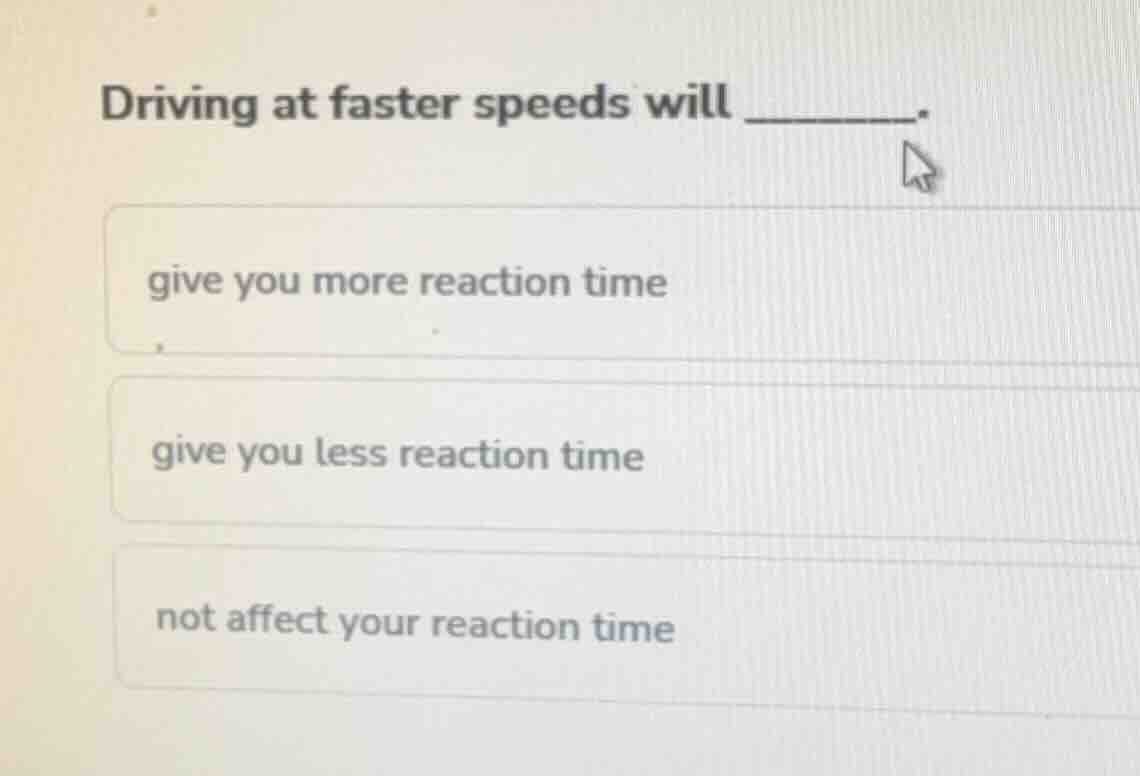
driving at faster speeds will ______.
give you more reaction time
give you less reaction time
not affect your reaction time
Analyze the relationship between speed and distance
As a vehicle's speed increases, it covers more distance per second. For example, at \(30\text{ mph}\), a vehicle travels about \(44\text{ feet per second}\), whereas at \(60\text{ mph}\), it covers about \(88\text{ feet per second}\).
Evaluate reaction time and reaction distance
Your physical reaction time (the time it takes to detect a hazard and apply the brakes) remains relatively constant. However, because the vehicle is traveling faster, it covers much more distance during that same reaction time. This means you have less time to react to a hazard before a collision becomes unavoidable.
Assess the given options
- "give you more reaction time": Incorrect. Higher speeds reduce the time window available to avoid an obstacle.
- "give you less reaction time": Correct. The faster you drive, the less time you have to perceive, process, and react to hazards.
- "not affect your reaction time": Incorrect. While your physical reflex speed doesn't change, the practical time window to avoid a crash is significantly reduced.

Snap & solve any problem in the app
Get step-by-step solutions on Sovi AI
Photo-based solutions with guided steps
Explore more problems and detailed explanations
- give you more reaction time
- give you less reaction time (Correct answer)
- not affect your reaction time