QUESTION IMAGE
Question
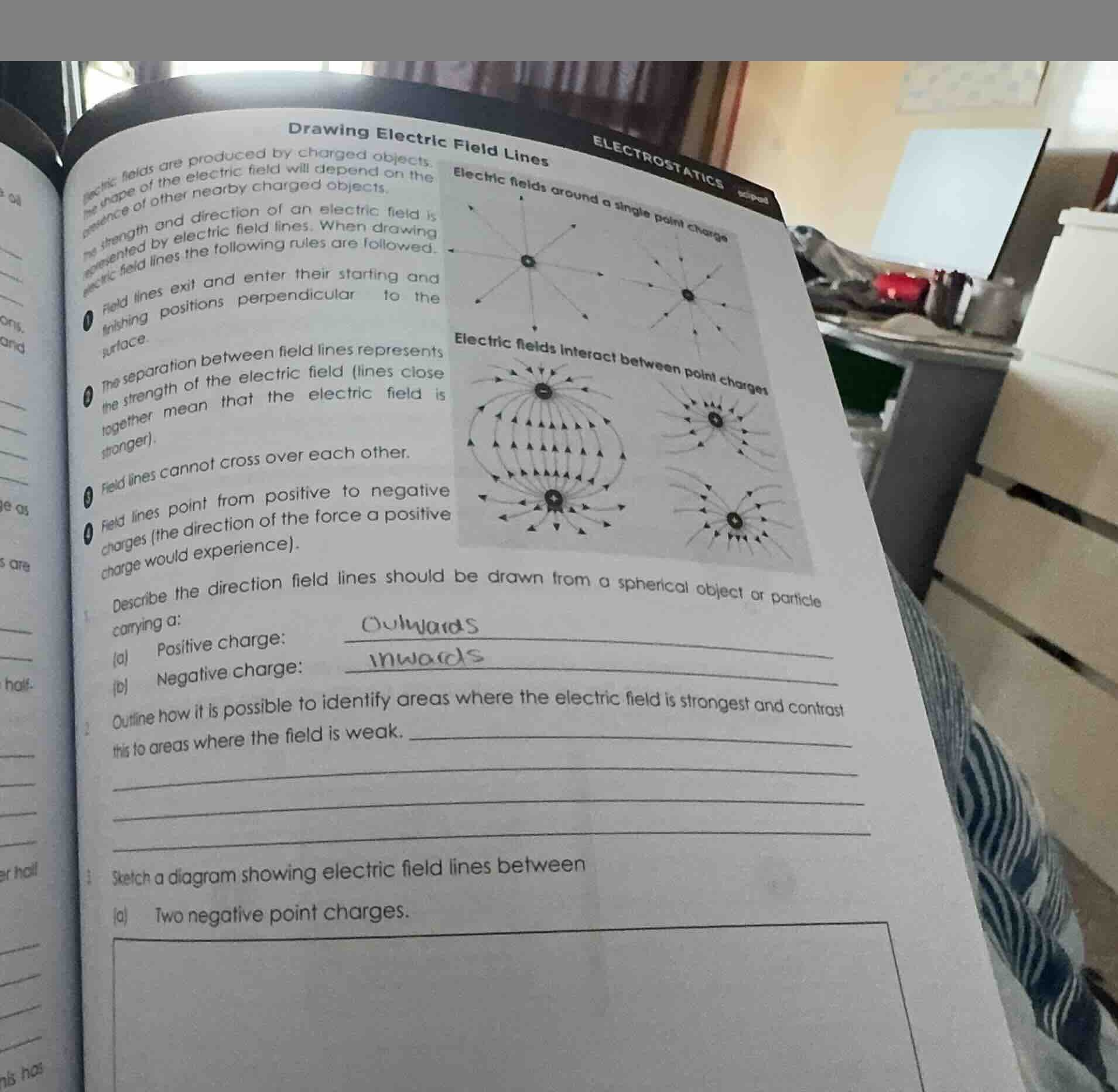
drawing electric field lines
electric fields are produced by charged objects. the shape of the electric field will depend on the presence of other nearby charged objects.
the strength and direction of an electric field is represented by electric field lines. when drawing electric field lines the following rules are followed.
- field lines exit and enter their starting and finishing positions perpendicular to the surface.
- the separation between field lines represents the strength of the electric field (lines close together mean that the electric field is stronger).
- field lines cannot cross over each other.
- field lines point from positive to negative charges (the direction of the force a positive charge would experience).
- describe the direction field lines should be drawn from a spherical object or particle carrying a:
(a) positive charge:
(b) negative charge:
- outline how it is possible to identify areas where the electric field is strongest and contrast this to areas where the field is weak.
- sketch a diagram showing electric field lines between
(a) two negative point charges.
Identify field line directions
Using the Electric Field Lines and Point Charges knowledge points, we determine the direction of electric field lines for isolated charges. By convention, electric field lines represent the path a positive test charge would take. Therefore, lines point away from positive charges and toward negative charges.
- For a positive charge, the force on a positive test charge is repulsive, so the field lines point radially outwards.
- For a negative charge, the force on a positive test charge is attractive, so the field lines point radially inwards.
Relate line density to field strength
Using the Electric Field Lines knowledge point, we analyze how field strength is represented visually. The spacing between electric field lines indicates the magnitude of the electric field:
- Areas where the field lines are close together (high density) represent a strong electric field.
- Areas where the field lines are far apart (low density) represent a weak electric field.
Analyze two negative point charges
Using the Point Charges knowledge point, we determine the field configuration for two identical negative charges:
- Since both charges are negative, the field lines must point radially inwards toward each charge.
- Because like charges repel, the field lines bend away from each other in the region between the two charges, resulting in a neutral point (zero electric field) directly halfway between them where no field lines pass.
Synthesize the final answers
We compile the descriptions for the direction of the field lines, the explanation of field strength representation, and prepare the visual layout for the sketch of two negative point charges.

Snap & solve any problem in the app
Get step-by-step solutions on Sovi AI
Photo-based solutions with guided steps
Explore more problems and detailed explanations
Question 1
Describe the direction field lines should be drawn from a spherical object or particle carrying a:
(a) Positive charge: Outwards (radially away from the charge)
(b) Negative charge: Inwards (radially toward the charge)
Question 2
Outline how it is possible to identify areas where the electric field is strongest and contrast this to areas where the field is weak:
The strength of an electric field is represented by the density of the field lines. In areas where the electric field is strongest, the field lines are closely spaced together. Conversely, in areas where the electric field is weak, the field lines are widely separated from one another.
Question 3
Sketch a diagram showing electric field lines between:
(a) Two negative point charges:
(The diagram below illustrates the electric field lines for two negative point charges, showing lines pointing radially inwards toward each charge and bending away from each other in the central region.)