QUESTION IMAGE
Question
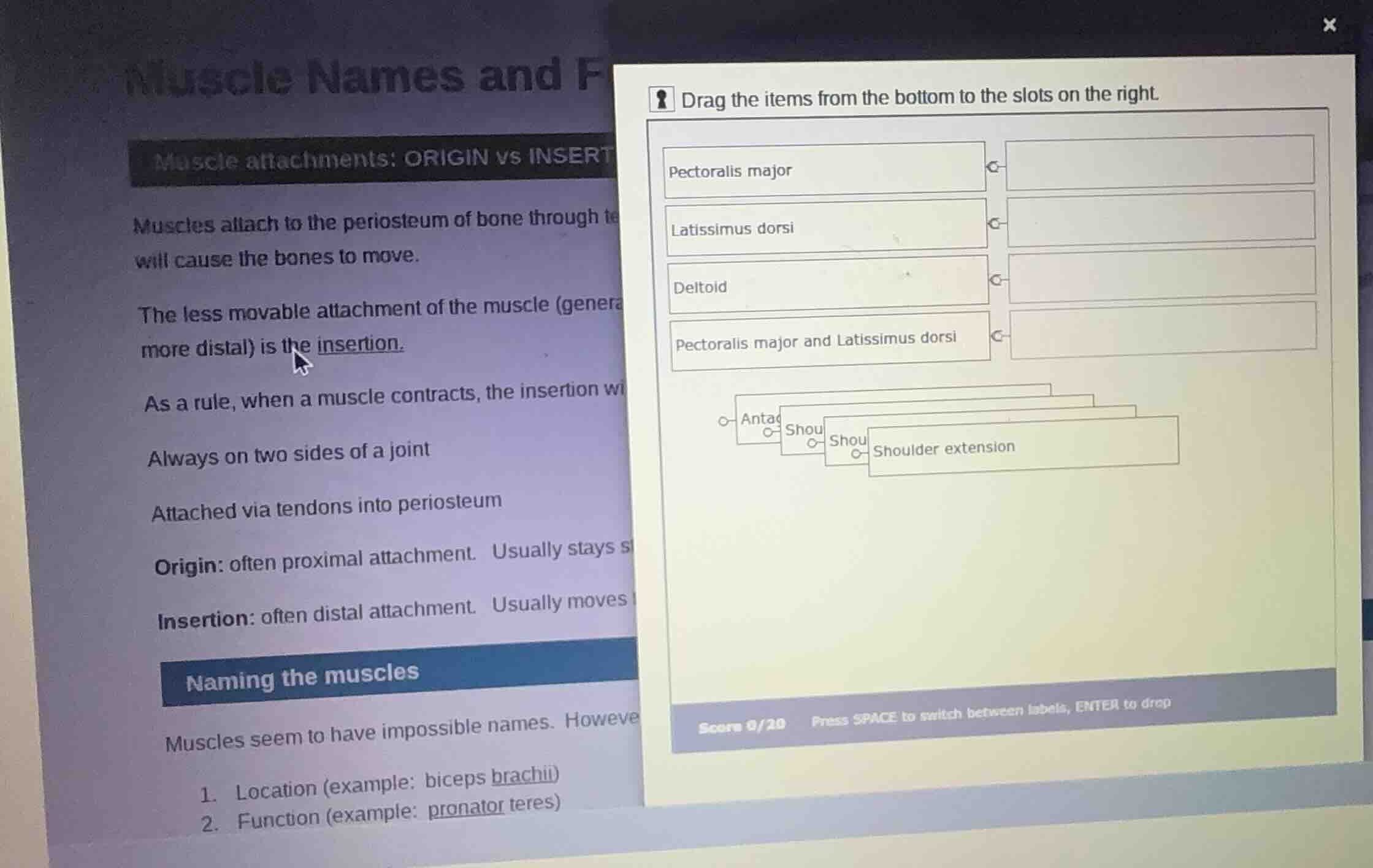
drag the items from the bottom to the slots on the right.
pectoralis major
latissimus dorsi
deltoid
pectoralis major and latissimus dorsi
antagonists
shoulder extension
Identify the target muscles and actions
The task requires matching four muscle categories to their corresponding functional roles at the shoulder joint from the draggable items at the bottom. The muscles listed are:
- Pectoralis major
- Latissimus dorsi
- Deltoid
- Pectoralis major and Latissimus dorsi
The visible draggable items at the bottom include:
- "Antagonists" (or "Antagonistic" / "Antagonists to each other")
- "Shoulder flexion"
- "Shoulder abduction"
- "Shoulder extension"
Analyze Pectoralis major action
The pectoralis major is a large muscle on the anterior chest. Its primary actions at the shoulder (glenohumeral) joint include flexion, adduction, and medial rotation of the arm. Therefore, it matches Shoulder flexion.
Analyze Latissimus dorsi action
The latissimus dorsi is a large muscle of the back. Its primary actions at the shoulder joint include extension, adduction, and medial rotation of the arm. Therefore, it matches Shoulder extension.
Analyze Deltoid action
The deltoid is the primary muscle responsible for arm abduction at the shoulder joint (specifically the middle fibers). Therefore, it matches Shoulder abduction.
Analyze the relationship between Pectoralis major and Latissimus dorsi
Since the pectoralis major acts as a primary flexor of the shoulder and the latissimus dorsi acts as a primary extensor of the shoulder, they perform opposing movements. Muscles that oppose each other's actions are called antagonists. Therefore, "Pectoralis major and Latissimus dorsi" matches Antagonists.

Snap & solve any problem in the app
Get step-by-step solutions on Sovi AI
Photo-based solutions with guided steps
Explore more problems and detailed explanations
- Pectoralis major $
ightarrow$ Shoulder flexion
- Latissimus dorsi $
ightarrow$ Shoulder extension
- Deltoid $
ightarrow$ Shoulder abduction
- Pectoralis major and Latissimus dorsi $
ightarrow$ Antagonists