QUESTION IMAGE
Question
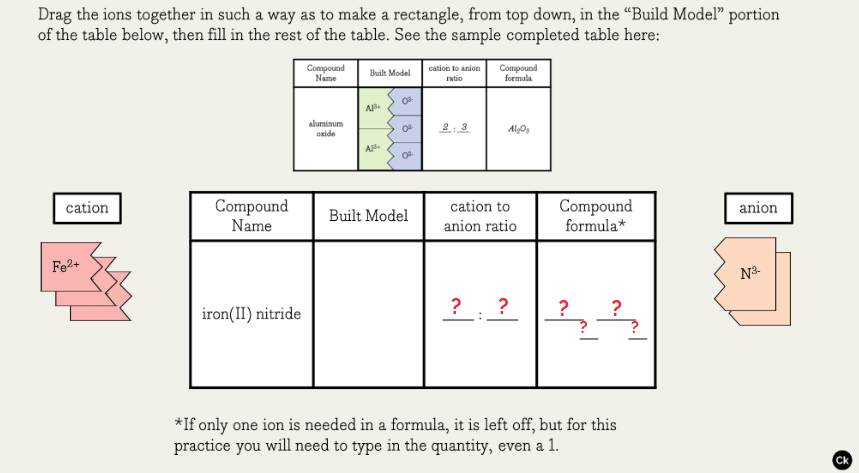
drag the ions together in such a way as to make a rectangle, from top down, in the \build model\ portion of the table below, then fill in the rest of the table. see the sample completed table here:
\
\
& 2 : 3 & \text{al}_2\text{o}_3 \\\\
\hline
\end{tabular}
\
*if only one ion is needed in a formula, it is left off, but for this practice you will need to type in the quantity, even a 1.
⚡ Using what you learned: formation of ionic and covalent bonds
Step 1: Identify the charges of the ions
The compound is iron(II) nitride.
- The cation is iron(II): \(\text{Fe}^{2+}\) (charge of \(+2\))
- The anion is nitride: \(\text{N}^{3-}\) (charge of \(-3\))
Step 2: Balance the charges to find the ratio
To form a neutral ionic compound, the total positive charge must equal the total negative charge. We find the least common multiple (LCM) of the charges \(2\) and \(3\), which is \(6\).
- Total positive charge needed: \(+6\)
- Total negative charge needed: \(-6\)
This gives a cation-to-anion ratio of \(3 : 2\).
Step 3: Write the chemical formula
Using the quantities determined in Step 2:
- Number of \(\text{Fe}\) atoms = \(3\)
- Number of \(\text{N}\) atoms = \(2\)
The compound formula is written as \(\text{Fe}_3\text{N}_2\).

Snap & solve any problem in the app
Get step-by-step solutions on Sovi AI
Photo-based solutions with guided steps
Explore more problems and detailed explanations
- cation to anion ratio: \(3 : 2\)
- Compound formula: \(\text{Fe}_3\text{N}_2\) (entered as \(\text{Fe}\) \(\underline{3}\) \(\text{N}\) \(\underline{2}\) in the blanks)