QUESTION IMAGE
Question
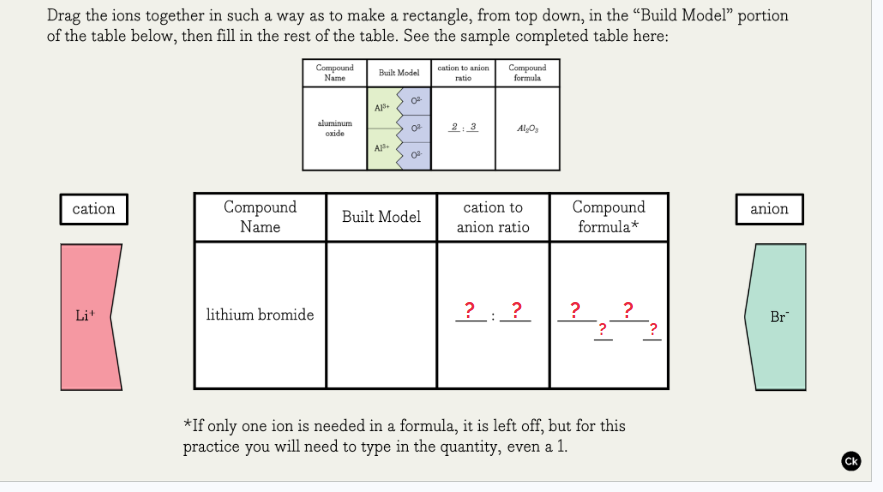
drag the ions together in such a way as to make a rectangle, from top down, in the \build model\ portion of the table below, then fill in the rest of the table. see the sample completed table here:
*if only one ion is needed in a formula, it is left off, but for this practice you will need to type in the quantity, even a 1.
⚡ Using what you learned: formation of ionic and covalent bonds
Step 1: Identify the charges of the ions
To build a neutral ionic compound, the total positive charge from the cations must balance the total negative charge from the anions.
- Cation: Lithium ion, \( \text{Li}^+ \) (charge of \( +1 \))
- Anion: Bromide ion, \( \text{Br}^- \) (charge of \( -1 \))
Step 2: Determine the ratio for a neutral compound
We combine the ions in a ratio that makes the overall charge zero:
This means we need exactly 1 lithium ion (\( \text{Li}^+ \)) for every 1 bromide ion (\( \text{Br}^- \)).
- Cation to anion ratio: \( 1 : 1 \)
Step 3: Write the compound formula
Using the ratio of \( 1 : 1 \), we write the chemical formula. The prompt specifies that for this practice, we must include the quantity even if it is 1:
- Compound formula: \( \text{Li}_1\text{Br}_1 \)

Snap & solve any problem in the app
Get step-by-step solutions on Sovi AI
Photo-based solutions with guided steps
Explore more problems and detailed explanations
- cation to anion ratio:
1 : 1 - Compound formula:
Li_1Br_1(entered into the blanks as Li 1 Br 1)