QUESTION IMAGE
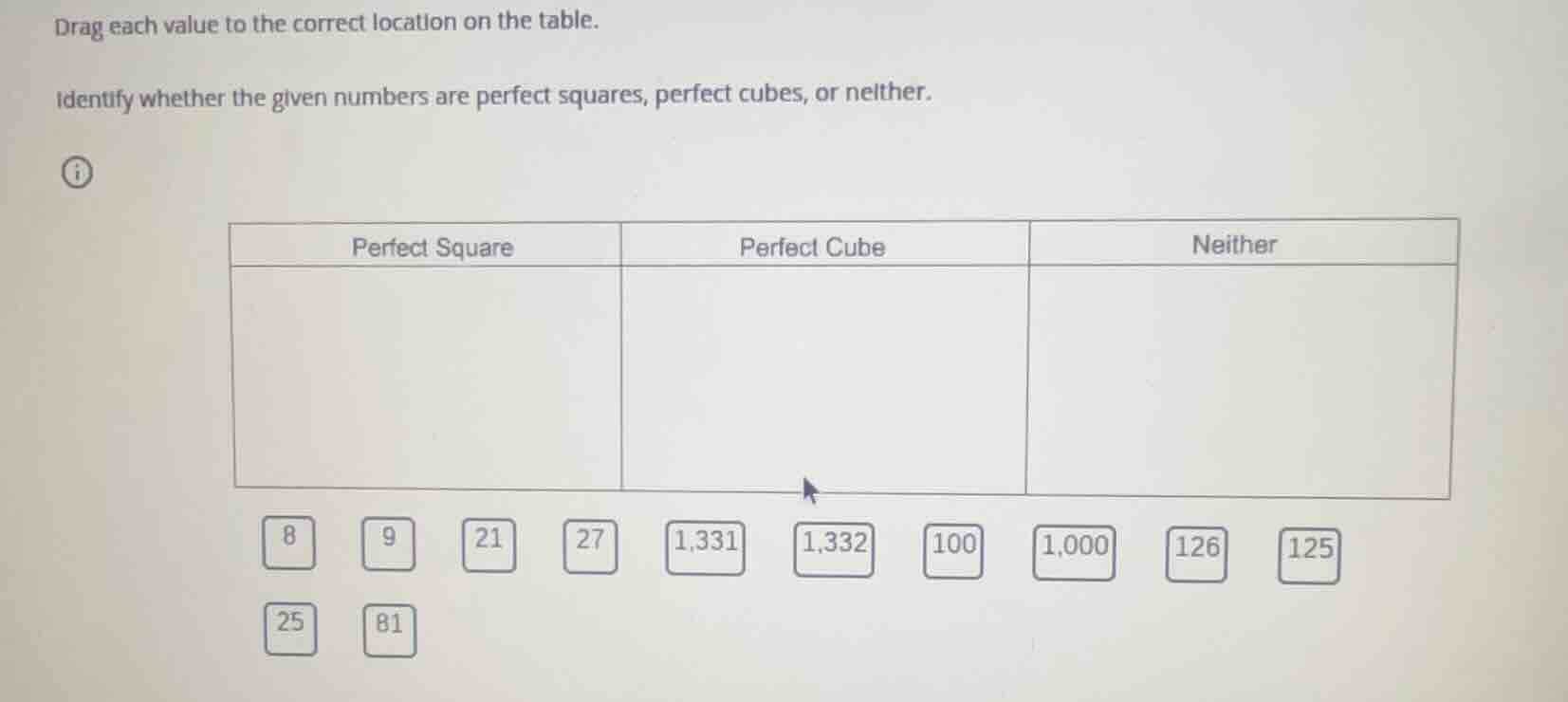
Question
drag each value to the correct location on the table.
identify whether the given numbers are perfect squares, perfect cubes, or neither.
perfect square | perfect cube | neither
values to drag: 8, 9, 21, 27, 1,331, 1,332, 100, 1,000, 126, 125, 25, 81
Define perfect squares and perfect cubes
Using the Exponent Rules knowledge point
An integer \(n\) is a perfect square if \(n = k^2\) for some integer \(k\).
An integer \(n\) is a perfect cube if \(n = m^3\) for some integer \(m\).
Analyze each given number
We evaluate each number from the list: \(8, 9, 21, 27, 1331, 1332, 100, 1000, 126, 125, 25, 81\).
- \(8 = 2^3\) (Perfect Cube)
- \(9 = 3^2\) (Perfect Square)
- \(21\) (Neither)
- \(27 = 3^3\) (Perfect Cube)
- \(1331 = 11^3\) (Perfect Cube)
- \(1332\) (Neither)
- \(100 = 10^2\) (Perfect Square)
- \(1000 = 10^3\) (Perfect Cube)
- \(126\) (Neither)
- \(125 = 5^3\) (Perfect Cube)
- \(25 = 5^2\) (Perfect Square)
- \(81 = 9^2\) (Perfect Square)
Group the numbers into categories
- Perfect Square: \(9, 25, 81, 100\)
- Perfect Cube: \(8, 27, 125, 1000, 1331\)
- Neither: \(21, 126, 1332\)

Snap & solve any problem in the app
Get step-by-step solutions on Sovi AI
Photo-based solutions with guided steps
Explore more problems and detailed explanations
| Perfect Square | Perfect Cube | Neither |
|---|